Old bike ride, new bike ride

I’m shocked to find that three months have passed since I swapped on bike ride to work for another.  On my last pedal up the ever-chaotic Holloway Road I thought that I should probably write about both rides, so here I go.

Old ride

From outer north London, 020 8 land (any fule no not to write 0208), it is south, south, south to Old Street. The route crossed the North Circular and the isolated oddness of Strawberry Vale, a huge and strange estate that’s cut off by the A406 on one side and Islington & St Pancras Cemetery on the other. It’s best to keep riding, up and over East Finchley, then up Far Highgate bank past Wellington SIdings and on to Highgate Wood.

The downhill stretch of the ride is exhilarating, with views of distant St Paul’s from the relative safety of the Archway Road bus lane. Coming in the opposite direction tough boys and girls ride up and over Highgate Hill, avoiding the crunch of traffic at Jackson’s Lane and testing stamina, achilles tendons and fitness. But Holloway Road is unavoidable, a mash of blind t-junctions, buses and trucks and endless waits at busy junctions. It is a wonder anyone gets on a bike to do this but we do, every day. Once round the roundabout at Highbury Corner New North Road is something of a raceway, where you start to pick up fixie riders heading west from Hackney and beyond. City Road, and journeys end, and glad tidings for not dying en route. 8 miles. 40 minutes.

New ride

From outer north London it is a gently curving south-westerly ride to White City. While there are many better places to ride to, the ride itself is lots of fun. The backstreets of Finchley Church End lead to Regents Park Road and Henley’s Corner. Once past Golders Green the ride starts to feel unusual for someone used to riding into and out of the centre, passing unfamiliar places with new views of London. Wembley’s arch looms omnipresently further west. Sunsets around Child’s Hill and off to the A41 are breathtaking. 

From Finchley Road Fortune Green Road runs fast downhill, with enough kick to make the return leg a leg-stretch. One of London’s oddest places awaits, West Hampstead’s jumble of stations, pedestrians and queuing traffic. It is the one part of the new ride that feels like the old one. Past here and further downhill, West End Lane snakes with antiquity towards Kilburn, once home to a priorty. West End Lane curves off almost unnoticed from the main flow of traffic to the High Road, and after a dog leg a long, straight line leads on past Queens Park and through Brondesbury to Kensal Rise.

Where am I now? I’m not sure. The friendly spirits of the West London Cemetery – my grandmother and Isambard Kingdom Brunel ensure safe passage to Scrub’s Lane and the last coast to journeys end, livened up by a tasty junction and a crossing beneath the Westway, where we hold on for tomorrow as the song goes. White City and journeys end and, usually, less thought to risks en route, more thoughts of other things. 11 miles. 45 minutes.


Athens in a day

Or, a day in Athens. Written on location in August. Sorry for not publishing before now. I’ve been a bit busy with the day job!

A stopover in Athens is a treat, and for me was a chance to see again I city I last visited in 1992, and thought the world of despite nay-sayers loudly trumpeting its downsides.

I loved Athens on that fleeting visit: the bright, slippery rock of the Acropolis, the searing heat of the summer streets and best of all my Dad having an enormous tear-up with a taxi driver which resulted in us piling in to the taxi, shouting a lot, then getting out again without having got anywhere. And I was excited to return.

Byzantine in period, not in outlook

Now, like then it is August and Athens is sweltering. The cooling breeze that made Chios (where I’d been for a wedding) delightfully temperate was absent, and I chose the mad-dog Englishman approach to exploring, charging round in the heat of the day, seeking shade where it was offered.

Nearly 20 years on, Athens felt familiar and different. The wide streets were there, as were the street-side caves of Kolonaki and the sense of gentility mixed with raw, youthful energy that I found thrilling last time. I am no longer a slightly awkward teenager wearing a loud shirt and straw hat, but my love of history and charging round cities remains. Athens did not disappoint.

Anthropomorphic olive oil drum in the Benaki

My flight from Chios landed at 8am, leaving me 11 hours before my next hop home to London. I was able to leave my bag at left luggage – €4 for a half-day, and get a metro trip into town and back for €14. The train took 38 minutes to get one stop short of Syntagma, where if the Acropolis is your only goal you an change lines and be whisked to the foot of the legendary rock.

I hopped out Evangelinos, from where the Byzantine Museum is a quick stroll away. It was a treat which skilfully filled in the blanks between Roman and Ottoman occupation, and viewed late antiquity through a Greek prism. The icons were particularly spectacular and it made for a better introduction to the Byzantine World, ironically, than anything to be found in Istanbul. The copies of iconic mosaics from Ravenna and Constantinople, painstakingly recreated by masterful modern scholars of the form were a delight to be able to inspect.

Downtown Athens is dotted with seriously ancient churches like this

After a quick visit to the British Council, where Patrick Leigh Fermor worked for a while and a cafe where you could feel his ghost scribbling away in the sunshine it was on to the Benaki, which for reasons I’m not entirely sure of was huge fun. It was bright and airy with a terrace cafe affording my first glimpse of the Parthenon and Panathenaic Stadium. Among many wonders in a wide-ranging collection they had a drawing of Athens in its classical pomp by Edward Lear. I wanted all their books, especially some stunning bilingual works on Greek architecture.

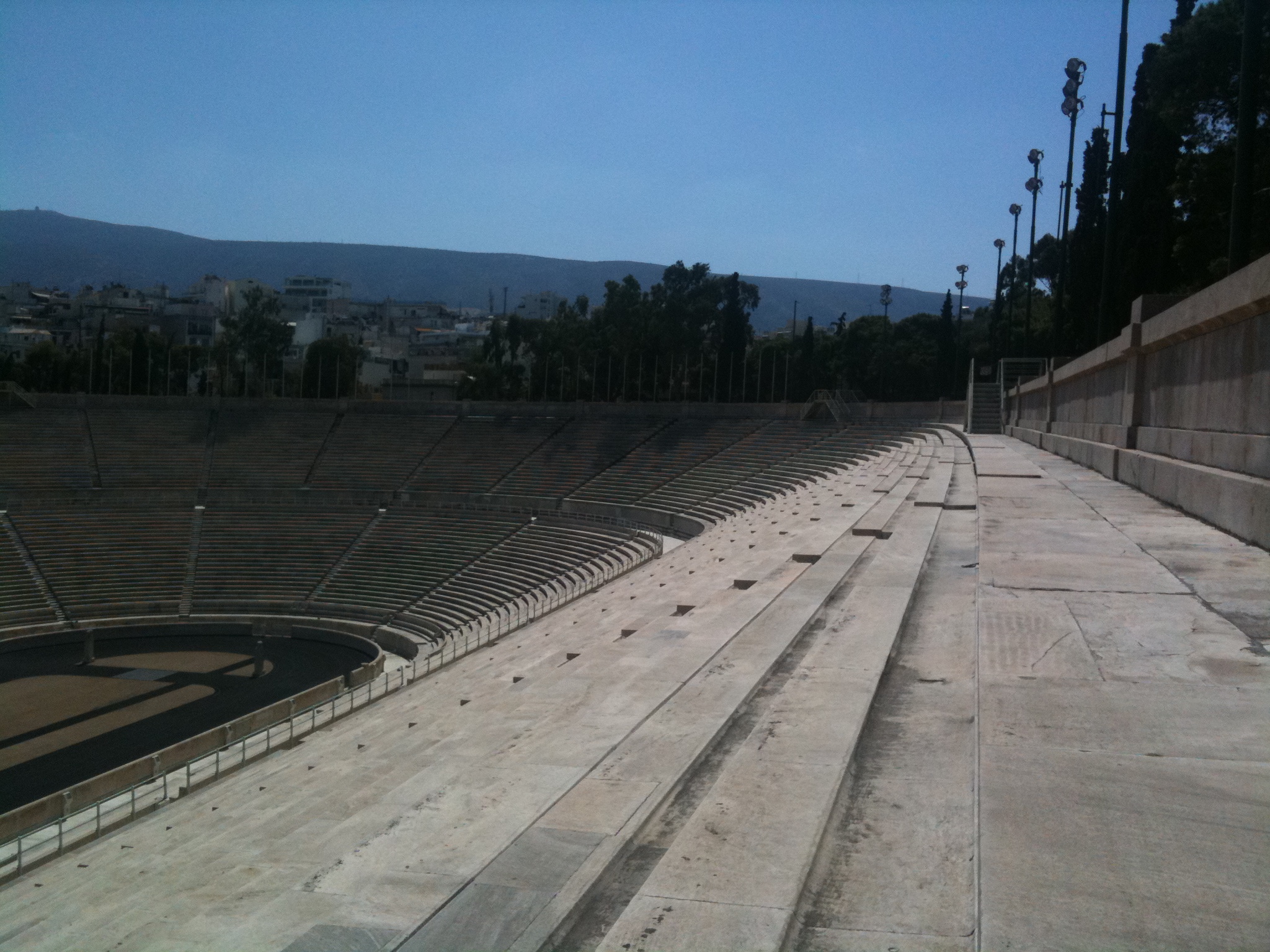
No surging please, we’re Athenian: the Panathenaic Stadium

From here I must add a note of caution. I’m footsore and a little sunstruck after doing what I did and would recommend an edited version of this. On the other hand I saw a huge amount and made the most of the day. The Panathenaic stadium, venue for the 1896 games was terrific value at €3 including an excellent audio guide. I walk on to Syntagma, Monstiraki and the flea Market (underwhelming) and on to the pedestrian promenade the links the market to the Acropolis via a host of ancient treats. I hopped up the Pnyx, saw the theatre of Herodus Atticus and ogled the Parthenon from a wide variety of angles before diving into the Acropolis Museum. In case you’re wondering, by this point I was sweating profusely and opted out of the hike up to the top in the afternoon sun.

The Parthenon shining in the afternoon sun

The new Acropolis Museum is now 7 years old, which feels scarcely believable. It is a key sight and deals quite marvellously with the Elgin Marbles issue. The museum’s presentation of the friezes eloquently and without hysteria makes the case for their return. It is convincing, informative and above all keeps the constant theme of telling the story of the Parthenon while leaving the visitor to draw their own conclusions. It is another place with a superb viewing terrace.

Outside, it was back to the glorious sweat of the Athenian wanderer. It’s easy to get lost, or lose the tourist crowds, in the backstreets of Plaka, and I loved the walk to the Agora as much as rambling around this huge site. On your way out on the Monastiraki side there are lots of lovely cafes to refuel in.

Lastly, a few other small notes in case you’re wondering: Athens was orderly, clean and friendly. It was not expensive and eating was very reasonable – €4 for a souvlaki and coke at a cafe in a lovely square is a good deal in western Europe in August. Athenians are friendly, proud of their city and seemed delighted I was there. In every room of every museum I went in, even the busy Acropolis Museum, guards grinned and said hello.

It will not be 20 years before I next return.

How did we get here? Morrissey from Kill Uncle to Your Arsenal

In search of stout? As a wise man once said...

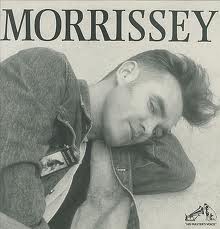
It is 1991, and Morrissey is at his most handsome, about to surge to the peak of his powers as a solo artist, a post-Smith. From the single My Love Life up until the incomparable Vauxhall and I the Mancunian singer produced an unbroken string of classic records that tower over much of the rest of his work.

The journey is a decidedly odd one. Kill Uncle, his second (proper) solo album after the rightly-revered Viva Hate, is an elusive record. Written with Mark Nevin (best known for recording with Fairground Attraction and Kirsty MacColl) and recorded with session musicians (Andrew Paresi, who documented his experiences in the BBC radio documentary I Was Morrissey’s Drummer) and those roped in from other bands (Madness’ Bedders), the album was short and at times bizarre. The singles (Sing Your Life and Our Frank) were light and breezy, but the rest of the album is loveable in parts and instantly forgettable in others. The first side of the record ends with the enjoyable Mute Witness and, Morrissey’s funniest ever song, King Leer, veering towards music hall, camp and winsome. The flip side, barring the lyrical high of Driving Your Girlfriend Home, can only be described as a palate cleanser for what comes next.

What came immediately next was Morrissey’s return to the live stage for the first time since the legendary free concert at Wolverhampton Civic Hall in December 1988 where he had taken to the stage with his former Smiths, minus Johnny Marr. The extensive Kill Uncle tour was to be different, and an all new band was recruited. Before this tour (if anyone can confirm if first contact was for the video for Sing Your Life, which has both Mark Nevin and Mozzer’s soon-to-be new band playing at Camden Workers Social Club then I’d be grateful, as I’m stumped to be any more precise) Morrissey had met Alain Whyte and through him other rockabilly enthusiasts Boz Boorer, Gary Day and Spencer Cobrin. After Sing Your Life they became his band. The effect of working with these new influences was immediate – compare Pregnant for the Last Time with anything on Kill Uncle. Harder, faster, shorter and with quiffs not harking back to the halcyon 60s but the Psychobilly scene where punk and rock and roll met. Funnily enough, Pregnant for the Last Time stands up well in a chronological listen to Morrissey’s singles, though the fork in the road between a pop past and a rock future is clearly here. Isn’t it?

Pregnant for the Last Time

And yet, the path is laden with wrong turns for the listener, and makes for a confusing journey. Morrissey released Kill Uncle in March, 1991. The second single, Sing Your Life, was released in April. Pregnant For the Last Time follows in July, with Whyte, Boorer and co playing on it but written by Nevin. It whacks along. You feel like you can draw a straight line from this to Your Arsenal’s bolshy bits. Yet what comes next is a blast of melodic loveliness in the shape of My Love Life which came out in September. This near last-gasp of Morrissey’s partnership with Mark Nevin was arguably the best thing they recorded together, though I Know It’s Gonna Happen Someday from Your Arsenal runs it close. Nevin also has writing credits on Glamourous Glue, though Alain Whyte has the rest of the tunes on the album in his name.

The incomparable Alain Whyte

Throughout this time the link with Kill Uncle’s distinctive sound weakens, mostly driven by Morrissey bonding on and off stage with his new bandmates and the resulting creative output. I was too young to see any of the Kill Uncle shows, first seeing Morrissey live at Alexandra Palace in December, 1992, after an abortive attempt to see him supporting Madness at Finsbury Park that summer. He had been bottled off by skinheads the day before and had decided against dancing round the stage draped in a Union Flag. My knowledge only comes through Live in Dallas, an easy-to-find document of the Kill Uncle tour, and shows how Boorer, Whyte, Day and Cobrin were shaping up as Morrissey’s band. Rockabilly, fast-paced romps through material that wasn’t their own, with blasts of the sound that was to surface on Your Arsenal. The tour is documented in Linder Sterling’s brilliant Morrissey Shot, which shows a gang of young men on a hysteria-fuelled adventure round the world set to a changing sound.

Your Arsenal: an altogether more masculine Mozzer

Nevin’s contribution to Your Arsenal, that controversial classic, is often overlooked as it suits a linear view of history to assume Whyte, Boorer and producer Mick Ronson gave that lame-coated masterpiece its identity. The truth is more complex, and makes for an enjoyable Saturday night with some of Morrissey’s loveliest record covers and most interesting songs.

Fountain Island and Sarah Records

I’m not entirely sure why I decided to buy it that day. I could have heard somewhere about a record label that was right up my street. I may have noted something on the radio that caught my ear. It’s just as likely though that on that warm summer’s Saturday in Reckless Records on Camden High Street I picked up Fountain Island, liked the cover and, with a fiver (£5.25 to be precise) in my pocket, took a chance on it and carried it home.

I was hooked before the tube ride had finished and I’d got it on the stereo. Staring at the sleeve of something you’ve just brought while going home did that sometimes. Fountain Island was one of the classic compilation LP’s Sarah Records put out throughout the labels life, collecting songs otherwise only found on singles. The artwork, benefiting from 12-inch rather than 7-inch size covers, reminded me of back gardens and sun-baked suburban streets. Once on the turntable I was quickly hooked by the mix of gentle and more urgent guitar music, which carried a strong antipodean flavour to go with the more expected Bristol fuzzy noise. I now count some of the bands on that LP as my favourites: the Orchids, the Sugargliders and some that only my brother and I seem to know and cherish: Tramway, take a bow.

Fountain Island got me hooked on Sarah. This record label, I quickly learned, was run by Clare Wadd and Matt Haynes, from a PO Box in Bristol. I wrote off to them for some singles and, when they came back I had a hand-written reply with some thoughtful responses to what I’d asked them. Over time, I came to look forward to these notes as much as the music. When I got good enough GCSEs to go to Sixth Form College Matt sent a pat on the back. I still have the note. Record inners came decorated with pictures of branch line services from Bristol. Mini-catalogues backed with hand-cut collages of tight-typed prose about love and loss. Here’s one, in lieu of me being sufficiently organised to scan my own ones. Besides, they’re personal.

Sarah had been going for a few years by the time I had cottoned on to it. Just like every musical movement ever, you should have been here a few years back. I didn’t care. I’d never found anything I liked doing more than going to the football, but rooting round record shops in search of missing Sarah seven-inches came pretty close.

Most other articles about Sarah descend into dullard cliches far too easily, labelling its output fey and winsome. Critics lack the respect and imagination to listen any further. The Field Mice and Heavenly are, to those lazy ears, the sum total of Sarah’s contribution to music, with a caustic nod to Pristine Christine by the Sea Urchins, the very first Sarah single. iTunes will prove the nonsense of this position. By all means have a listen to the Field Mice and Amelia Fletcher’s timelessly sharp lyrics, but also take the time to find Secret Shine, Blueboy, Brighter, Even As We Speak and Tramway. I shall keep mentioning the latter band until anyone reading this buys ‘Maritime City’. I’m not sure there’s ever been a record quite like it. You can hear the b-side here. St Christopher’s blazing rendition of All of a Tremble is another excellent introduction to a wonderful and underrated band.

Matt Haynes went on to produce Smoke: a London Peculiar, a publication as unique and rooted in place as Sarah had been, and I scribbled a few things for that. Thought Clare and Matt have admirably refused to cash in on their cult status you can find lots of Sarah stuff on iTunes. Here’s my top ten in no particular order:

1. All of a Tremble – St Christopher
2. Helmet On – East River Pipe
3. Maritime City – Tramway
4. After Years – Secret Shine (though Loveblind, sometimes known as Spindrifting is wonderful too)
5. You Should All Be Murdered – Another Sunny Day
6. Half-Hearted – Brighter
7. Emma’s House – the Field Mice
8. If I could Shine – the Sweetest Ache
9. Distraction – Boyracer
10. Shadow of a Girl – Gentle Despite

Anyone else have a Sarah favourite to share?


Ithaka by C P Cavafy

As you set out for Ithaka
hope the voyage is a long one,
full of adventure, full of discovery.
Laistrygonians and Cyclops,
angry Poseidon—don’t be afraid of them:
you’ll never find things like that on your way
as long as you keep your thoughts raised high,
as long as a rare excitement
stirs your spirit and your body.
Laistrygonians and Cyclops,
wild Poseidon—you won’t encounter them
unless you bring them along inside your soul,
unless your soul sets them up in front of you.

Hope the voyage is a long one.
May there be many a summer morning when,
with what pleasure, what joy,
you come into harbors seen for the first time;
may you stop at Phoenician trading stations
to buy fine things,
mother of pearl and coral, amber and ebony,
sensual perfume of every kind—
as many sensual perfumes as you can;
and may you visit many Egyptian cities
to gather stores of knowledge from their scholars.

Keep Ithaka always in your mind.
Arriving there is what you are destined for.
But do not hurry the journey at all.
Better if it lasts for years,
so you are old by the time you reach the island,
wealthy with all you have gained on the way,
not expecting Ithaka to make you rich.

Ithaka gave you the marvelous journey.
Without her you would not have set out.
She has nothing left to give you now.

And if you find her poor, Ithaka won’t have fooled you.
Wise as you will have become, so full of experience,
you will have understood by then what these Ithakas mean.

Translated by Edmund Keeley/Philip Sherrard

(C.P. Cavafy, Collected Poems. Translated by Edmund Keeley and Philip Sherrard. Edited by George Savidis. Revised Edition. Princeton University Press, 1992)

I am indebted to the Guardian reader who referenced this poem in a tip they sent in last week for bringing these wonderful words to my attention. I know nothing more about Cavafy, but have seldom read a better evocation of the journey, as opposed to the end point, being the point of travel.

Menelaus and Helen by Rupert Brooke

HOT through Troy’s ruin Menelaus broke
To Priam’s palace, sword in hand, to sate
On that adulterous whore a ten years’ hate
And a king’s honour. Through red death, and smoke,
And cries, and then by quieter ways he strode,
Till the still innermost chamber fronted him.
He swung his sword, and crashed into the dim
Luxurious bower, flaming like a god.

High sat white Helen, lonely and serene.
He had not remembered that she was so fair,
And that her neck curved down in such a way;
And he felt tired. He flung the sword away,
And kissed her feet, and knelt before her there,
The perfect Knight before the perfect Queen.

So far the poet. How should he behold
That journey home, the long connubial years?
He does not tell you how white Helen bears
Child on legitimate child, becomes a scold,
Haggard with virtue. Menelaus bold
Waxed garrulous, and sacked a hundred Troys
’Twixt noon and supper. And her golden voice
Got shrill as he grew deafer. And both were old.

Often he wonders why on earth he went
Troyward, or why poor Paris ever came.
Oft she weeps, gummy-eyed and impotent;
Her dry shanks twitch at Paris’ mumbled name.
So Menelaus nagged; and Helen cried;
And Paris slept on by Scamander side.

Arsenal 1990-91: the almost invincibles (part II)

This article first appeared in issue 215 of the Gooner. It looks better in print and you can find it here. The first part of this article was posted earlier this year on this blog here. If you don’t read that first, this one won’t make much sense!

As Autumn turned to winter a season of immense promise threatened to derail. We hadn’t lost a match, but lost ground in mid-November, when the FA, who were embarrassed by the Manchester United punch-up being broadcast around the world if not in England, docked Arsenal two points. We had, they argued, previous charges after a scrap against Norwich City the previous season. United, unbelievably at the time, lost only one point. The sense of injustice was huge, and the galvanising effect immediate. Everyone connected with Arsenal was convinced it was a conspiracy and at the next home game Southampton were routed 4-0. The next week Arsenal were behind again at Loftus Road heading into the last quarter of the game, before three late goals sent us all packed into that vile, poky away end into raptures. Our captain marked that win by reminding QPR fans how many bob their club and stadium was. Kevin Campbell was busy scaring the life out of defences.

The drama kept coming. In the League Cup Manchester United turned up at Highbury in their blue and white chicken suit shirts. If our goal led a charmed life in the league at Old Trafford, in this match every time United shot, they scored. Lee Sharpe in particular was rampant. At the time he was one of England’s brightest young prospects and he arguably made the greatest back five in our history look more ordinary than any other player in any other match that night. Even Danny Wallace got one, after we’d pulled two back and at one stage looked like we were going to get back into the game.

As agonising as the United reverse felt, Liverpool were the real enemy and our home match that Sunday was the biggest game of the season so far. 3-0 to us.  Listen up everyone, this result seemed to be saying: we were going to be top dogs this season. The numbers looked good. Still no defeats. Points deduction starting to look irrelevant. Two fingers in the air. What are you going to throw at us next?

The answer came quickly, and it came as a big shock. Tony Adams was sent to prison on 19 December 1990 for drink driving offences, four days after captaining Arsenal during a disappointing 2-2 home draw against Wimbledon. It was six days before Christmas and the courts were keen to send out a strong message.  No arguments with that. Unfortunately it cost us our captain. Years later, however, no well-known name has been sent to prison for a similar drunk-driving offence. Years later, no other team has had even one point docked for on-pitch fighting. See why we thought everyone was against us?

Adams’ plight presented fans with an ethical dilemma, but whatever the rights and wrongs of publicly idolising a man serving time in Chelmsford Prison, we stuck by Tony. ‘We’ve lost our Tony Adams’ to the tune of ‘You’ve lost that loving that loving feeling’ was a winter anthem.  The team responded with three straight wins. Andy Linighan was thrown into the team next to Steve Bould.

Considering the praise rightly lavished on the Invincibles team I still find it remarkable that this Arsenal side does not get more credit for nearly managing the same achievement 13 years before in far more trying circumstances. The unbeaten run lasted through January and fell at what was then the most rancid cesspit in the league, Stamford Bridge. Their ground today is a world away from what it was pre-Taylor Report. The away end was, like the Shed at the other end, thirty yards from the pitch. It had no roof and state of the art amenities: for 1905. Which was the last time someone had changed a lightbulb in the place. As if losing to them wasn’t bad enough, and seeing the small knot of idiots who used to congregate in the lower paddock of the West Stand  as close as they could get to the away fans – still fifty yards away – dance about like demented apes, we then had to wait for an age in the fading gloom of a wintry west London night to be let out. The queue for Fulham Broadway station was still an hour, even after all that.

Stamford Bridge looking its best, anytime from 1905 to 1992

But things were looking up and Arsenal were not to lose again in the league. Adams emerged from prison and, after a reserve run out attended by 8,000 supporters the same day as we finally saw off Leeds in the FA Cup fourth round replay, was back as captain for the return fixture against Liverpool. We headed up to Anfield for a very tasty away game on a crisp March afternoon. Stanley Park was warmed by early Spring sunshine and Arsenal’s away support was mildly mivved at being moved into the opposite corner of the Anfield Road end from the one we’d occupied in 1989. No matter, we were not messing around. Seaman made two magnificent saves from John Barnes, the media darling and perpetual man of the match. Then in the second half Paul Merson intercepted a wayward wobble from Peter Beardsley, advanced into the Liverpool half, swapped passes with Alan Smith and rolled it past Grobellaar. Behind the goal we sucked the ball into the net. It took and age to go in. When it did, it was party time. It felt at the time like we’d won the title and nothing could take it away.

A solid series of wins and draws in March and April, including a 5-0 win over Aston Villa with David Platt taking over in goal at the end, and solid progress in the FA Cup once we’d got rid of Leeds after three replays had us dreaming of the double. You might want to look away now. We lost the first all north London FA Cup Semi Final at Wembley on April 14. I’m sure you know all you want to about that dark day. Before that semi-finals weren’t held at Wembley. Now we’re stuck with it.  Another legacy of that unhappy day. Let’s move on.

Kenny Dalglish’s heart wasn’t in managing Liverpool after Hillsborough, and though he made it throught the 1989-90 season on auto-pilot he had no stomach to take on George Graham’s ruthless pursuit of his sides title and he quit. Graeme Souness, the first but not the last Manager to win everything in Scotland and fail miserably in England, arrived to succeed him but there was no stopping the Arsenal juggernaut.

Four games after losing to Spurs, and a few days after that rainy trip to Sunderland we were champions. In fact, it happened without a ball being kicked. Liverpool’s loss to Nottingham Forest meant we couldn’t be caught and the return game against Manchester United became a procession, albeit one livened up by the return of the big red ‘Champions’ banner and the sight of Robson, Bruce and the rest of Ferguson’s drinking club applauding us onto the pitch.

If there was any hangover, and there surely was, then the players didn’t show it the following sunny Saturday against Coventry City, when an Anders Limpar hat-trick and another whack from Perry Groves brought the house down.

A 6-1 win in front of 41,039 was the perfect way to end the season. There were dark clouds that day – the launch of the bond scheme and the plan to make Highbury all-seater – but they couldn’t detract from a season of rich achievement, one of the greatest ever and certainly one of the most eventful.  In the league our final stats read played 38, won 24, drew 13, lost one, goals for 74, goals against a miserly 18, and 83 points with a big fat asterisk next to it marking the two deducted points.  Twenty years on there are lessons from the class of 1991 in guts, character, determination and the fine and hopefully not quite lost art of Arsenal defending.

Thanks to all the excellent people on YouTube who thoughtfully uploaded videos of this season.

Random brawls in medieval London

A History of London Life by R J Mitchell and M D R Leys is a lost classic of London historical writing, dating from 1963. It takes the reader on an admirable journey through the history of the city at street level, looking at Londoners and their lives through the ages. You can find it on abebooks. I am indebted to friends who picked up a copy for me in upstate New York, a long way from home but couriered with great thought and care.

Passages feel like a forerunner to the way that Ackroyd and Sinclair seem to effortlessly pull out breathtakingly obscure documents of London history. One of the best examples of this is a passage taken from the Londoners’ Pasttimes chapter, detailing a thirteenth century scrap that evidently got well out of hand:

Teams of Londoners played games among themselves and also against the neighbouring suburbs; in the summer of 1222 a wrestling match with the youths of Westminster had a disastrous sequel. The city men won, and a return match was fixed for a week later, but this time the Steward of the Abbey armed the home side so that the Westminster men set about the Londoners and caused many casualties. The irate Londoners went home to gather strength and, ignoring the advice of the Mayor, rushed to Westminster and pulled down the Steward’s house. When the Abbot came to complain they seized his horses, beat his manservants and stoned him out of the city.

The Abbot in question, if the dates are right, is either William de Humez or Richard de Berkyng (of Barking), most likely the former as Richard did not take his position until October. The High Steward of Westminster Abbey today is a ceremonial position held since June by Tory peer Lord Luce.

And what of the over-exuberant boys of the City, and of Westminster? Well, chances are they weren’t roughed up by their wrestling, which seems to have been an exercise in endurance grappling rather than the Giant Haystacks kind of wrestling we may think of today. That might also explain why the Londoners had enough about them to pull someone’s house down after a bout.

It might be worth considering next time you stroll down the Strand that both parties – and the aggrieved Abbot – would have stomped their way down the same route which was then a little more than a rural track.

In 1222 John III Doukas Vatatzes was crowned Emperor of Byzantium, the European discovery of America was still over 200 years away and Henry III was King of England. And in a small, thriving city a bunch of blokes had a good old scrap which got quite out of hand.

Olympic London: slalom canoe course, Waltham Cross

‘Lean left! Left! Hard left!’ shouted our guide. Our raft, it seemed, had other ideas, and in a flash the boat had flipped and I was plunging through rapids. Just dodging some sharp-looking rocks and body-surfing a raging torrent I found my footing and dragged myself to the side. I’d swallowed about half the river but was laughing hard. It was the absurdity that got me. I wasn’t on the Zambezi at Victoria Falls, or New Zealand’s Karawau River, but in Waltham Cross, right in the middle of London’s commuter belt. And it is here that the Canoe Slalom events for the 2012 Olympic Games will be held. Best of all, it’s one of the few Olympic venues mere mortals like you and I can have a go in, too.

King Canoe: the Olympic course

Located north of London proper, the Lee (or Lea, no-one’s really sure) Valley doesn’t tend to attract too many tourists. A trickle may come to admire the nearby town of Waltham Cross’ Eleanor Cross, one of three surviving from the original twelve monuments erected by Edward I along the funeral procession of his Queen in 1291. Otherwise there’s just leafy, green scenery around the waterways of Hertfordshire to stroll around, popular with families, runners and dog-walkers.

The newly opened Lee Valley White Water Centre looks set to change all that. It’s easy to reach – journey time is 40 minutes by train from London’s Liverpool Street station. The first and only Olympic venue to open before the games, and home to the Great Britain Canoe Slalom team, it is as visually striking as it is thrilling to ride. The Olympic course runs for 300m and has a 5.5m descent over the length of the route. I was excited to have the chance to have a go.

The author meets Wenlock (left) and Mandeville, London 2012 mascots, pre-dunking

Before the soaking, the briefing. There were to be eight of us in a raft, and each was given a wetsuit, that most flattering of garments, and a full safety briefing. Then, after an initial dunking masquerading as a man overboard-type drill we paddled into position onto the ramp up to the head of the course. This felt a little like the start of a rollercoaster, and we were soon off, flying through rapids and, as you might expect, getting utterly drenched.

After one run I was thinking future ones could feel samey, but one of my team decided to liven things up by leaning the wrong way at a crucial moment, sending us all tipping out of the boat. After that four of our team decided they’d had enough, leaving the rest of us on the final two runs to surf, scoot and crash around the course. At one point the British rafting team, testing the course out, also went flying, which made us all feel reasonably hardcore.

If London is short on one thing, it’s a waterpark with slides and chutes. You won’t find that here, but it’s definitely the most fun you can have in a wetsuit close to the capital. Best of all, you’ll be smashing through waves made by 2012’s Olympic heroes.

Lee Valley White Water Centre is now open to the public. Advance bookings are necessary. A raft adventure lasts around two hours, including getting kitted out with a wetsuit, buoyancy jacket and helmet, a safety briefing and four runs on the Olympic course. www.gowhitewater.co.uk

Here are some shots of the Eleanor Cross:

Waltham Cross' Eleanor Cross

Brompton meets Eleanor

London Swimming Review: Serpentine Lido

For a city with a generally unimpressive number of indoor swimming pools, London makes up for it with plenty of more surprising options for a quick dip.

Swimmers ready for the plunge at Serpentine Lido

I’ve written warmly (don’t let that word confuse you about the temperature) before about Highgate Ponds, with separate men’s, women’s and mixed bathing ponds. The latter is ideal for those of mixed sex. Nearby Parliament Hill Lido makes for a lovely alternative, and there are other marvellous outdoor lidos at Brockwell Park, Tooting, London Fields and Hampton. The last two are let down a little by being heated.

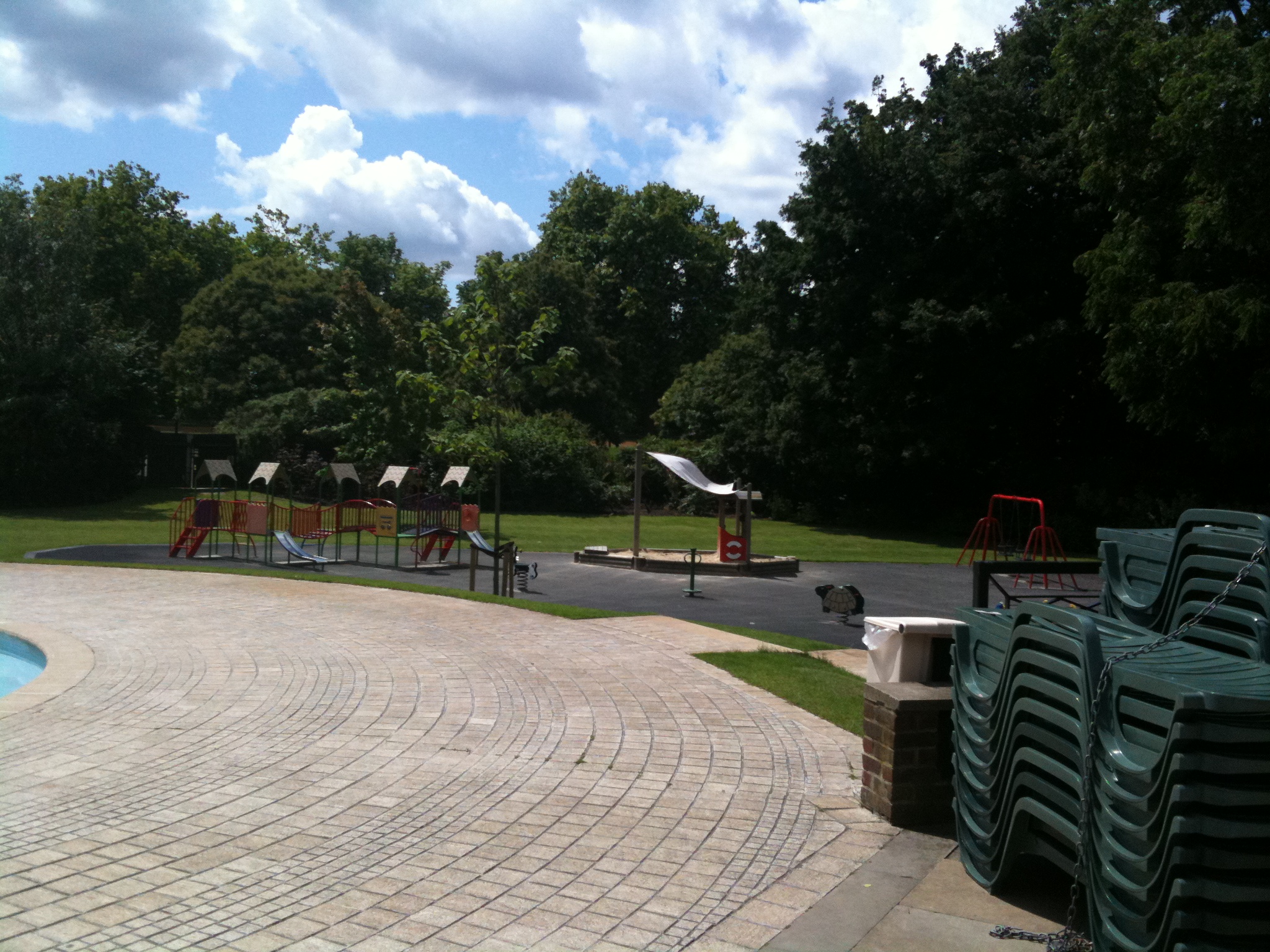
Paddling pool...

...and children's play area

Until this week, however, I hadn’t tried the most central of the lot. The Serpentine Lido, right in the centre of Hyde Park, promised a dip in untreated water in the heart of London. The Serpentine is a large man-made lake created in 1730 by the waters of the River Westbourne but now fed by the Thames. It’s a haven for bird life and is the sort of lake which you’d normally hire a boat to row on a summer’s day. Unusually there’s swimming here, and has been since 1930.

View across the Lido from the bridge. Yes, you really are in central London...

Unlike Highgate Ponds, which offer a wonderful and deliberately spartan experience, there’s plenty here to make you feel like your £4 entrance fee is well spent. There are changing rooms, lockers (20p, refundable) and, once you get upstairs, a large lawn, paddling pool and playing area for kids. Nippers catered for, swimmers cross a bridge over the path – attracting odd looks from tourists at the cafe next door in the old Lido building – and go down steps to the water’s edge. The lake has sloping sides, so diving’s a no-no, so there’s a jetty to stroll, then steps to descend. As it’s late June the water is a balmy 18c, and as there’s no-one else in the water there are a few onlookers gawking from the cafe ensuring no prevaricating on the water’s edge.

Once in, the water is lovely, fresh and cool, and with plenty of space makes for very relaxing swimming. If you’re doing back crawl or breast stroke you can take in some of the landmarks of London visible from the water – the London Eye and the Victoria Tower of the Houses of Parliament are two to look out for. Upon exiting (cold shower at the waterside), you’re back in the land of normal non-cold-swimming types very fast, especially if you hop on one of Boris Bikes conveniently stationed nearby. The warm glow from such a lovely dip will stay with you on your travels around the British capital.

Incidentally, this was the second Olympic venue I’d been able to try out, having test-rafted the Canoe Slalom course at Lea Valley Watersports Centre in May. I’ll upload my report from this over the next few days. The Serpentine will host the 10k open water swimming race, which, having managed a few lengths of the 110m buoyed area, sounds like incredibly hard work.

Keen swimmers may wish to join the Serpentine Swimming Club, a hardy gang of enthusiasts who use the facilities right through winter.