Five things to learn from volcano chaos

Now the dust has happily settled here are a few ways in which the Eyjafjallajökul eruption can result in an improvement to the way we travel.

The least popular Ash since the one who plays for Chelsea

EU Compensation law doesn’t work for anyone
EC Regulation No 261/2004 was conceived with the best possible will, but it doesn’t work. Airlines hate it as it can force them to pay out for circumstances beyond their control. It’s also not designed for week-long delays, which are unprecedented. But airlines are transporting passengers from a to b and if they can’t get there then those passengers are vulnerable and should be looked after. Passengers have found the compensation set-up too hard to understand and it can be tough to get an airline to pay out. Ryanair’s ‘what you going to do about it?’ challenge summed up who airlines feel they can wriggle out of making payments. They had to backtrack somewhat – though not totally – but the broader point is that even when a delay is just that, rather than a crisis, getting a payout is extremely difficult. This regulation needs to be redrafted and toughened so airlines cannot avoid responsibilities to passengers in trouble.

Consumer protection needs to be looked at again
Two people from the same country in the same hotel, both stuck without the means to get home, would have found themselves in a very different position depending on how they booked their trip. If you booked your trip with an agent you probably got much better treatment and home quicker. If you booked independently, you were on your own. repatriation in a crisis should not be a unique selling point, and independent travellers should not be punished for making their own arrangements. As AITO have suggested, it is time to look again at consumer legislation to protect all customers as a point of principle.

Some companies will have gained customers for life
The above notwithstanding, there were some very impressive performances under pressure by travel companies.  Those who offered a human to speak to, a regularly-priced phone line that was open at weekends and late and who took fast action should take a bow. Included in this are insurance companies who made ex gratia payments. Hopefully travellers will remember who performed well and who let them down.

Lava

Travel insurance needs to be clearer
Buy travel insurance. Buy it because even the worst policy will help you out if you get injured overseas. Don’t expect too much more. You are buying a health insurance policy with a variety of irregular add-ons. Some policies are excellent, some have proved worthless. I don’t work in the insurance industry but a more standardised policy plus greater guidance on what is necessary and what is frivolous seems like a good way forward.

Some people are really good at travelling
One of the most astonishing things about last week was the avalanche of stories of people who had got themselves home by a series of inventive means. Not all of them involved shelling out thousands of pounds. Hats off to everyone who, by any means possible, made it home.

Things you don’t see every day on the Underground

Kings Cross St Pancras, yesterday evening

The appeal of small capitals

This article first appeared, translated into Norwegian, in the April 2010 issue of Zine, hence any Norwegian references.

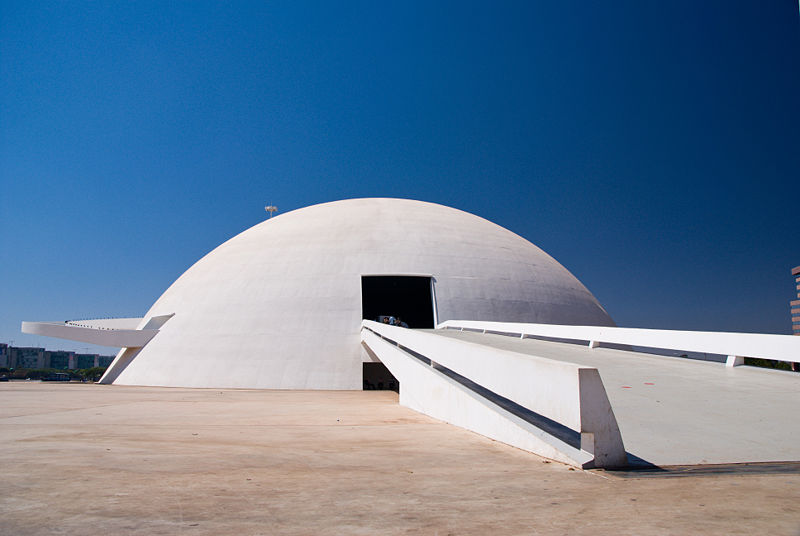
National Museum, Brasilia

National Museum, Brasilia

This month marks the 50th anniversary of the building of Brasilia, the purpose-built city deep in the Brazilian interior. Upon completion, Rio de Janeiro was stripped of its status as the capital of Brazil and handed to the new city. Today Brasilia has a growing reputation as a treasure-chest of post-war architecture, but while it attracts plenty of visitors the history, beaches and hard-partying reputation of Rio ensures it keeps the lion’s share of tourists. It remains the principal city, the capital in all but name.

It’s a similar story in Australia where the debate about which of the two titans of what was then a British colony, Melbourne or Sydney, should be the capital of the new country. Rather than choose, a compromise saw a new city emerge from the bush between the two cities. I found Canberra one of the most fascinating places in Australia. A completely planned city based around a spectacular man-made lake, it is home to national institutions and monuments and is seen as somewhere to experiment with new architectural ideas. Elsewhere in Australia Sydney and Melbourne folk derided the place, reflecting their natural cynicism when it came to politics and bureaucracy, both of which dominate Canberra life. Yet it is the one place in Australia that I have seen a kangaroo hopping down the street and a koala in a tree. It’s quirky, fun and very different to the big cities.

Dodoma, Tanzania

Dodoma, Tanzania

And there runs the debate in any country where the capital city is a curiosity rather than the place to be. It can be baffling for outsiders. Ottawa, Canada isn’t a patch on Toronto, Montreal or Vancouver. Most visitors to Tanzania go nowhere near Dodoma, the post-independence capital that took the title from the main colonial city of Dar es Salaam. Today the trend continues with the reclusive regime in Myanmar (Burma) first changing the name of the capital from Rangoon to Yangon, and then moving it hundreds of kilometres to the green-field site, which is now the fast-growing city of Naypyidaw. In Kazakhstan the pleasant city of Almaty has given way to the sci-fi capital of Astana. The reason for these two changes is political, but usually the idea is to make a break with the past and make something new. A new capital is an exercise in building a nation.

Of course, moving a capital isn’t new. For centuries uprooting the headquarters of a country to somewhere else was a show of strength by a new ruler as well as a way of keeping an eye on friends and enemies alike. This accounts for the spectacular sights of Beijing and St Petersburg to name but two. Any purpose-built capital has a wealth of architecture from a distinct period, from the Mongol capital at Karakoram to Pakistan’s 1970s-chic Islamabad.

Astana Station, Kazakhstan

Sometimes a planned capital can be spectacular. Washington DC stands shoulder-to-shoulder with any city on the eastern seaboard bar the undisputed capital of the world, New York. What’s Washington’s secret? Iconic buildings, a history that feels neither contrived nor less impressive than other capital contenders and lots and lots for visitors to do. I whizzed around DC on a Segway, a kind of motorized broomstick on wheels for a few days and still left frustrated I hadn’t seen more. Small capital, big appeal.

So when you’re visiting somewhere with a seemingly illogical capital, you should always try and visit. You’re certain to find something you won’t find anywhere else, and usually the trappings of government and national institutions will be yours to explore. Indeed, most of the time you’ll be visiting somewhere other travellers are bypassing in favour of big-name attractions. Go and see and make up your own mind, then you can debate with sceptical locals.

Old Euston station

When skirts were very large indeed: Euston, 1837

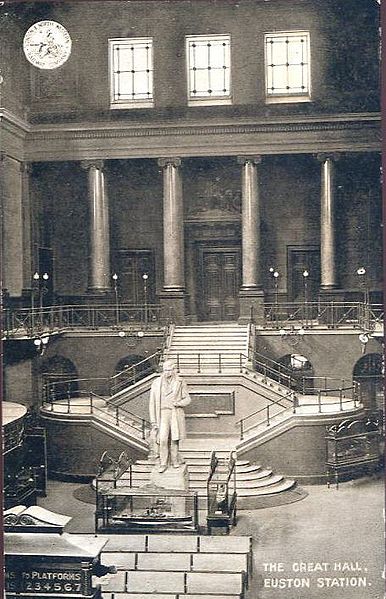
London’s first railway terminus was Euston. In fact, as Dan Cruikshank noted, it was the first railway terminus in any capital city in the world, opening in 1837 as the London gateway for the London to Birmingham Railway. Its rapid growth, and long-lost Doric Arch were emblematic of the railway age and Victorian progress. The ticket hall and waiting room, the largest in the world and later remodelled by Lutyens, were wonderful statements of the age. As London and Britain grew and thrived, so did Euston.

All of which may come as a surprise to anyone who has felt the shrinking feeling of ascending the escalator into the giant, airless and seatless concourse that is Euston today. The station is one of London’s most charmless buildings and there is no less fitting starting point for Britain’s greatest train journey, the Caledonian Sleeper to Fort William. Only after escaping the low-slung depths of the platforms and emerging up the Camden Bank does this and other journeys emerge into natural light. So how did we get here?

The clues are dotted around Britain. When the first railways into London were built they were forbidden to proceed, with the exception of the cut and cover (and therefore sub-surface) route to Farringdon, to stretch any further than what was then New Road, known today as Euston Road. At this thoroughfare the London to Birmingham Railway terminated, with only two platforms, opened in July 1837. Victoria had been Queen for a month. Had she popped up to Euston to see the train she would have seen trains being pulled in and out of the station using cables, which were used in lieu of locomotives until 1844, at the request of nimbyish Lord Southampton.

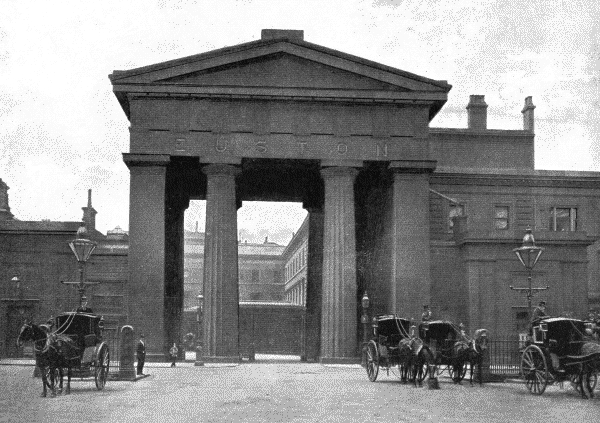
The station grew quickly as railway mania took hold, and in 1849 the Great Hall was built. Photos show a grand, classical building with sweeping staircases reminiscent of Grand Central Station, if smaller. Already in place was the Doric Arch – strictly a propylaeum – marking the entrance to the station. In those days the station was located a little further north than it is today, cut off from Euston Road by Drummond Street. The statue of George Stephenson, inventor of the Rocket (if not steam trains themselves) survives on the concourse today.

So far, so jolly nice, and Euston was the first of a fine triumvirate of stations on Euston Road, joined by Kings Cross in 1852 and St Pancras in 1868. But Euston didn’t last. The station was deemed too small and too inflexible to accommodate passengers, and too old-fashioned to do very much with.

Interestingly, efforts centred on saving the Euston Arch rather than the station building, which even to enthusiasts was a lost cause, too small and obsolete and not conducive to expansion. I wonder if a way might have been found today. The voices would surely have been louder.There are echoes of Penn Station in New York. After the Second World War got in the way of attempts to replace it in the 1930s, it finally fell in 1960 despite the best efforts of Sir John Betjeman and a host of other campaigners, and a group of young architects who scaled the arch and draped it with a banner demanding it be saved. The Euston Arch Trust article (sterling work boys, by the way) notes that even the demolition company tearing down the arch piece by piece – it was in too densely populated and built up an area to blow up, or else they would have done that – offered to store it somewhere to enable later reconstruction. It was to no avail. Down the road, St Pancras was saved from the wrecking ball but Euston and its arch was the one that got away.

Euston Arch 1896

And that, it seems, is that. No wonder Mancunians and Scousers are so snippy about London if this is their first impression.

There are plans for a new station to come with the high-speed line to Birmingham and beyond, one which rights some of these wrongs and even brings back, if not the booking hall and other fine rooms, the Doric Arch, now only otherwise referenced by the station pub which sold good real ale last time I visited. Remarkably, it was in part the decision to grant east London the 2012 Olympic Games which gave the cause some hope. Once these chunks of Yorkshire stone were torn down they were, in the main, chucked into a section of canal known as Prescott Channel, a flood relief flue near Three Mills Lock at Bromley-by-Bow. Take a bike ride down there sometime. Other bits ended up in the gardens and even walls of houses of those who demolished it. The Euston Arch Trust takes up the story.

Nothing remains of old Euston station building, but you can see two of the lodges at the entrance to the bus station in front of today’s Euston. A happy, geeky hour can be passed thumbing through a few books in the London Transport Museum‘s shop which has more pictures of old Euston and its demolition. Maybe a better memorial for a long-lost station is to visit some of Britain’s very fine stations that didn’t get torn to pieces as the car put the skids on our train network. Birmingham Moor Street, Newcastle and Huddersfield, as well as St Pancras, would be good places to start. In fact, that’s a recipe for an interesting tour of Britain.

Stop also at York, with its very fine curving trainshed, and stroll to the National Railway Museum. Here, on your left as you enter the main hall where the Mallard and other great engines live, are the magnificent wrought iron gates which once adorned the Doric Arch itself. It’s a long way from London, but a fitting resting place for a relic of the bold start of London’s railways.

Two quotes from The Making of the English Landscape

W G HoskinsThe Making of the English Landscape is one of the best books on British history I’ve ever read. Packed with detail, it takes the reader from a time when England was populated by a few tiny Celtic hamlets and covered in forest, through the creation of villages and towns under successive invasions and through to the industrial revolution and beyond.

On the way the reader learns, at times open-mouthed with astonishment, at how English people lived and worked and eventually tamed enough of the forests and heaths to grow prosperous and, sometimes, healthy.

A couple of quotes in particular caught my eye. Hoskins romanticises the late seventeenth century, or more specifically 1688, as the finest time to be an Englishman:

Few boys lived beyond easy walking distance of thick woodland,or of wild and spacious heaths, where they could work off freely the aninal energies that in the twentieth century lead too manyb of them in the foul and joyless towns into the juvenile courts. There was plenty of scope for poachers of fish and game, and plenty of fresh air and space for everybody, and silence if they wanted it. No industrial smoke, nothing faster on the roads than a horse, no incessant noises from the sky; only three million people all told, spread thinly about the country. The largest provincial town (Norwich) could be described as ‘either a City in an Orchard, or an Orchard in a City, so equally are Houses and Trees blended in it’ – how infinitely more pleasant a place England then was for the majority of her people!

And then, in the best justification for exploring what’s on your own doorstep I’ve read, he writes:

So behind every generalization, there lies the infinite variety and beauty of detail; and it is the detail that matters, that gives pleasure to the eye and to the mind, as we traverse, on foot and unhurried, the landscape of any part of England.

While this book is rightly heralded as a classic work of local history, it also is important in learning about how the experience of living in England has changed over the centuries. Hoskins’ own views, including his distaste for much of the modern world, bubble up from the pages making for a lively read. He would have made an engaging dinner guest and near-unbeatable walking companion.

The Making of the English Landscape is a fine companion to exploring rural England, and is the perfect read this springtime to herald the excitement of summer.

A night in the giant colon

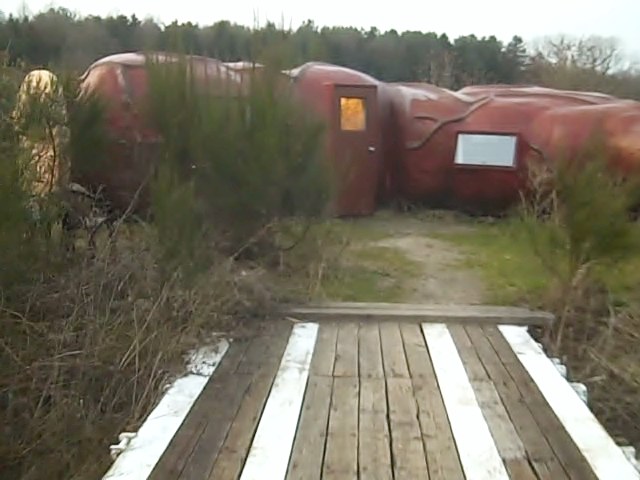
It’s not every day you get the chance to spend the night in a giant digestive system, but last week I did just that. At the Verbeke Foundation, midway between Antwerp and Ghent in Flanders, Belgium lurks CasAnus, the creation of Dutch designer Joep Van Lieshout.

Getting to the Verbeke Foundation by public transport was not easy. You’re made to work for your art. First, a train to St Niklaas, and unremarkable Flemish town on the Ghent to Antwerp line. Then a bus, packed with schoolchildren. Armed with instructions of where to disembark and then a map of what to do then, it was somewhat inevitable that I would first miss the bus stop and then take a couple of wrong turns before reaching the distinctly unusual entranceway that marks the entry to the foundation. It would be easier to approach the Verbeke Foundation by car. Once home to the freight forwarding business of Geert Verbeke, it is now one of western Europe’s edgiest art venues.

Here you’ll find artists in residents living on-site and working on ambitious projects, and a few unusual ways of paying the bills. And this is why I found myself sitting in a giant greenhouse at 6.30pm with an 8m long helium-filled fuselage of a plane to my left and various futuristic installations outside surrounding a man-made lake. Mr & Mrs Verbeke fund and operate the foundation themselves and were on hand during my visit. they seem both devoted to their work and immensely welcoming. Over dinner, I learnt more about their hard work to open and operate this astonishing place so far from Europe’s artistic heartland. It requires vision, dedication and not a little funding and huge amounts of hard work. It was impossible not to be impressed. Perhaps the remote location frees their hand to be truly innovative.

What brought me here in the first place is on an island in the lake. CasAnus is, as the name suggests, a huge human colon. It was  made into a dwelling which, for a mere €120 a night – barely a three-star hotel in business-account Brussels – visitors can spend the night in. Before anyone reading this recoils in horror, staying here was a genuine pleasure, The small staff who work here, including Geert and CarlaVerbeke, are passionate about their foundation and the art being made and displayed here. On first arrival, a stroll around the grounds and through the large and important collection of collage works by artists from around the world sets the scene. There’s also the chance to have a drink in the bar-cum-cafe area with the resident artists and owners, who will happily fill you in on what’s new.

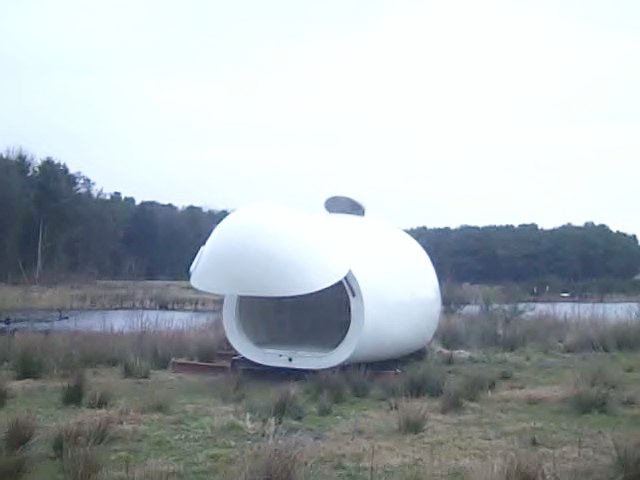
Then there’s the matter of getting your head around sleeping in CasAnus. You stroll through works of art including a huge white pod and a clutch of chickens (also a piece of living art, as it turned out) until crossing a small bridge to reach the intestines themselves. Once inside, the bed is comfy, there’s a shower and toilet and towels and bedding is provided. It is utterly silent and pitch black at night, so bring a torch if you want to creep around at night. It is as normal as sleeping in a slug-like space can be. I woke in the night wondering where on earth I was. Then I realised. It took me some time to get back to sleep as I digested the information.

Since opening, CasAnus has attracted everyone from curious hacks to overnighting artists to paying customers from many European countries. I asked how people take to the experience – apparently it is universally positive. If the novelty of staying in a giant polyester intestine wears off then there’s always the thrill of spending the night quite alone in an artwork. Not an everyday occurence.

The next morning you have breakfast in the large greenhouse and reverse the trip. for €120 a night you and a friend could enjoy a visit to what must be Europe’s oddest place to stay, surrounded by cutting-edge art in the most unlikely of locations.

Here’s a video of my visit to CasAnus.

Behind the scenes at Talking Travel: Lonely Planet & PRI The World’s podcast

The latest Talking Travel podcast went live today, talking about the World Cup, South Africa and, just to broaden the appeal, the Houston Rodeo.

Bush House - from London to the world

Recording the podcast is always fun, and requires a trip deep into the labyrinth of studios and corridors of Bush House, the iconic home of the BBC World Service. The inscription above the door of this wonderful building reads ‘Dedicated to the friendship of English-speaking peoples’.

Bush House is on Aldwych (definitive articles need not apply), the oddly-positioned buffer between the Strand and River Thames beyond and Holborn and Covent Garden to the north and west. Best known to older Londoners as giving the name to a disused stub of Piccadilly Line, the area is also home to the London School of Economics, the Indian and Australian High Commissions. Two superb churches, St Clement Danes (with Samuel Johnson lurking round the back) and St Mary-le-Strand, marooned in the middle of the busy road, can be found close by. Robert records from BBC America’s studios in midtown Manhattan, while Clark drives from PRIs HQ in Boston, Massachusetts, from whence sprang musical genius Jonathan Richman.

The podcast is a joint effort between Public Radio International’s The World programme and Lonely Planet, and contributors reflect this. Here’s a little more about the voices on the recording:

Clark Boyd

Clark Boyd in Hungary

Location: Boston, Massachusetts USA

Favourite destination(s): Edinburgh, Scotland, Santiago de Compostela, Galicia, Spain, Bryce Canyon, Utah, US

Next destination: Moving to Brussels, Belgium

What I like about recording the podcast: I normally cover technology for the show, so hosting Talking Travel gives me a chance to explore something new and different. I feel like I’m learning loads about one of my favourite things to do: travel.

Robert Reid

Robert Reid in Mexico

Location: New York City

Favourite destination: Home after a long trip, when curiosity radar is still activated and you see familiar things in new light; or Mexico

Next destination: A hobo convention in Mississippi, seriously

What you like about recording the podcast: It is simply a pleasure to be a part of, and I enjoy listening to the result – and learning from Tom and Clark – as much as making it.

Tom Hall

Tom Hall in X-Ray Machine, Manchester Airport

Location: London

Favourite destination: Paris, Rome or anywhere in Africa

Next destination: Cardiff, Wales

What you like about recording the podcast: having a chance to explore themes and destinations in detail, and the transatlantic banter.

We’d welcome your comments and suggestions for what you’d like to hear on Talking Travel, so get in touch if you have any thoughts.

Easter Island and the 2010 solar eclipse

This article first appeared, translated into Norwegian, in the March 2010 issue of Zine, hence Norwegian references.

Holidays are usually about chasing the sun. There may be the odd occasion when you choose to leave a beautiful country like Norway for somewhere wet and cold, but most of the time the quest takes us somewhere we can get a blast of tropical heat and a vitamin D overdose. It shouldn’t be a surprise then that eclipse chasing is, well, hot.

Earlier this year an annular eclipse – where the moon partially obscures the sun – provided a spectacular ring of fire visible from the Maldives, southern India, Sri Lanka and China. Many snowbirds who had flown south for the winter found themselves in the right place at the right time. The Eclipse lasted in parts for eleven minutes – the longest not only this century but also this millennia.

It’s not surprising then that Easter Island is proving quite a draw for eclipse chasers on July 11, when a total eclipse will pass over the heads of the islands famous statues for four minutes and thirty-nine seconds. The combination of somewhere utterly fascinating – and with a special pull for Norwegians brought up on stories of Thor Heyerdahl’s Pacific adventures – and an eclipse sounds almost too good to be true.

Hold on before you rush to book. Let’s consider what will await those who pay the inflated costs of getting to one of the world’s hardest-to-reach islands at eclipse time? I was lucky enough to visit Easter Island a few years ago, travelling from Santiago in Chile to Tahiti on the only international flight to pause and refuel here. In fact, the plane carries enough fuel to render the landing unnecessary, to counter the risk of there being no fuel available on arrival and the flight being stranded. There are also several domestic flights each week from the Chilean mainland to Easter Island.

I found the land of the moai a very special place, with an almost unbelievable history and sense of separation from the rest of the world. Visitors tour the island on horseback, on foot and by best of all by bike, and at night the main town of Hanga Roa rocks to a gentle yet inviting island ryhtmn. Like all remote islands it can have a lonely feel, and though I treasure having visited I was relieved when my flight came in. Now I’d return here before going anywhere else.

Tukuturi: aka the kneeling moai - and the only statue on the island with legs

Easter Island has only got more popular since then and flights haven’t got any less busy. Eclipse time will be the busiest of peak times. The islanders themselves are increasingly unhappy with the volume of tourists who visit – 70,000 came last year to a place with a permanent population of 2,500 – and it likely that every room on the island and then some will be filled up when with Eclipse chasers. This means big costs for those who do come. It may be the holiday of a lifetime, but be aware that it might take you that long for your wallet to recover. At least the enigmatic moai will be standing impassive and not asking visitors to pay a premium for a photo.

There’s one other risk worth considering. July is bang in the middle of the wet season and while blue skies are entirely possible, a cloudy day would not be unusual. The Total Eclipse which passed over the UK in 1999 did so through a blanket of cloud. I watched from the top of Parliament Hill in London, one of the city’s best vantage points, and the effect was a little like a series of progressively greyer clouds rolling over your head. Thousands of excited eclipse-watchers hooted and booed at the cloudy skies which seemed ridiculous at the time. We tramped back to the Lonely Planet office more than a little disappointed.

Viewing a solar eclipse may not be worth all the hype. There are certainly better times to come to Easter Island. But both are worth seeing and should have a space on every traveller’s must-see list. You could wait a year and see Easter Island at a quieter time, and make sure you’re closer to home on June 1 2011, when a partial eclipse will be visible over northern Norway. All this obeys one unwritten rule of travel: while you’ll want to go when everybody else does, it’s usually better to plan your trip for when the crowds are elsewhere.

Morrissey Shot

Moving house for the second time in six months. Putting books away unearths memories again. Well loved old favourites get dusted down and packed off, destination another bookshelf. Some catch your eye and demand a leaf-through.

Morrissey Shot

Chief among them is Morrissey Shot, Linder Sterling‘s spectacular photobook from Morrissey’s solo golden years, 1991-92. In this period Mozzer shed the seclusion of his early solo years, released a succession of wonderful singles and albums and formed an unlikely songwriting and touring partnership with a pack of rakish Kentish Town quiffed-up Rockabilly boys. The concerts, including the marathon Kill Uncle tours, were the first chance a generation of post-Smiths fans had to come together. The level of fervour and celebration has never been matched since.

Sterling’s photos capture the fun and curiosity of this time.

Morrissey looks fabulous throughout, mysterious and imposing on stage, at turns playful and melancholy off it. Boz Boorer and the rest of ‘The Lads’ as clueless critics dubbed them lark around in the background. Through it all fans provide constant inspiration for Sterling. Several shots capture fleeting, tender moments between fan and singer, a snatched moment indelible to the fan, one of thousands for Morrissey. The faces of the crowd, from Dundee to Tokyo, are potraits of wide-eyed excitement. There are a few examples here.

Morrissey went on to record two of the best albums of the 90s – Your Arsenal and Vauxhall and I – then end the decade in exile. Fans continued to believe and fight the good fight against lazy critics of a genius. His concerts are still wonderful, celebratory affairs – you’ll see quiffs, hearing aids and flowers harking back to the mid-eighties – and it would be a disaster to miss Morrissey when he passes through your town. But to see him at his most handsome, his most creative and most alive, seek out a second-hand copy of Morrissey Shot.

Notes from Northern Ireland: pubs, murals and an airport named after a footballer

As you might expect from a city at the northern tip of an island in the Atlantic Ocean, Belfast is not always a dry place at the end of February. It poured down from the moment I stepped off the plane at George Best Airport until I took off again.

An artful long pass from the city centre

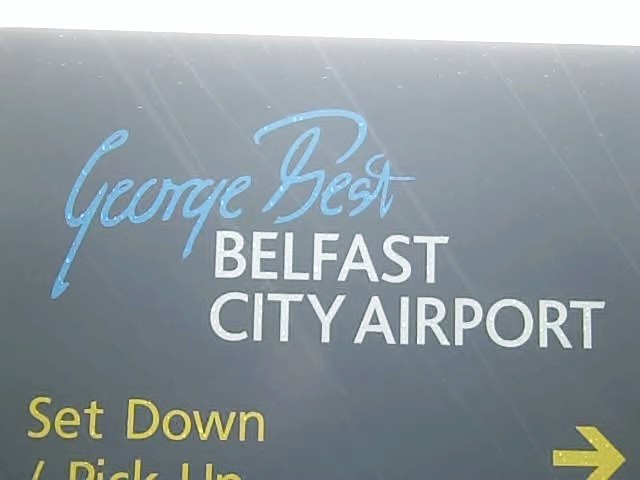
George Best Belfast City Airport is the only one in the world named after a footballer. Unless Buenos Aires or Três Corações get around to renaming their air terminals after hometown boys Diego Maradona or Pele there will be no airborne association with a more gifted player. Best is everywhere in Belfast and a true unifying figure in a city which still has visible divisions, even if today’s Belfast is very much looking forward to a shared future.

King of pubs

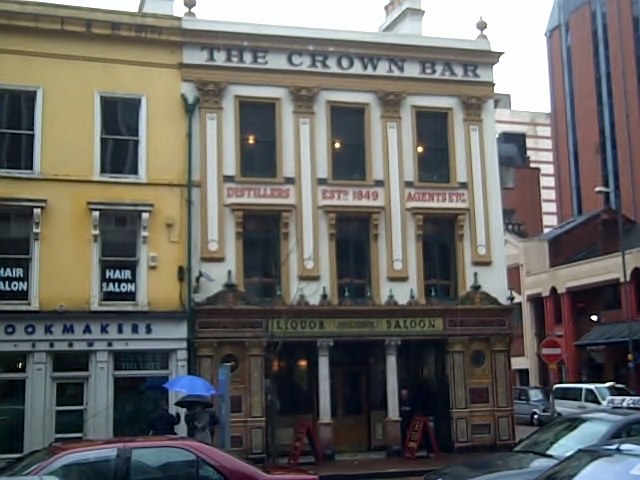
I was only in town for one night but dropped in on the Crown Liquor Saloon. This pub is a Victorian folly that somehow made it as a boozer, complete with ornate woodcarvings, neo-Gothic decor and huge private booths that hide you from the outside world. I congratulated myself on snagging one, only to realise you’re totally left alone once inside and that it was more fun chatting at the bar. Strolling the city in the evening drizzle I happened upon bands setting up to play gigs in the bars tucked away in the cobbled Cathedral Quarter and hotels like the Fitzwilliam offering upscale drinking and dining that was too trendy for a soggy corduroy-clad hack like me.

Belfast Wheel by night

The next morning I had a chance to look around. City Hall, the visible expression of the nineteenth century prosperity, the end result of Belfast’s status as one of the world’s manufacturing and shipbuilding powerhouse has excellent exhibitions and a great guided tour. It’ easy to find, next to the Belfast Wheel which is the best place from which to see the changing skyline. If big ships are your thing – and the giant Harland & Woolf cranes which are visible from all over the city prove that it was Belfast’s thing for generations – then don’t miss the fascinating Titanic Trail and accompanying boat tour. Both take in sights associated with the ill-fated ocean liner which left here – working perfectly, as locals will point out with tongue firmly in cheek – a hundred years ago next year. You’ll also find an art trail hugging the banks of the Lagan River, including this fishy fellow below.

A visit to West Belfast, still home to large working class Catholic and Protestant communities, is the best way to get a handle on the Sectarian divide which shaped the twentieth century history of the Northern Irish capital. Many come on excellent and informative Black Taxi Tours. I opted to go on foot, and suspect I was the only person to walk down both the Shankill and Falls Roads that day. Both areas are aware of their attraction to visitors and the both local communities and the city council have signs and maps to direct casual visitors around and make you feel welcome.

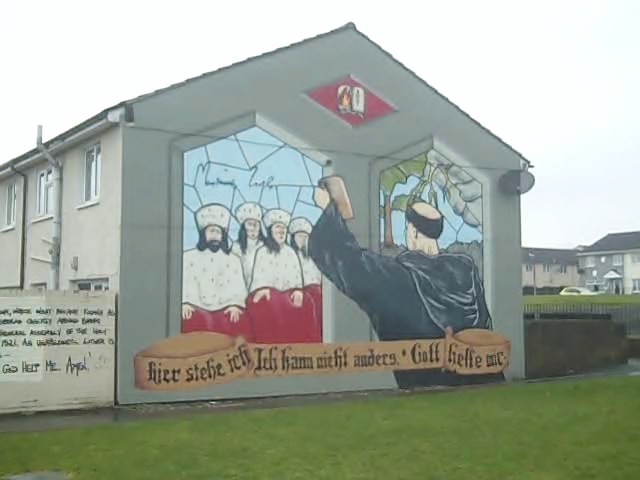
Martin Luther in the hood

It is hard to avoid the sense that these murals belong to the last century, not this one. The first mural you come to walking west along the Shankill Road no longer homages the loyalist cause but makes a proud claim on the area being the earliest of Belfast’s settlements. Yes, you’ll still find militaristic and political murals, and other monuments while exploring both sides of West Belfast, but the more recent renewals are more benign and hopeful and in many places offer outlets for imaginative local artists. My favourite, found elsewhere in the city, is this one devoted to one of Science’s most philosophical questions. I passed it while out running so was camera-less.

Interesting place, Belfast. It has centuries of history, a few cracking hotels and anyone who grew up with Northern Ireland looming large in the news would do well to go and see it for themselves. The city sits in the shadow of some towering mountains and is close to some lovely coast, meaning with a few extra days you could see a lot of what Northern Ireland has to offer. Bring an umbrella.