
After reading a biography of JRR Tolkien I was struck by his mastery of Old English and the influence of its literature and history on Lord of the Rings. I didn’t know much about the language nor really the period – though it turned out I had skirted round the subject while reading various books – and, curiosity piqued I decided I’d like to know more about it, and a bit of searching led me to the fantastic Colin Gorrie and his graded reader, Ōsweald Bera. While this hasn’t been a route to fluency, it has been a first step in this lost language. Learning it has been befuddling fun, with some genuine wonders emerging from the mist of time. And while I’m not trying to persuade anyone, I wanted to write down some of the favourite things that I have found along the way.
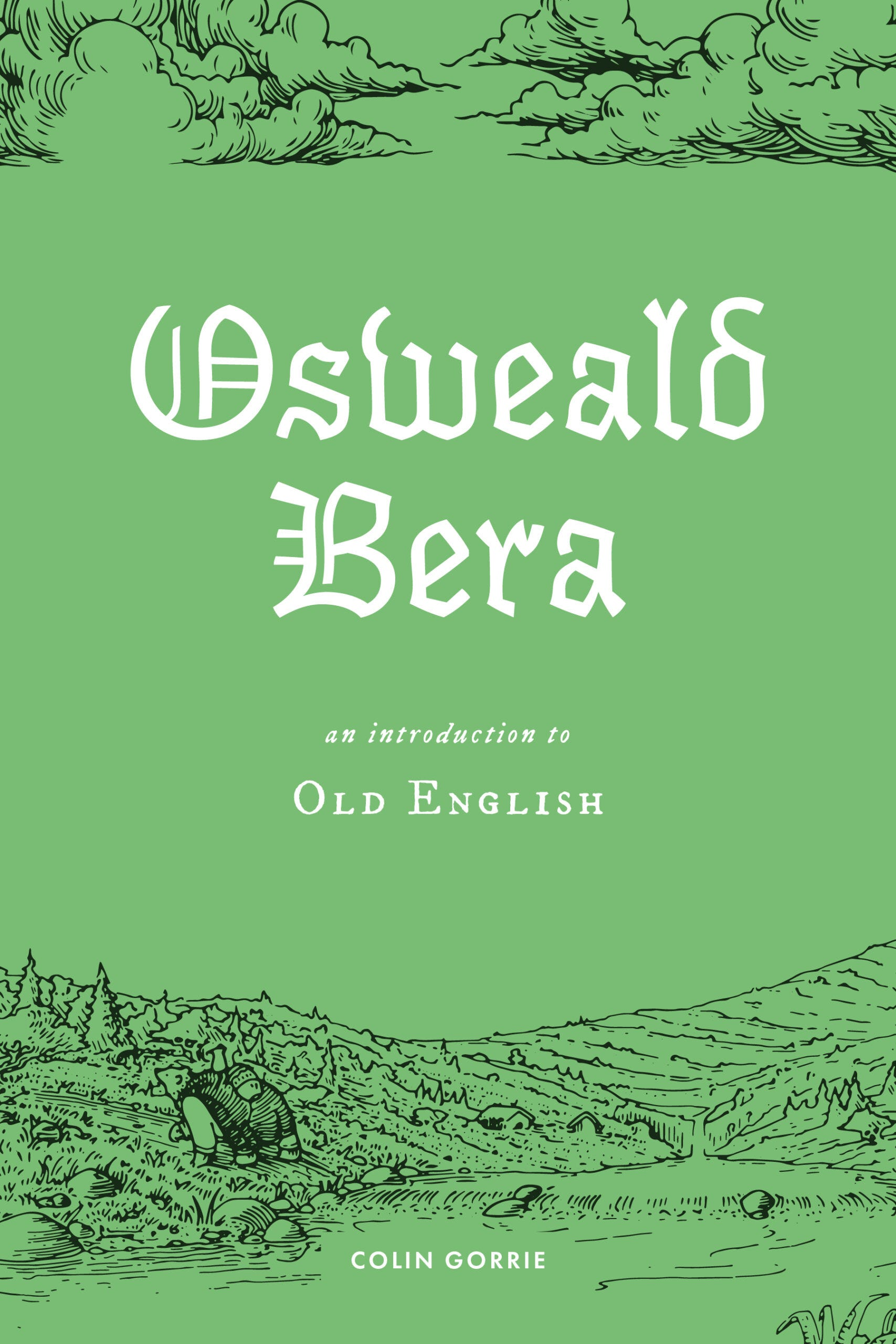
By all means buy the brilliant Osweald Bera here. I recommended it to a friend’s daughter who was intimidated by the prospect of studying Old English as part of her Oxford Undergraduate course and by the sounds of it, it has done the trick there.
Another excellent and reader-friendly way into Old English is to read Hana Videen’s The Wordhord: Daily Life in Old English, which will introduce you to wonderful words for all sorts of everyday things, as well as gently opening the door on more concepts you’ll encounter further down the track.
The letters Þ / þ (Thorn), Ð / ð (Eth), Æ / æ (Ash) and Ƿ / ƿ (Wynn)
These letters are among the first things anyone looking at a line of text (see Hwæt below) will notice, as they’re not present in modern English. Blame the printing press, among other things, with its continental letters. Getting my head around these letters, especlally learning to write them, has given me a real kick. My daughter’s called Winnie. Should that be Ƿinnie?
That the runic alphabet is called ‘The Anglo-Saxon Futhorc’
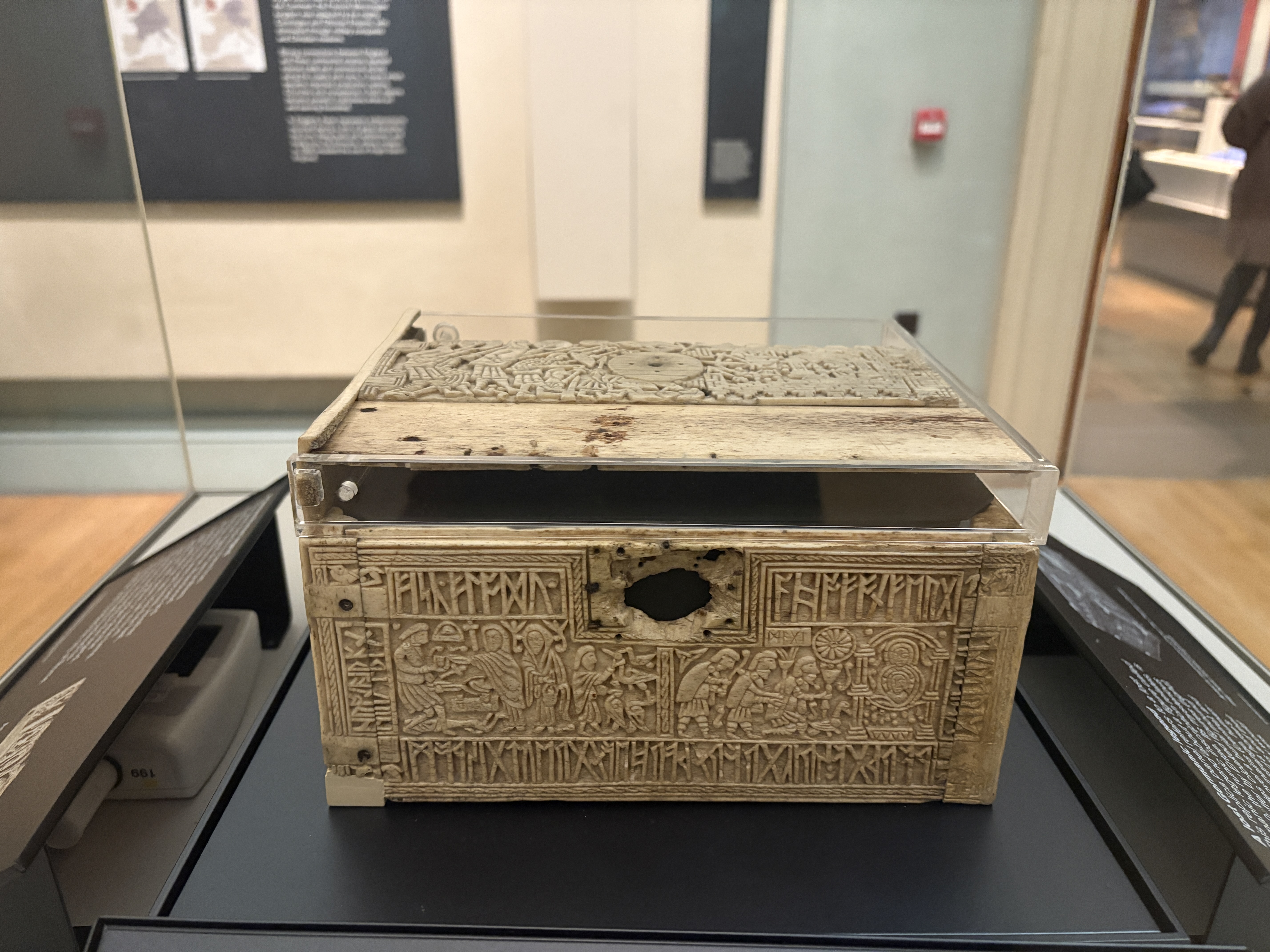
Like a typewriter keyboard’s ‘qwerty’ keys giving its name, the runes that made up the Anglo-Saxon alphabet bear the name of their first six characters: ᚠᚢᚦᚩᚱᚳ, fuþorc. We misspell fuþorc because English has lost the letter thorn (þ), inefficiently replacing it with two letters, th. I would like to learn the runes. Fuþorc. There it is again. The Franks Casket, a whale-bone chest in the British Museum, is a great place to see Anglo-Saxon runes up close, as are the casts in the Victoria & Albert Museum of the mighty crosses from northern England and southern Scotland. Having written down the full fuþorc, I was able, with a little close inspection, to pick out individual runes on both the casket and the crosses, which gave me a kick.
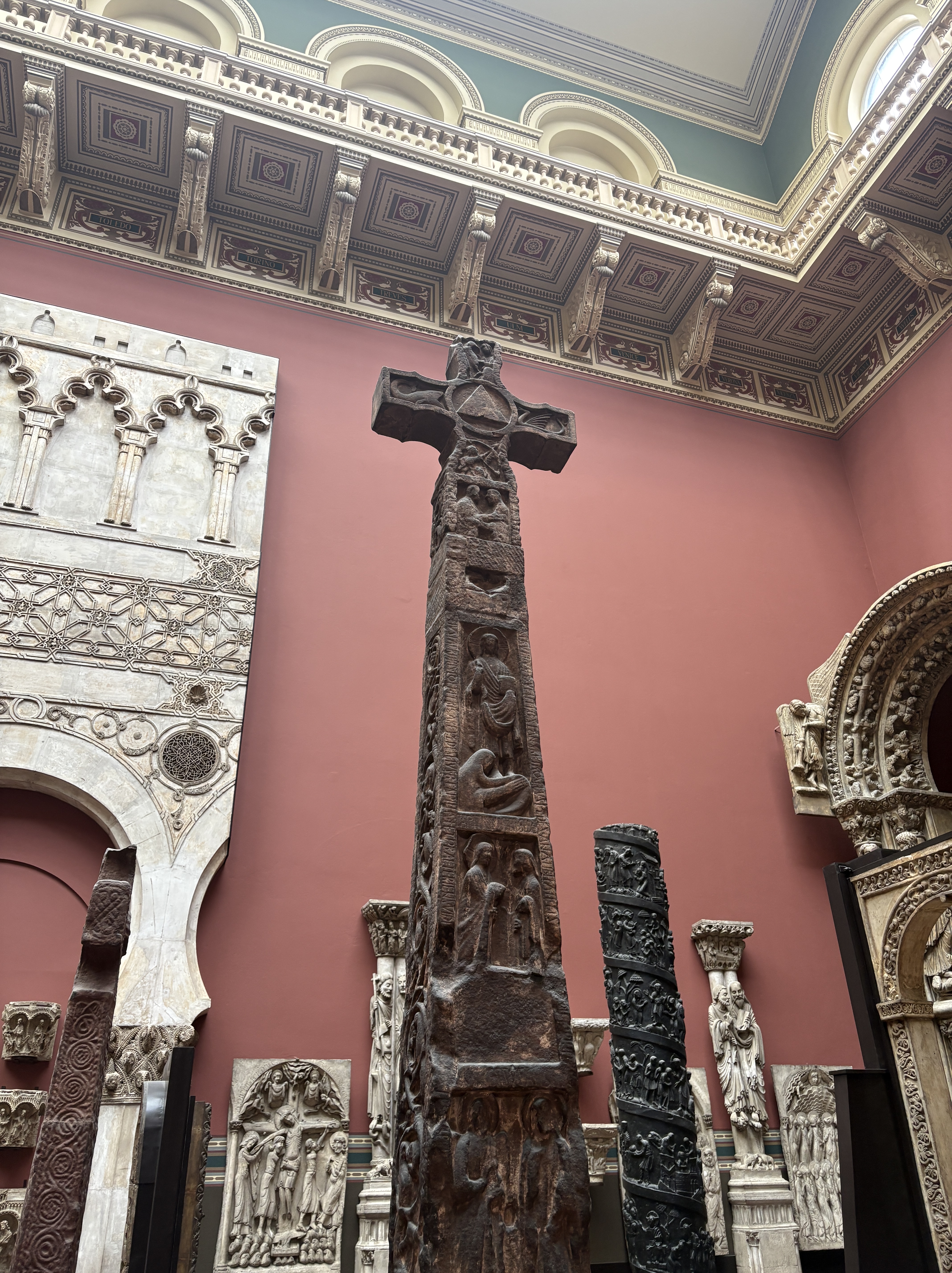
At least, that is, until you can persuade your family to take a holiday there and see the real thing in Ruthwell.
Poetry
Nothing challenges the idea that the Anglo-Saxon period was the ‘Dark Ages’ (no darkness please, Early Medieval will do just fine) than the small but fascinating body of poetry that survives in manuscripts like the Exeter Book. Richard Hamer’s Choice of Anglo-Saxon Verse has been a brilliant window onto the world of Old English poetry. The poems I have been particularly drawn to are known as The Ruin – a description of the faded, mysterious glories the Anglo-Saxons had around them as leftovers of a Roman civilistaion they could not emulate; Durham, a beautiful description of the cathedral city that could still apply today and Wulf and Eadwacer, a lament for a lost love and an imagined future that refuses to come to pass. There’s so much more to dive into.
Manuscripts
Things get even wilder and glorious when you stick your nose into a manuscript. Here’s a mention of Hroðgar (Hrothgar), King of the Geats and builder of the Great Hall of Heorot:
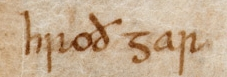
Hroðgar
So that’s an r and a g also looking considerably different as well as the different letters noted above. And Hrothgar here looks like two words. Very confusing, very cool. I feel like there’s a lifetime of pouring over individual words trying to make sense of them. By the way, Hrothgar’s queen? Ƿealhþēoƿ (Wealhtheow).
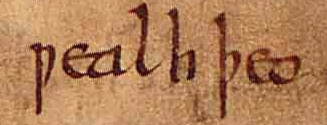
Ƿealhþēoƿ
Hwæt
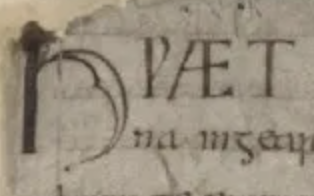
Hwæt
Hwæt (often written as Hwæt! but there was no exlamation mark in Old English, and there dispute over the use of the word in this context) is as far as most people, I think, get with Old English. It’s the first word of Beowulf, the most famous piece of Old English literature, a monumental work about Germanic inter-tribal warfare, monsters, monsters mothers, feasting, the passing of time and so much more besides. Beowulf, the name of the protagonist, wasn’t exactly a common name in Anglo-Saxon English, though a visitor to the see of Durham at some point in the 7th century went by the incredible name to our eyes anyway of Biuuulf, suggesting it was somewhat in use at that point. Anyway, ‘Hwæt’ greets new arrivals into Old English, meaning anything from ‘Lo’ ‘Hark’ ‘Listen’ to something different. It may have been given significance as a rousing attention-grabber it doesn’t fully deserve. I like this idea as it fits with my Dad’s excellent and unique suggested translation of Hwæt as ‘F*ck me!’.
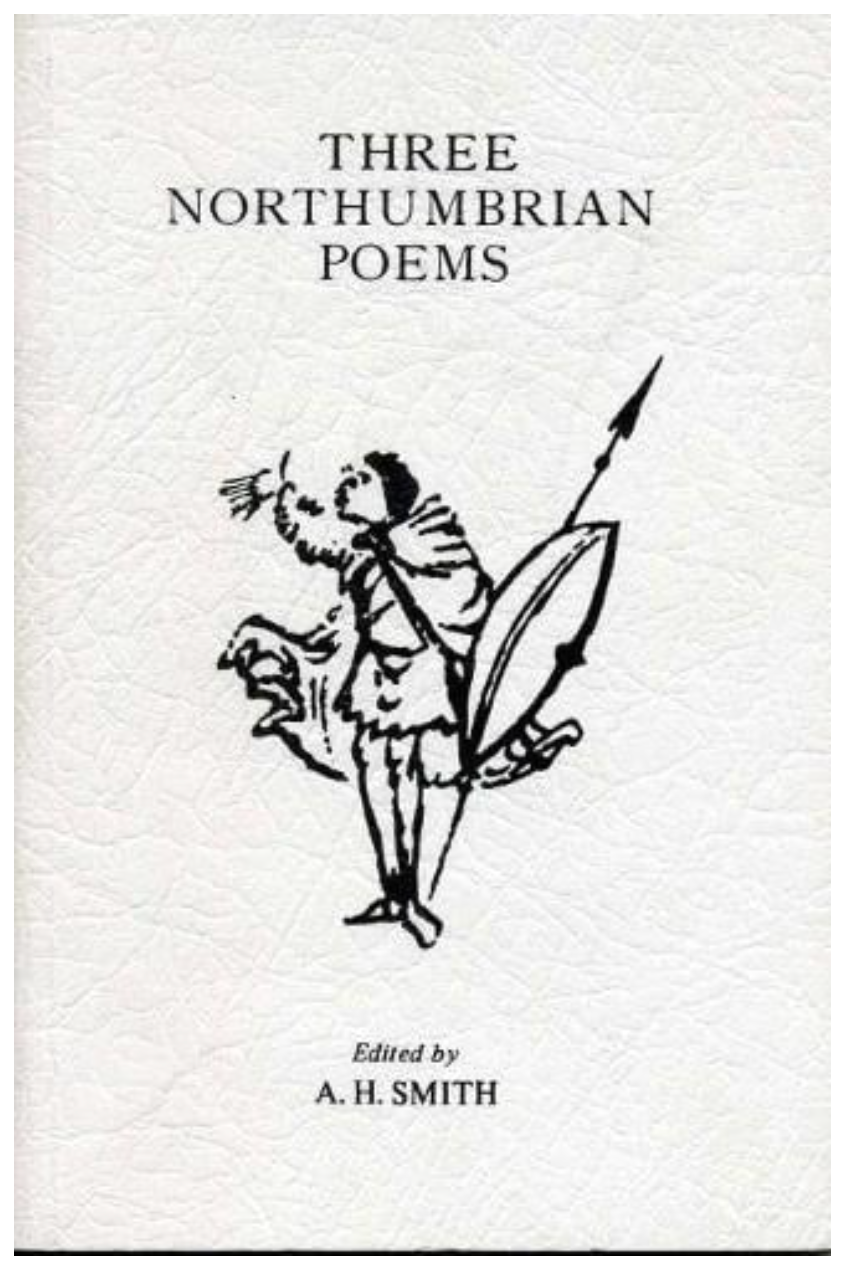
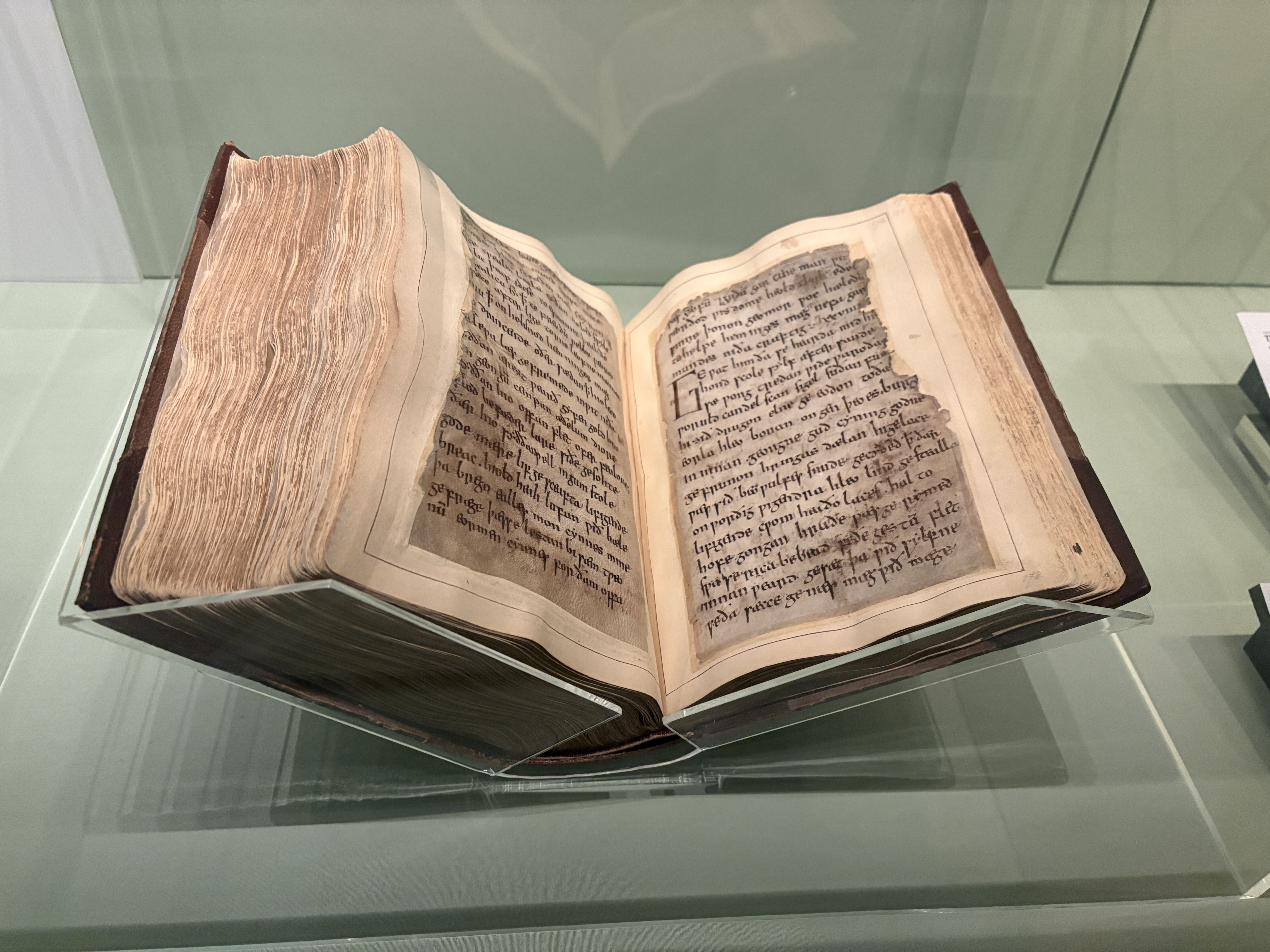
Here is a scop – a performing poet who would have recited Beowulf and many other works, pictured on the cover of the pretty hardcore Three Northumbrian Poems by A H Smith. This drawing is another thing I love about Old English. I haven’t read much of Beowulf – it’s certainly beyond my current capabilities – but I have been to gaze at the sole surviving written copy of it, also know as the Nowell Codex, in the British Library.
Grammar
Speaking of things that are very difficult to me, elements of Old English are, to me at least, really hard. It’s not so much that it’s a ‘dead language’, there’s enough of it online (Graham Scheper, take a bow) to make it feel very much alive. It’s the prospect of learning grammatical terms, how and when they apply, what things like inflections and cases even are. English speakers like me can be very lazy when it comes to languages, so there’s an irony to struggling to understand the terms and tools of the precursor of this language, let alone the language itself. The sort of brief aside on a modern languge like French or German that someone like me was given doesn’t give much of a grounding, and was long, long ago. Osweald Bera gives this challenge the swerve and looks to introduce the language in a different way, and I’m getting there with help from Peter Baker and, yes, the odd AI tutorial. Bookmark this and let’s see where we are in a few years.
Bede’s Parable of the Sparrow
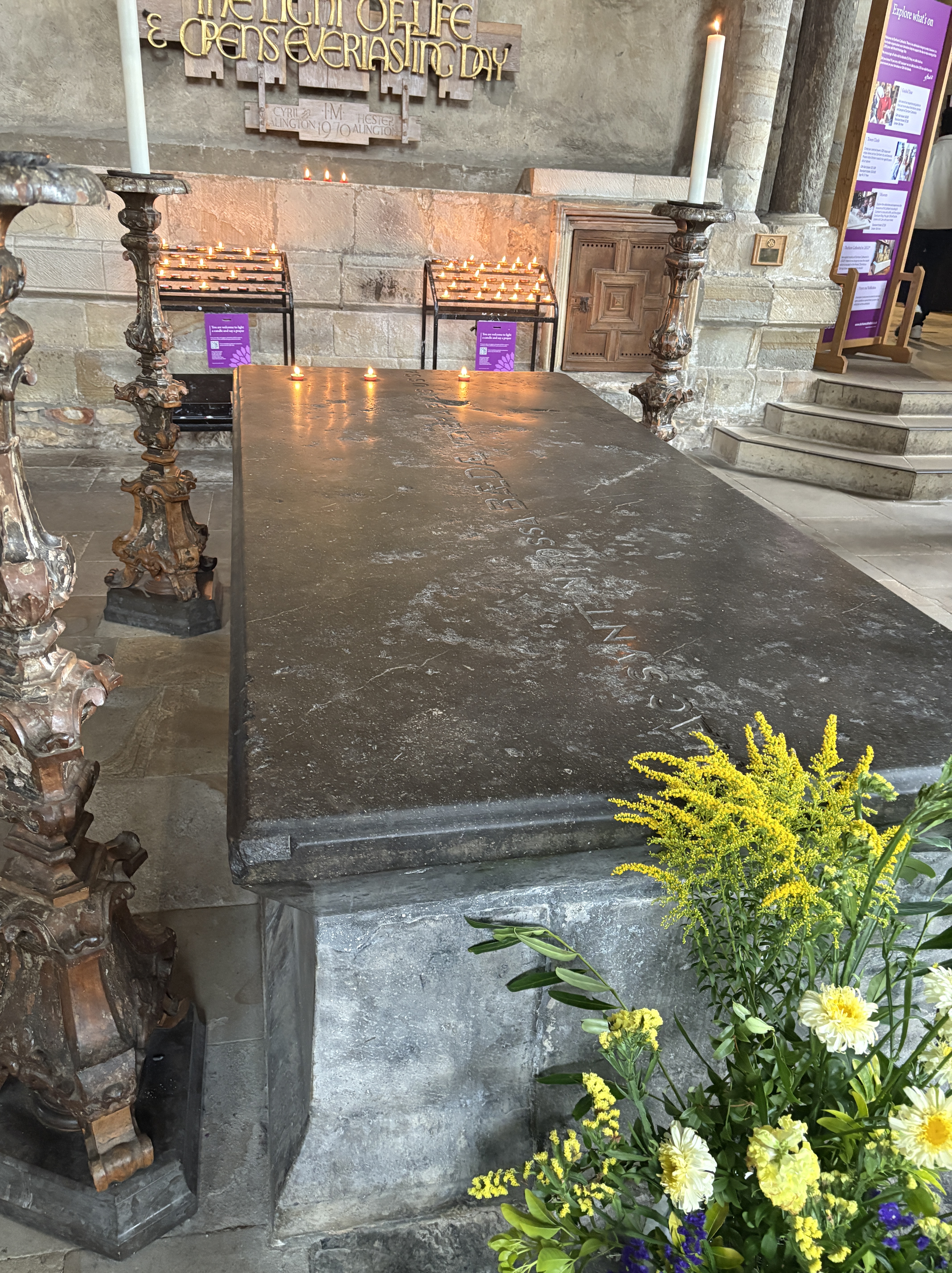
I won’t write out Bede’s Parable of the Sparrow, found in his Historia Ecclesiastica – you can read it for yourself here, for example. Not only is it a vivid analogy aimed at the dwellers of the mead-hall, but also a beautiful metaphor for the fleeting nature, and wonder of life and the mystery of faith. Bede is buried in Durham Cathedral, a most fitting place for him.
Northumbrian: even more out there
There’s so many wonderful connections between Northumberland (Norþanhymbre) and Old English. This isn’t a surprise as Northumbria was one of the ancient Anglo-Saxon Kingdoms, and home to Bede, Cuthbert, King Oswald and the humble shepherd Cædmon. As someone who has frequently visited and loves the region – and whose grandmother was born in Gateshead – this has been a fresh window on the north-east. Fleeting fragments of the Northumbrian Old English dialect survive, in scattered manuscripts found in unlikely, distant libraries like St Gallen, Switzerland and Saint Petersburg. They hold versions of texts like Cædmon’s Hymn and Bede’s Death Song, and within are some wild words. Bede’s Death Song alone brings into the twenty-first century uuiurthit (“becomes”), thoncsnotturra (“more thoughtful” or “wiser”), and ymbhycggannae (“to reflect upon” or “to consider”), the last of which I am sure I can hear with a dash of modern Geordie. Wonderful, befuddling words, constantly tempting to attempt a translation of, hard to learn, I will get there one day.

