Cyclists this way (Wikimedia Commons)
This is from a trip to Jutland in 2008, and rescued from the vaults.
Denmark is flat. It must be flat, because everyone says so. It is with some surprise then that I find myself hissing ‘It’s supposed to be flat here’ as I sweat my way up another short, sharp hill on a bicycle that while sturdy and upright, is clearly built for cruising round the heavenly cycle lanes of the country’s northern cities.
This is not the only surprise that greets me while cycling 75 miles – plus detours – across north Jutland, from Aalborg to Skagen by bike. Danes, it appears, do not cycle like I do. Like many commuter cyclists, I like wearing as much unflattering cycling gear as possible and charging off at breakneck speed. Danes glide along in everyday clothes, seemingly incapable of sweating or indeed getting even slightly steamed up. Mikael Colville-Andersen, who runs the Danish cycling website Copenhagen Cycle Chic explains why. Cycling, he says is ‘a social activity for people first and a sport second.’ Colville-Andersen takes this philosophy to heart, and his website is light on practical tips and heavy on pictures of pretty girls on bikes. An emotional approach to cycling also explains why everyone in Denmark appears to be riding granny bikes. ‘Danes will go for colour and style – and it’s definitely style over speed’
Resplendent in Kraftwerk-esque black lycra cycling gear with angry bumblebee pannier bags, style was never going to be a problem. Speed, however, was leaving much to be desired. This was only partly down to my grey granny bike which would have had London commuters sniggering at me at the lights. Aalborg, Denmark’s fourth largest city and the starting point for my journey was home to enough great-looking cafes for a dozen breakfast carbo-loading sessions. It was tempting to linger. By the time I’d detoured via Lindholm Høje, Denmark’s largest – and very cool – Viking gravesite, my vision of idly pedalling along for eighty or so wind-assisted miles in a day seemed somewhat foolish. Not that doing something foolish is a problem. Having got used to the head-shaking reaction of friends and family at many dubious travel plans over the years, the English eccentric on holiday label sits comfortably on my shoulders. It was no more than a pleasant surprise that the good people in the Aalborg tourist office said I was ‘crazy’ when I told them my route plans. It was a sure sign of a good trip in prospect.
Undaunted, I hit national route 3 and put my foot down. The path largely follows the Old Military Road up the spine of Jutland, the peninsula that makes up the largest part of Denmark. Copenhagen, the usual destination for the 700,000 Brits (this figure is growing) who visit every year, is a few hundred miles away on the island of Zealand. Soldiers, merchants and pilgrims have passed this way for centuries, travelling from other parts of Scandinavia to central and southern Europe. They avoided soggy feet by following the contours of the land rather than blazing a trail across rivers and streams. The path remains rural and beautiful: it passes stone circles, visits medieval castles and crosses forests full of wildlife before hitting the coast and joining route 1, which leads north and east to Skagen.

Tilsandede Kirke near Skagen (Wikimedia Commons)
Route signing, as you might expect, is immaculate. The Danes are proud of their cycle paths. ‘Denmark was the first country in the world to develop a national bike route system and there are over 10,000km of signed bike routes.’ explains Colville-Andersen. ‘From the nineteenth century, Cycling Unions were well-organised and politically active and cyclists’ voices were heard.’ The result is a served as the blueprint for our own National Cycle Network – and is a boon for holidaymakers. It only goes wrong when you ignore it and attempt to build your own route visiting nearby places with silly-sounding names like Pajhede Skov and Uggerby. I learnt this to my cost mid-morning, when pondering that the bloke I was passing on my left hitting golf balls looked just like the bloke I’d passed twenty minutes ago on my right. He was the same chap. Lesson learnt: stick to the signed route.
Chastened, I returned to route 3 and, turning back into a London cyclist, started chasing the only other riders I saw all day. They seemed to be wearing their Sunday best and riding bikes straight out of Last of the Summer Wine. I expected to catch them quickly. They disappeared over the next hill and I didn’t see them again. Mikael Colville-Andersen later told me that these bikes are standard issue in Denmark. In fact, Danes insist on them: “Each year about 500,000 new bikes are sold in Denmark. Bikes are an important accessory for Danes and it’s an ever-changing market, even if the bikes are, as a rule, granny bikes. Even companies like Raleigh and Batavus have models only available in Denmark for the Danish market.”
Despite the occasional hiccup, there were enough wow moments to ensure I felt pretty smug all day. Being a bike commuter the quiet roads and respect for cyclists were remarkably refreshing. The morning’s sunlit fields of head-high corn and long grass gave way to forest trails and, as afternoon rolled on to sandy heathland. As the afternoon sunshine began to redden the bits of my body not covered in lycra I got my first whiff of the sea. Suddenly I was on holiday, surrounded by Danish families on bikes, pedalling out to the dunes and into small towns from their holiday homes. I joined a crowd paying a respectful visit to Dens Tilsandede Kirke, a medieval church lost to the sands in the eighteenth century. A reminder of the centuries-long battle against encroaching sand in this part of the world, it’s used as a navigation aid and a rest-stop for knackered cyclists starting to think the people at Aalborg’s tourist board might have a point.
Granny bike or not, I made it to Skagen, with lengthening late afternoon shadows and a strong breeze hastening my progress through dense beech forest and past the towering dunes of Rabjerg Mile. It seemed I had arrived in the Danish Cape Cod, complete with clapperboard houses and an unmistakable air of fishy gentility. My hotel owner greeted my explanation of how far I’d come with a friendly incredulity, which made me feel even better. The scene in Skagen revolved inevitably around the harbour. Yachties from Norway, Sweden and Germany scoffed freshly caught £5 fish and chip suppers – and they said Denmark was expensive – and swapped stories long into the night. Another surprise came as the temperature dipped: a triumph of function over Scandinavian style. Rather than retreat inside, outdoor drinkers wrapped themselves up in thick, beer-branded blankets and continued grogging.
Skagen has a lot going for it, especially in summer. The Danes know this and do their best not to tell anyone. Everyone in town is especially proud of the light in Skagen. It is, apparently, famed throughout the country for its ethereal qualities and every local I spoke to wanted to know what I thought of it. It was an interesting question, especially as the main thing I was thinking about was how my buttocks were feeling after yesterday’s exertions. But as light goes, it had a certain something, especially from under my nice warm blanket with a cold, cold beer.
The Skagen light has inspired painters for years, and while the town’s excellent art museum concedes that actually it’s the same light as everywhere else. If something special is going on it’s probably all the sand making everything seem brighter. The museum is celebrating its centenary this year with a superb exhibition of Skagen art, including works by PS Krøyer and Michael and Anna Ancher. The museum also provides another insight into the Danish cycling psyche. A timeline of local and world events exclaims in big bold type that in 1861, Ernest Michaux invented the modern bicycle. The publishing of Darwin’s The Origin of Species two years earlier is a footnote in small type. The visitor is in no doubt which event is of greater importance.
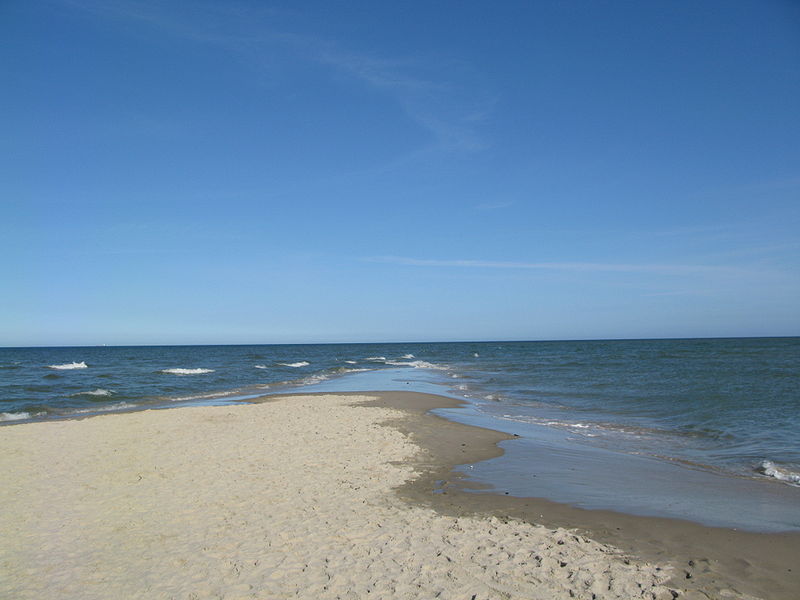
The cycling, however, did not stop there. Skagen is best explored by bicycle, especially as the town’s big draws are a little spread out. Over a million Danes each year visit Grenen, the sandy tip of both Skagen and Denmark. They all, it seems, have the same idea as me: shoes and socks off, trousers rolled up, digital camera out. This means that the natural beauty of Grenen gets a little lost in an orgy of camera-swapping and sprints into the frigid surf. If you prefer a more sheltered setting to appreciate the light, Skagen Odde, the Jørn Utzon-designed nature centre a mile or so across the sands from the town is a temple to natural light and elements. As well as displays on the local ecosystem has an impressive collection of 1960s and 70s Olivetti computers and serves excellent coffee. It still asks happily museum-like questions: one display invites the visitor to ponder whether vikings did indeed ‘bring a new type of mussel from America?’ Answer: probably.

Europe's end: Grenen
Reluctantly, the next day I took the train back to Aalborg, and after another fantastic lunch at an outdoor cafe moved on to Århus, another Jutland gem and Denmark’s second largest city. It’s also another cyclists paradise, with row upon row of bikes stacked around the magnificently frescoed cathedral, a short pedal from the Latin Quarters coffee houses and music shops. The city’s other big draw, the Bronze Age Moesgård Man is a more taxing excursion six miles south of the city. Judging by how full my Ryanair flight home (£4 including taxes – again, who said Denmark was expensive), word may be getting out about this part of Denmark. Explore it on two wheels to see it at its best.
Factbox
Tom Hall returned from Århus with Ryanair – a wide range of fares are available. He stayed in Aalborg at the Radisson SAS, doubles start at £53 per person including breakfast. In Aalborg, bikes can be hired from Munk’s Efterfølger. For more information about north Jutland, start at Visit Nordjylland and Visit Denmark (020 7259 5955 ).