Secret London: Holloway Road’s long-lost spiral escalator

Holloway Road Station on the Piccadilly Line is an unremarkable place. It is inconvenient for most places except the nearby London Metropolitan University. The stop before or after Arsenal, but closed to fans on match-days. It’s one of only two stations on the northern (or is it eastbound?) section of the Piccadilly Line with lifts. And yet it was nearly so different. If the station’s Edwardian construction had gone to plan, this unassuming N7 landmark could have been home to a unique engineering achievement.

Strange plans from another time: spiral escalator blueprints

Strange plans from another time: spiral escalator blueprints

The clues can be found in the London Transport Museum Depot in Acton. Dumped down an aisle of jumble and boxes are some dust-covered piles of chains, steps and tangled metal. Don’t pass by so fast: this is the remains of what was supposed to be the world’s first spiral escalator.

Men at work: did costs spiral out of control?

Men at work: did costs spiral out of control?

And there the trail dries up. Labels attached to the wreckage offer a photo of workmen, and a sketch of what the escalator would have looked like. The picture resembles a DNA double helix. Escalator buffs suggest that Jesse W Reno, inventor of the escalator, was the man behind the designs. Christian Wolmar, in his superb Subterranean Railway history of London and the Underground, notes that the idea was not a success and that, it seems, was that. The construction was abandoned and left to rot until found a few years ago. No spiral escalator, no grand achievement – but at least someone gave it a try.

UPDATE 7/1/10: Visitors to this site from District Dave’s London Underground Site have pointed the way to this comprehensive discussion about the spiral escalator, including some fascinating photographs and the news that sections of it are being restored. If you’re intrigued by what’s here, the site is well worth a look. And is you’re a District Dave regular passing through, thanks for stopping by. And don’t forget to give Holloway Road station a respectful doff of the cap the next time you’re passing by. It’s proof that London is full of interest.

Kon-Tiki Oslo

3,000 miles with only one beard blowing: the Kon-Tiki raft

3,000 miles with only one beard blowing: the Kon-Tiki raft

When Thor Heyerdahl set out from Callao, Peru in 1947 bound for a vague Pacific destination, he was aiming to prove that ocean-going exploration from the Americas predated Columbus – and may have helped populate Polynesia.  His subsequent fame,  ensured by the success of sailing a balsa-wood raft thousands of miles from South America to an atoll in Tuamotu freed his hand to turn his attention to other mysteries of the Pacific, most notably Easter Island.

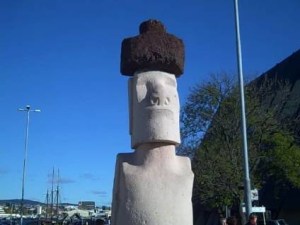
My Moai is bigger than yours - outside the Kon-Tiki Museum in Olso

My Moai is bigger than yours - outside the Kon-Tiki Museum in Oslo

While Thor was gadding about on tropical islands the rest of the world looked on in amazement and responded in the only way possible: by wearing Hawaiian shirts, forming surf rock bands and opening Tiki themed bars serving exotic fruit based cocktails.

Heyerdahl's Easter Island magnum opus

Heyerdahl's Easter Island magnum opus

In time, this craze passed and the eyes of the world moved on. But there is a corner of Oslo that is forever Tiki: the Aku Aku Tiki Bar at Thorvald Meyers Gate 32 in the happening neighbourhood of Grunerlokka. Not being a big drinker is usually a fatal impediment to enjoying a bar but not on this occasion. Tropical juice cocktail in hand, I sheltered from a chilly Autumn afternoon admiring the Moai motifs, hula sounds on the jukebox and puffer-fish lampshades. Aku Aku refers to a kind of spiritual intelligence, which you will acquire if you drink enough of their Volcano Bowl cocktails. The joint jumps to a 1950s luau beat by evening.

Oslo's awesome Aku Aku Bar: Polynesian paradise

Oslo's awesome Aku Aku Bar: Polynesian paradise

A visit here is the perfect accompaniment to visiting the essential Kon-Tiki Museum on the beautiful Bydgoy Peninsula. Between them, they offer a delightfully bonkers taste of the south Pacific Ocean in neat and tidy Oslo. Other cities take note: the world needs more Tiki bars.

Secret London: a day out at the museum depot

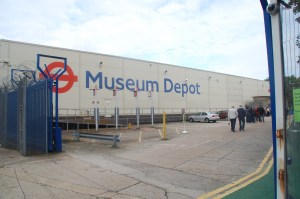
Family Hall – three train buffs, one in training and one person too exhausted to argue – went on a long-awaited outing to the London Transport Museum’s Depot this weekend – and were not disappointed. The depot, located by Acton Town tube in deepest west London, holds everything that can’t be crammed into the main museum in Covent Garden. It’s only open to visitors twice a year, which meant there was not long to check out the 370,000 artefacts from three centuries of public transport in London. There was no time to waste, which is why it was ideal to arrive an hour early.

Big shot depot

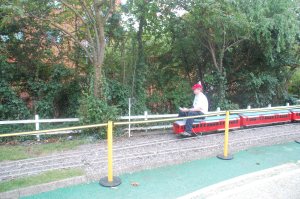
The fun begun before we even got in the front door with not one, but two miniature trains to ride on along the edge of the depot. One was a replica of an original Metropolitan Railway steam engine, the sort which used to belch smoke into tunnels from Paddington to Farringdon. The other was an electric model of what (to my untrained eye) appeared to be a Central Line train from years gone by. The drivers of these trains are serious, blue overall-wearing men. The children riding behind them are equally straight-faced, staring wide-eyed at the train, track and signal. Only the adults accompanying the very young let the side down, grinning from ear to ear.

Mini Metropolitan Railway steam engine

Mini Metropolitan Railway steam engine

Accompanying small tube train

Accompanying small tube train

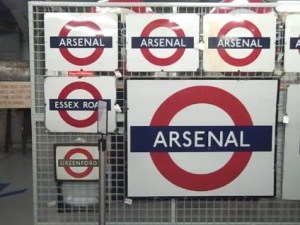
Inside, the Depot housed a fascinating collection of rolling stock from differing ages, and in varied states of preservation, repair or mothballing. As well as trains there were trams, buses and several magnificent avenues of signs, one corner of which was dedicated to Arsenal station roundels. Another wall held pre Harrry Beck tube maps and the odd stray station sign, which hinted at a time before London Transport’s design and branding was very strictly uniform.

Mind the gap, Gooners

Mind the gap, Gooners

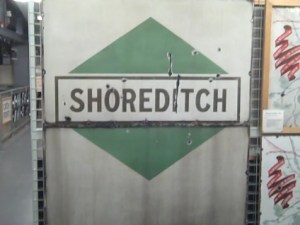
Rogue Shoreditch - no wonder they closed it (twice)

Rogue Shoreditch - no wonder they closed it (twice)

Some of the more curious objects inside took a little finding. In one corner was a grey metal cone, which on closer inspection was an air raid shelter for one, or maybe at a pinch two (presumably very friendly) London Transport employees. The other was so interesting it warrants its own post, so beyond putting the words Holloway Road Spiral Escalator in as a future link I shall say no more about it.

Air raid shelter for two

Air raid shelter for two

We left, a little giddy after too many doughnuts, and vowed to return for the spring model railway event.

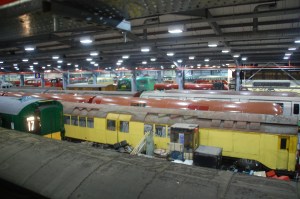
London Transport as far as the eye can see

London Transport as far as the eye can see

Not lost on the Tour d’Afrique

This article appeared in the Autumn 2009 edition of Traveller, and is reproduced with thanks.

Traveller magazine

Traveller magazine

Not lost on the Tour d’Afrique
Tom Hall

What started out as a regular day on a bicycle ride across a continent was suddenly not going according to plan. My speedo told me I was ten, maybe fifteen kilometres past where our bush camp was supposed to be that night. Something in my head told me to ignore my dwindling water and energy supplies, to not turn around and look for the tell-tale pink flagging tape and instead to press on for Maun, our destination the following day. You could call it a mad moment. Everybody else did.

This felt a long way from the water-cooler conversation at Lonely Planet HQ just under a year earlier. On a rainy London day three of us hatched a plan to join the Tour d’Afrique, the 8000 mile (12,000 kilometre) pedal-powered expedition which runs from Cairo to Cape Town every year. Around fifty riders cross nine borders and almost every conceivable terrain and climate (it doesn’t snow much) on the way. I was riding the penultimate stage, riding 1000 miles from Livingstone in Zambia to Windhoek, Namibia’s capital.

Reading the signs for once

Reading the signs for once

Riding I certainly was. Spurred on by a thrill of doing something probably quite stupid a long way from home, I went for it. It worked for a while. I was averaging 22mph (36kmh) which won’t give Lance Armstrong any headaches but was enough for me. But a double puncture when you’ve only got three spare tubes is no laughing matter. The next emergency was water. I needed a lot – it was 45c – and I didn’t have any. A roadside coke stop proved salvation and the man behind the cool-box got a hug and a sweaty handshake while I either drunk or bought his entire stock. He must’ve been pretty pleased as he took the next day off and no-one else saw him. Or perhaps he was a benevolent spirit sent to reward the intrepid and daft.

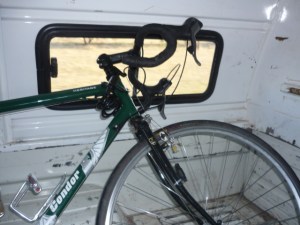
Twenty kilometres from the end of the ride and dreaming of a cold shower, the ‘pfft!’ of a third puncture left me with one option. After ten hours riding in the heat I was done in. I stuck my arm out and the first truck that passed stopped. How I loved that I was in Africa at that moment! Slightly confused, the driver gestured I should hop in, and phoned ahead to tell his mates he had a very soggy and hot white chap in his pickup. They formed a speechless welcoming party in Maun, silently shaking my hand before I wheeled my bike off towards the hotel.

Bike meets truck: sad end to gloriously silly day

Bike meets truck: sad end to gloriously silly day

The next day, reunited with my fellow cyclists, who found the whole thing hilarious, I was finally able to put some clean clothes on. My bags had done the sensible thing and stayed behind back at bush camp. I wasn’t allowed to forget that it was the travel hack who’d gone missing.* I now know three things: puncture repair kits are not optional, Botswana is a big, hot place and that if you turn a bike around it will still pedal.

*The only other rider who’d gone missing on the Tour was also from Lonely Planet.

Lundoniae maxime sanctus*

St Erkenwald, Bishop of London (d. 693) was quite a chap. His Wikipedia entry has the usual bumph: brother of Ethelburga, founder of Barking and Chertsey Abbeys, that kind of thing. For the real goodies though look to Peter Ackroyd’s indispensible London: The Biography.

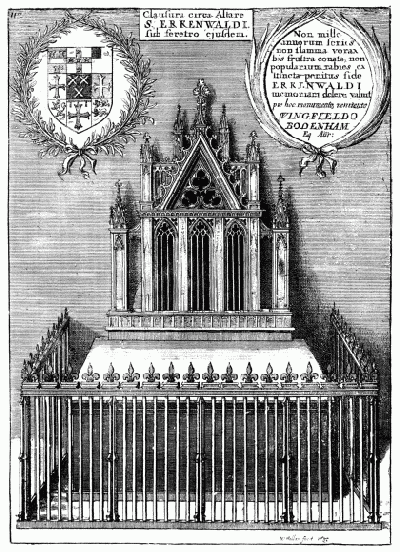
Erkenwald's shrine in old St Paul's (from Old St Paul's Cathedral by William Benham)

Erkenwald's shrine in old St Paul's (from Old St Paul's Cathedral by William Benham)

Erkenwald was Bishop of London for eighteen years and, enfeebled in his later years, he would ride around the streets of London in a litter (a wooden cart) which itself was credited with curative powers. Splinters and fragments of the cart were part of the medieval trade in saintly relics and icons. Together with Erkenwald, the cart was interred at St Paul’s Cathedral and he was the subject of a cult which ran as late as the sixteenth century. Ackroyd notes that ‘successful lawyers of London…on nomination as serjeants of law, would walk in procession to St Paul’s in order to venerate the physical presence of the saint.’ Most remarkably, when St Paul’s burnt in 1087 Erk’s shrine and silken covering remained intact.

Not much survives of Erkenwald. His shrine was swept away in Wren’s site-clearances before building the cathedral you see today. Eagle-eyes can find his name on the roll of Bishops of London in St Paul’s, an imaginatively-named Essex League Basketball team and this street in East Acton.

It’s high time for a London icon to resurface, 1300 years on.

*’the most holy figure in London

Two quick tube trip tips

Anti (or maybe pro) tube staff graffiti at Alexandra Palace

Anti (or maybe pro) tube staff graffiti at Alexandra Palace

A recent and surprisingly pleasant move from the long-loved trails of grot and canals of Camden Town to 020 8 land has prompted me, after several blissful years of bike-only commutes, to get on the tube now and again.

Our local tube station – in, gasp, zone 4- resembles a pre-Beeching branch line halt, freshly tended flowerbeds and all, but more on that later.

What has become immediately apparent is that everyone continues to be useless at travelling on the tube. London’s underground railway is the world’s oldest. Our Victorian forebears should have provided a user’s manual to go with their mighty achievement. It may, however, make the pocket map more of a dossier of handy tips. Two suggestions to include in the appendix:

There are signs requesting riders to stand on the right of escalators. They are polite. If one person ignores this then the whole thing grinds to a halt. Londoners then get to do what they do best: tut. It’s time polite signs were replaced with barking dogs, trained to attack those persisting with the ‘continental method’ of standing.

When I last lived in the burbs I was, for some of my time there, a small boy. Riding the Piccadilly Line into central London for football matches and other fun days out my father compelled my brother and I to surrender our seat to ladies and the old. This seldom happens now, yet little else makes you feel like a decent human being in a harsh world of savages more than hopping up at Finsbury Park to let someone else sit. Perhaps London Transport would consider a give up your seat day. Or just get those dogs in again, aimed at men in suits who refuse to embrace the swinging dongles.

This short rant is a cathartic exercise needed after a mere week of non rush-hour journeys. Heaven knows how commuters put up with it every day. Perhaps, to paraphrase Morrissey, we endure, because we must. You can however get a bike for less than 200 which will give you a smashing alternative.

Q&A with Shanghai newspaper

I was asked by the guys in Lonely Planet’s Melbourne office to answer a few questions for a Chinese newspaper. Some of them are slightly unusual questions, and as it’s not going to be published in English I thought I’d post a transcript of some of them here. Alternative answers are more than welcome.

If you won a $5000 air ticket, where would you go and what’s your itinerary?

If money was no object I’d start by filling in some blanks on my map of the Middle East  – Beirut, Damascus and Jerusalem. Then it’s Africa, first to Dakar in Senegal for nightclubbing, then on to Libreville in Gabon to see the surfing hippos of the Loango National Park. Then on to Namibia, somewhere I visited and long to return to for the desert scenery and wildlife. Things get simpler from there – to Hong Kong (probably via Dubai) to visit friends, then New Zealand’s South Island, to be specific trekking and sea kayaking in the Marlborough Sounds. I’d insist on coming home via Easter Island – which means a visit to French Polynesia to change planes, so let’s have a few days on Bora Bora while we’re there – Santiago in Chile, and New York City, because New York is the whole world in a small package.

If you could choose anyone on the earth to be your travel companion, who would it be?

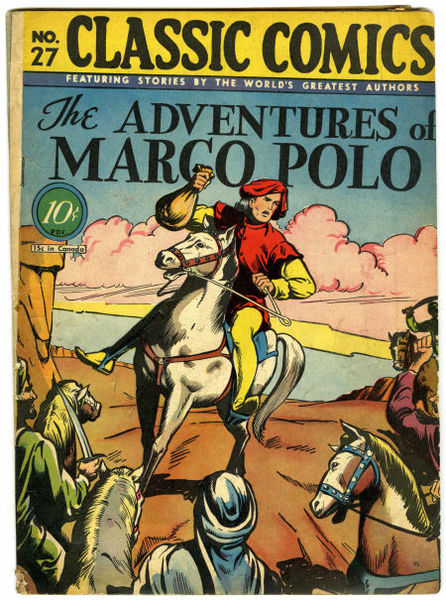
I love reading about Marco Polo and his journeys, so he would be first choice. If it has to be someone living I would choose Mark Beaumont, who holds the world record for fastest journey around the world by bicycle. If I could keep up with him I think we’d have a lot of fun.

Medieval Irish trailblazer Marc O'Polo

Medieval Irish trailblazer Marc O'Polo

If there were no trains, buses, airplanes, cars how would you prefer to travel (besides travel); camel, donkey, horse, spaceship, flying blanket or anything else?

It remains a source of disappointment that no-one tries to invent a flying carpet anymore. This proves society is going backwards. I also like the idea of seeing the world from a hovercraft which can go over land or sea.

Suppose you have a door which can lead you to anywhere you wish, which country would the door open to?

The door would open at dawn in Lalibela in the highlands of Ethiopia, where there some astonishing rock-carved churches. They’re unlike anywhere else on earth and I wish every day that I was there exploring them with only hermits and pilgrims for company.

What’s your favourite destination and why?

Paris, France is my favourite place. It is only two hours from my home by train and I am lucky to go there often, but I always find something new and beautiful to see. Often that beautiful thing is something I’m eating, which makes me even happier.

If you had an eight day vacation in October what would you do and where would you go?

I would go first to the English Lake District for some mountain climbing, then cycle north to visit the Isle of Skye off the west coast of Scotland, then take the sleeper train back home to London.

New blog post on Lonely Planet

What’s the best travel-themed music video?

Belgium’s brilliant coast

There is, not far from home, a North Sea coast that you never knew existed. Flanders’ narrow strip of beaches, dunes and villages is less than three hours from London and twelve minutes from the beaten paths of Bruges . And if you take the train, getting here won’t cost you a penny: simply hop on a train in Brussels , flash your Eurostar ticket and watch the easy-on-the-eye Flemish farmlands whizz by.

Belgium ’s coast runs for close to 45 miles, separating France in the south-west from the Netherlands to the north-east. This stretch of seaside, beloved by locals, is served by an almost unique mode of transport. The Kusttram (Coast Tram) is one of the world’s few inter-urban tram services, boldly going where other trams don’t even try.
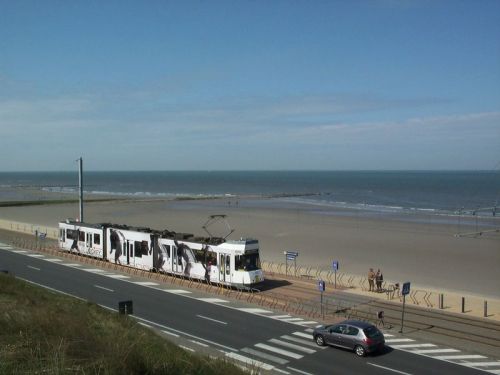
Belgium's unique coastal tram

Belgium's unique coastal tram

On its two hour journey the tram threads its way through every town and village on the coast, at times separated from the sea only by a thin strip of dunes, unlocking the secrets of the coast as it goes. Want to visit the worlds’ only remaining Napoleonic Fort or some mighty World War II gun emplacements and bunkers? Seeking out cycle paths, yacht havens or even (well-signed) nudist beaches? With a €5 day ticket securing unlimited travel, and with trams every fifteen minutes you can explore at will. Note however that clothes are not optional on the tram itself. And with the three main coastal towns – De Panne to the south, Ostend in the middle and Knokke in the north – all connected to Bruges , Ghent and Brussels by regular trains, getting here is a doddle.
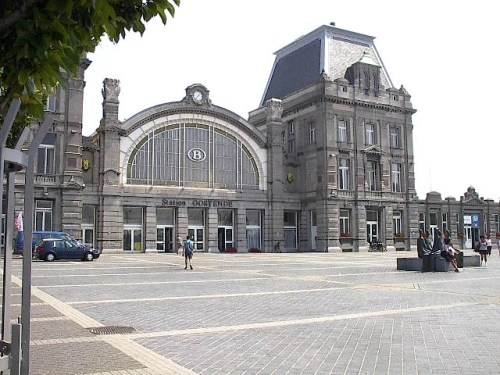
Oostende Station

Ostend Station

Ostend still feels like the seaside grandee and wears it well. The curvaceous art nouveau railway station was clearly designed as a great gateway to the continent and its position right next to the ferry terminal will delight those who remember the days when Calais Maritime was the launchpad for summers of European adventuring.   Ostend was for many years Belgium’s premier seaside resort – the beachfront Hotel Thermae Spa dates from this period and this palatial residence even has its own tram stop – and for many Briton’s was the gateway to northern Europe. And the town has bequeathed great art to the world – influential anglo-Belgian artist James Ensor lived here for over 30 years and his preserved house is one of several draws for art buffs in the town.

If you find yourself feeling amorous while you’re here, you’re not alone. It was while on an extended, head-clearing visit to Ostend in 1981 that Marvin Gaye composed Sexual Healing. Watching internet videos of him strolling the Albert I Promenade and belting out soul classics is a surreal and beautiful way to see some of Ostend from a generation ago.
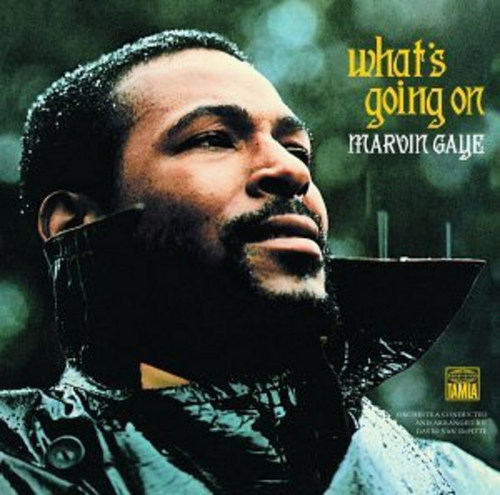
Did Marvin say 'What's Going On?' to passers by on Oostende's seafront promenade?

Did Marvin say 'What's Going On?' to passers by on Ostend's seafront promenade?

A stroll along the lively Promenade is a good place to start exploring, pausing at the quayside Fish Market for a fresh and fast plate of whatever’s come out of the sea that morning. But venture into town, too: the uninspiring apartments lining much of the seafront hide a lively town centre. Here you’ll find boutiques, bars and an artisan chocolatier selling hand-crafted chocolate whales, complete with smaller fish-shaped sweets trapped in its jaws. This being Belgium , it tastes better than it sounds. Though Ostend has few old buildings compared to inland Flemish cities, the unmissable Hotel du Parc has a sweeping art deco staircase leading to funky modern rooms. The attached bar, also harking back to roaring days, is the perfect place to while away a rainy day sampling the extensive beer menu.

But it’s the beaches here that will really grab you. Indeed, if you’re in any doubt that this would be a fun place to bring your family, a word about the sand you find on Ostend ’s town beaches and all along the Flanders ’ coast. This isn’t softie, pebbly stuff. This is real sand. Sand that sits shouts ‘make me into a sandcastle!’ as you walk past. Beach buffs take note: the spades on sale here wouldn’t look out of place on an allotment.

After this big and bold resort, De Haan comes as something of a shock, especially as I got off the tram too early and stumbled close to the Nudist Beach. Two stops on from naked Europeans, another, smaller art nouveau tram station welcomed me to what on first glance is Hampstead Garden Suburb-on-sea. Though Albert Einstein’s visit here in 1933 (he was heading to Germany but changed plans when Hitler came to power) is the town’s main claim to fame, its seaside, lined with upmarket cafes, timeless beach huts and golden sands suggests it may be the perfect summer holiday diversion. To top it off, there are boutique ice-cream parlours and a wonderful old-school toy shop.

The joy of the Belgian coast is that if – and I can’t see why you wouldn’t – Ostend and De Haan don’t grab you there’s plenty of other spots to try (see boxed text), all easy and cheap to get to. The Belgians love it, and with beer to drink and chocolate to eat, you will too. Just don’t be surprised if while digging a sandcastle or two you hear Marvin Gaye in your head.

~ Tom Hall

Tourism Flanders – Brussels (020 7307 7738; www.visitflanders.co.uk ) is the best place to plan a visit to the Belgian coast. Eurostar operates up to 10 daily services from London St Pancras International to Brussels with return fares from £59. Tickets are available from eurostar.com or 08705 186 186 and are valid for travel to any Belgian station. See www.dekusttram.be for route and fare details for the Coast Tram.

Five other Belgian coastal classics

Knokke-Heist – Belgium ’s swankiest seaside resort  is   a playground for the country’s jet-set during summer

Paul Delvaux Museum – This gallery is dedicated to one of Europe ’s greatest surrealist painters. It’s in St Idesbald – Koksijde, 40 minutes by tram from Ostend

Oostduinkerke
– Horse-riding local shrimpers go about their business in the traditional manner – the only place in the world where this still happens.

De Panne – the end of the tram line and a mecca for sand-sailing and windsurfing

Bredene – two and half miles of unspoilt sandy beaches and mighty dunes

Rambling through Oxfordshire

Saturday brought a family party in a quiet Oxfordshire village and a chance to explore just a little of this underrated county.

West of Oxford the villages are honey-coloured and the views come with the Cotswolds stamp of unmistakable Englishness. We tarried a while before home heading first to Swinbrook, every inch the perfect village, with a fine, understated church and a green with (what else) a game of cricket taking place. Bowlers spun lazy overs as the first leaves of Autumn swirled around the outfield.

Leaving the village we crossed the Windrush, a gently flowing tributary of the Thames and parked up in the hamlet of Widford. Widford barely exists, what village there was here was probably abandoned after the plague and never resettled, but at the end of a grassy track remained one thing very much worth seeing. St Oswald’s Church is the kind of treat you only find if you carry Simon Jenkins’ ‘England’s Thousand Best Churches’ in your glove compartment. This book has guided me to countless curiosities and works of architectural genius, the humbling work of unnamed ancestors hands.

St Oswald's, Widford from the banks of the Windrush

St Oswald’s is reached by strolling along a bridleway, with the Windrush below you. It sits in a field, walled off from a few cows and is a simple, sweet medieval church. With a satisfying clunk of the bolt we passed inside and sat for a while in box pews which have room for what would have been a few local families. During services they wouldn’t have been able to see each other.  There is a Roman mosaic beneath the floor here, evidence of far more ancient settlement, but a note pinned to the noticeboard tells you that previous visitors have helped themselves to too much of it and it has been covered up. In case you’re wondering, St Oswald was a seventh-century King of Northumbria.

St Oswald's churchyard

The afternoon was giving way to a cloudy late-summer’s evening and we padded back to the car, aimed for London and put Let’s Wrestle on at full volume.