Belgium’s brilliant coast

There is, not far from home, a North Sea coast that you never knew existed. Flanders’ narrow strip of beaches, dunes and villages is less than three hours from London and twelve minutes from the beaten paths of Bruges . And if you take the train, getting here won’t cost you a penny: simply hop on a train in Brussels , flash your Eurostar ticket and watch the easy-on-the-eye Flemish farmlands whizz by.

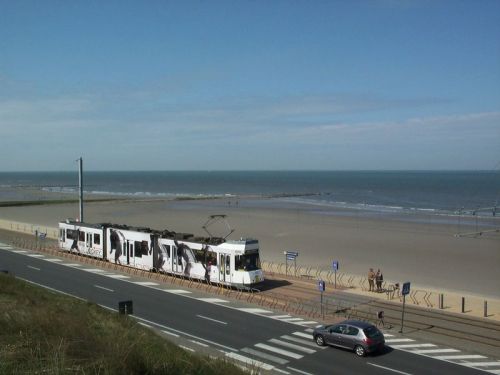
Belgium ’s coast runs for close to 45 miles, separating France in the south-west from the Netherlands to the north-east. This stretch of seaside, beloved by locals, is served by an almost unique mode of transport. The Kusttram (Coast Tram) is one of the world’s few inter-urban tram services, boldly going where other trams don’t even try.

Belgium's unique coastal tram

Belgium's unique coastal tram

On its two hour journey the tram threads its way through every town and village on the coast, at times separated from the sea only by a thin strip of dunes, unlocking the secrets of the coast as it goes. Want to visit the worlds’ only remaining Napoleonic Fort or some mighty World War II gun emplacements and bunkers? Seeking out cycle paths, yacht havens or even (well-signed) nudist beaches? With a €5 day ticket securing unlimited travel, and with trams every fifteen minutes you can explore at will. Note however that clothes are not optional on the tram itself. And with the three main coastal towns – De Panne to the south, Ostend in the middle and Knokke in the north – all connected to Bruges , Ghent and Brussels by regular trains, getting here is a doddle.

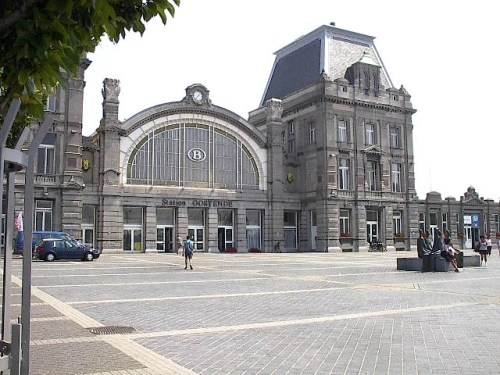
Oostende Station

Ostend Station

Ostend still feels like the seaside grandee and wears it well. The curvaceous art nouveau railway station was clearly designed as a great gateway to the continent and its position right next to the ferry terminal will delight those who remember the days when Calais Maritime was the launchpad for summers of European adventuring.   Ostend was for many years Belgium’s premier seaside resort – the beachfront Hotel Thermae Spa dates from this period and this palatial residence even has its own tram stop – and for many Briton’s was the gateway to northern Europe. And the town has bequeathed great art to the world – influential anglo-Belgian artist James Ensor lived here for over 30 years and his preserved house is one of several draws for art buffs in the town.

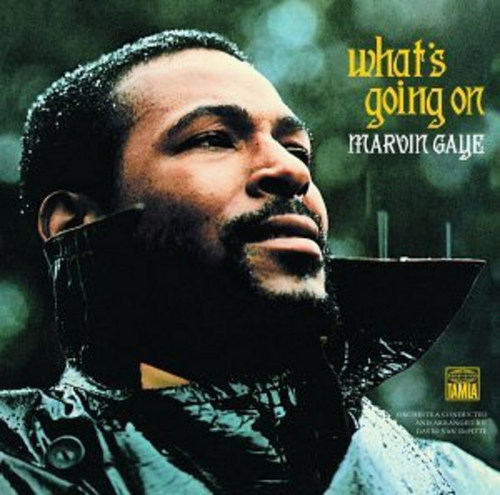
If you find yourself feeling amorous while you’re here, you’re not alone. It was while on an extended, head-clearing visit to Ostend in 1981 that Marvin Gaye composed Sexual Healing. Watching internet videos of him strolling the Albert I Promenade and belting out soul classics is a surreal and beautiful way to see some of Ostend from a generation ago.

Did Marvin say 'What's Going On?' to passers by on Oostende's seafront promenade?

Did Marvin say 'What's Going On?' to passers by on Ostend's seafront promenade?

A stroll along the lively Promenade is a good place to start exploring, pausing at the quayside Fish Market for a fresh and fast plate of whatever’s come out of the sea that morning. But venture into town, too: the uninspiring apartments lining much of the seafront hide a lively town centre. Here you’ll find boutiques, bars and an artisan chocolatier selling hand-crafted chocolate whales, complete with smaller fish-shaped sweets trapped in its jaws. This being Belgium , it tastes better than it sounds. Though Ostend has few old buildings compared to inland Flemish cities, the unmissable Hotel du Parc has a sweeping art deco staircase leading to funky modern rooms. The attached bar, also harking back to roaring days, is the perfect place to while away a rainy day sampling the extensive beer menu.

But it’s the beaches here that will really grab you. Indeed, if you’re in any doubt that this would be a fun place to bring your family, a word about the sand you find on Ostend ’s town beaches and all along the Flanders ’ coast. This isn’t softie, pebbly stuff. This is real sand. Sand that sits shouts ‘make me into a sandcastle!’ as you walk past. Beach buffs take note: the spades on sale here wouldn’t look out of place on an allotment.

After this big and bold resort, De Haan comes as something of a shock, especially as I got off the tram too early and stumbled close to the Nudist Beach. Two stops on from naked Europeans, another, smaller art nouveau tram station welcomed me to what on first glance is Hampstead Garden Suburb-on-sea. Though Albert Einstein’s visit here in 1933 (he was heading to Germany but changed plans when Hitler came to power) is the town’s main claim to fame, its seaside, lined with upmarket cafes, timeless beach huts and golden sands suggests it may be the perfect summer holiday diversion. To top it off, there are boutique ice-cream parlours and a wonderful old-school toy shop.

The joy of the Belgian coast is that if – and I can’t see why you wouldn’t – Ostend and De Haan don’t grab you there’s plenty of other spots to try (see boxed text), all easy and cheap to get to. The Belgians love it, and with beer to drink and chocolate to eat, you will too. Just don’t be surprised if while digging a sandcastle or two you hear Marvin Gaye in your head.

~ Tom Hall

Tourism Flanders – Brussels (020 7307 7738; www.visitflanders.co.uk ) is the best place to plan a visit to the Belgian coast. Eurostar operates up to 10 daily services from London St Pancras International to Brussels with return fares from £59. Tickets are available from eurostar.com or 08705 186 186 and are valid for travel to any Belgian station. See www.dekusttram.be for route and fare details for the Coast Tram.

Five other Belgian coastal classics

Knokke-Heist – Belgium ’s swankiest seaside resort  is   a playground for the country’s jet-set during summer

Paul Delvaux Museum – This gallery is dedicated to one of Europe ’s greatest surrealist painters. It’s in St Idesbald – Koksijde, 40 minutes by tram from Ostend

Oostduinkerke
– Horse-riding local shrimpers go about their business in the traditional manner – the only place in the world where this still happens.

De Panne – the end of the tram line and a mecca for sand-sailing and windsurfing

Bredene – two and half miles of unspoilt sandy beaches and mighty dunes

Rambling through Oxfordshire

Saturday brought a family party in a quiet Oxfordshire village and a chance to explore just a little of this underrated county.

West of Oxford the villages are honey-coloured and the views come with the Cotswolds stamp of unmistakable Englishness. We tarried a while before home heading first to Swinbrook, every inch the perfect village, with a fine, understated church and a green with (what else) a game of cricket taking place. Bowlers spun lazy overs as the first leaves of Autumn swirled around the outfield.

Leaving the village we crossed the Windrush, a gently flowing tributary of the Thames and parked up in the hamlet of Widford. Widford barely exists, what village there was here was probably abandoned after the plague and never resettled, but at the end of a grassy track remained one thing very much worth seeing. St Oswald’s Church is the kind of treat you only find if you carry Simon Jenkins’ ‘England’s Thousand Best Churches’ in your glove compartment. This book has guided me to countless curiosities and works of architectural genius, the humbling work of unnamed ancestors hands.

St Oswald's, Widford from the banks of the Windrush

St Oswald’s is reached by strolling along a bridleway, with the Windrush below you. It sits in a field, walled off from a few cows and is a simple, sweet medieval church. With a satisfying clunk of the bolt we passed inside and sat for a while in box pews which have room for what would have been a few local families. During services they wouldn’t have been able to see each other.  There is a Roman mosaic beneath the floor here, evidence of far more ancient settlement, but a note pinned to the noticeboard tells you that previous visitors have helped themselves to too much of it and it has been covered up. In case you’re wondering, St Oswald was a seventh-century King of Northumbria.

St Oswald's churchyard

The afternoon was giving way to a cloudy late-summer’s evening and we padded back to the car, aimed for London and put Let’s Wrestle on at full volume.

Recent Lonely Planet blog posts

Beyond the City – unmissable trips out of town, originally published September 2

Alcoholiday, about Brits drinking abroad, orginally published August 25

– Tom

A slice of Danish

This article originally appeared in the London Evening Standard, 10.05.2009.

A slice of Danish
Tom Hall
10.05.2009

It can take a while to find Aarhus on the map, and longer still to work out how to pronounce the name of Denmark‘s second-largest city (it sounds like Arrhoos, by the way).

Aarhus cityscape

Aarhus cityscape

Copenhagen‘s handsome little sister hides away on the east coast of Jutland, in a sheltered bay that belies its important historical role. Once here, you understand why the Danes keep it to themselves.

With a similar easy-going charm to the Danish capital, Aarhus is rapidly emerging as an artistic and architectural hotspot, complete with vibrant neighbourhoods full of stylish cafés and shops.

To get the hang of Aarhus it’s helpful to adopt a Danish mindset. The first thing you need is a bike. That’s no problem.

There are 450 tough-looking clunkers available on payment of a 20 kroner (£2.40) deposit. And unlike some European cities, they’re where they’re supposed to be. Aarhus isn’t hard to get around on foot but everyone else is on a bike so you may as well join in.

A short pedal from the station and distinctive Forties town hall (visit on the daily guided tour) is Aarhus’s most attention-grabbing attraction. ARoS is one of northern Europe’s finest art spaces, an enormous red-brick cube built in 2004 by (you guessed it) a Danish design team. Inside, nine floors of modern and traditional art are linked by spiralling staircases and curving, snow-white walls.

ARoS sets the tone for the city: fresh and funky, with a nod to both tradition and the world beyond Aarhus. Its bright and dazzling interior seems to be inspired by the austere interior of the city’s Domkirke, whose stunning frescos have been revealed after centuries behind Reformation era whitewash.

ARoS

ARoS

Most cycles, however, end up being deposited next to outside tables in cafés and bars at the first hint of sun. Trying to blend in, I did the same.

The Aarhus Å (which means creek in Danish) is lined with al fresco options but for cutting-edge turn the other way from the station and head to the trendy Frederiksberg area, in particular the oldmeets-new bars and restaurants on Jægergårdsgade. Aarhus excels at modern Scandinavian cooking at Malling & Schmidt’s much-heralded restaurant in Frederiksberg.

All over town brewhouses can be found. They make and serve everything from lager to IPA to wheat beers, as well as cooking up excellent-value pub grub.

The Latin Quarter and narrow cobbled streets south of the creek are lined with independent small shops — fashion and design are specialities, plus a huge number of superb children’s boutiques.

And with the Danish kroner offering better value than the euro these days, Aarhus is a great destination for this summer.

That bike did come in handy again on day two when I shook off a fuzzy head with a ride through eye-poppingly lovely woodland. Fifteen minutes after leaving my hotel I had come to Moesgård.

The main reason to come here is to peep at the 2,000-year-old Grabaulle Man who, after millennia preserved in peat, doesn’t look bad for his age despite what appears to have been a painful death.

The bold can take advantage of some of the best sandy beaches in Scandinavia.

I did — and reckon that between June and August the water’s just about perfect. In fact, there are lovely beaches up and down Jutland’s coast, especially around Ebeltoft and Grenaa to the north-east of the city, that are perfect for families.

Every Dane has their own favourite spot, though — just lean over and ask the couple at the next table and you’ll get some great suggestions. Over on the west coast are some of Europe’s finest surfing and windsurfing spots.

But further exploration can wait for another visit. Denmark beyond Copenhagen is an undiscovered European frontier — and it’s cheaper and quicker to get to from London by air than Manchester or Leeds on a train.

WAY TO GO THE FLIGHT
Ryanair flies from Stansted, returns from £13, http://www.ryanair.com

THE HOTEL
Hotel Guldsmeden (www.hotelguldsmeden.dk) has doubles from £119 B& B, http://www.visitaarhus.com.

THE CULTURE ARoS
(Aros Alle 2, http://www.aros.dk). The Aarhus festival, 28 August to 6 September, is the largest cultural event in Scandinavia, http://www.aarhusfestuge.dk.

THE RESTAURANT
Malling & Schmidt (Jaegergardsgade 81, http://www.mallingschmidt.dk).

www.visitaarhus.com

Football fan’s guide to Glasgow

Glasgow is a happy playground for the historically-aware football fan.

It was, therefore, with great excitement that I headed north from Euston for Arsenal’s Champions League qualifier with Celtic. The match that evening was a great excuse to come to somewhere I’d never been, but I was also hoping to spend a few hours exploring a few sights I’d long dreamed of seeing.

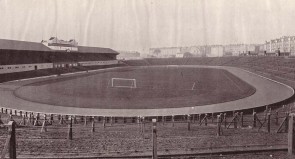
Mount Florida station is in a well-to-so suburb south of the Clyde, but has been for generations a step on the march to Hampden Park. Scotland’s national stadium may have been hosting a U2 concert that night, but I had different reasons for visiting. For many years Hampden was the largest football stadium in the world, a place where gates of 100,000 weren’t just the norm, they were considered disappointing. The ground crammed in 149,415 for a Scotland vs England match in 1937, but as late as 1970 it 136,505 piled onto Hampden’s mighty terraces for a Celtic Vs Leeds United European Cup Semi-Final. Together with then-mammoth Ibrox Park and Celtic’s Parkhead, Glasgow could in 1920 boast three stadiums capable of holding 90,000 spectators. No other city in the world has ever been able to make this claim. It happened at Hampden first: turnstiles, a press box and all-ticket matches.

Hampden Park in 1922

Hampden Park in 1922

Hampden Park today

Hampden Park today

These days Hampden holds a more modest 52, 103 and has long been all-seater. Outside it’s mighty walls sit the offices of Queens Park FC, a titan of Scottish football history. The Spiders, who basically invented football in Scotland and taught the English how to play their own game, remain the only truly amateur side playing senior football anywhere in Europe. They may languish today in the Third Division and scrap away in front of a few hundred fans, but Hampden is still where their home fixtures are played. In 1930 they hosted Rangers, the match attracting 95,722.  Elsewhere in that first round of the Scottish Cup a mere 150 pitched up to see Civil Service South vs Clachnacuddin, generating the mighty sum of four pounds at the gate.

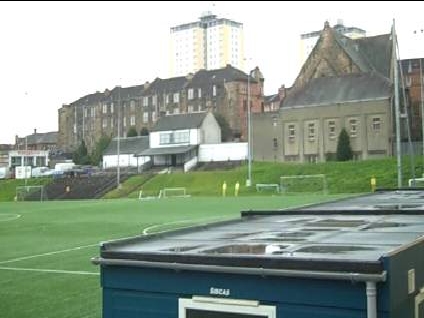
Queens Park’s offices were open and after having picked up a shirt and other QPFC goodies I was led into the depths of their prefabricated huts onto the all-weather training pitch at Lesser Hampden where their reserves and Junior sides play. Standing sentinel over this pitch is what is believed to be the world’s oldest football stand. This converted farmhouse has a double life as a pavilion and minibus park and dates back to the early nineteenth century. Sadly this is what remains of old Hampden: the giant banks of terracing are a thing of the past.

The world's oldest football stand at Lesser Hampden

The world's oldest football stand at Lesser Hampden

I didn’t have to wait long to find some terraces. A short walk away is unassuming Cathkin Park, the sort of place where men walk dogs in mid-afternoon. Cathkin has two reasons for significance. It was the site of an earlier Hampden Park, and on Queens vacating it’s genteel slopes for today’s site was taken over by Third Lanark FC. One of the mythical names of Scottish football, Thirds were three times League Champions and twice Scottish FA Cup winners. The good times infamously did not last: the Hi Hi (a nickname coming from the club’s best known chant) were wound up in April 1967 amid shady business practices.

I shot some video at Cathkin Park.

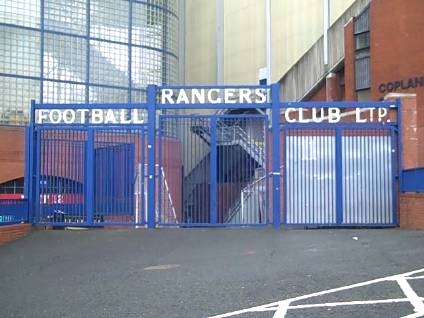
From here I took the train back into Glasgow Central, and walked up to Buchanan Street for a ride on the ‘Clockwork Orange’, as Glasgow’s underground railway is known. The service is the world’s third oldest subway and took me in around fifteen minutes to Ibrox Park, home of Glasgow Rangers. This stadium too is much changed from its original oval shape, and would be an unremarkable if imposing modern stadium if not for one thing. The Bill Struth Main Stand, recently renamed after their legendary manager, is the crowning glory of Archibald Leitch’s huge contribution to British football stadium architecture. Immense in form and ambition and richly symbolic of Ranger’s pre-eminence across Glasgow and the Scottish game in the 1930s, it is also the only rival I have seen to Arsenal’s East Stand. After pushing open an ornate door and hanging around after looking slightly lost for a while a friendly receptionist took me out to see the pitch. It was interesting also to note that Paul Gascoigne is one of the few names inscribed on the Rangers Hall of Fame board Back outside, Ibrox is not the most charming of neighbourhoods, so it was back onthe train into town.

Ibrox Park

Ibrox Park

Parkhead

Celtic Park

Evening brought a stroll up Gallowgate past countless Celtic bars, several of which had bands in full swing three hours before kick-off. Celtic Park, or Parkhead after the East End district it is found in felt reminiscent of Old Trafford from the outside and in. The match has been covered elsewhere, but after a lot of noise from our hosts – and a lot of fun in the away end – it was back to Glasgow Central and on to the sleeper to Euston. There is much still to see in Glasgow. I didn’t make it to Firhill, home of Partick Thistle. Bono’s arrival put the bosh on visiting the Scottish Football Museum and touring Hampden. Nor did I do any of the traditional must-sees in Glasgow. A return visit is in order: Rangers must deliver in the Champions League.

For more on Glasgow try here.

Return to Highbury

Saturday was an exciting day.

A friend invited us to his flat in the old East Stand at Arsenal Stadium (better known as the Gunners’ former home on Avenell Road, Highbury) for a drink and a stroll around the old place. In fact, being a man of impeccable taste he’d snaffled up the flat located exactly where we’d all sat for many years, just south of the halfway line, behind the away team’s greenhouse.

There’s still no place like home.

East Stand, Highbury

The Highbury Square development is largely complete, but there are obviously quite a few flats either unsold or not yet occupied. Those who are in there should count themselves lucky. The stadium is a unique development, with the classic East and West Stand facades retained and those in the East accessing thri flats by walking in through the Marble Hall. Herbert Chapman may have been moved from his plinth but the cannon and art deco crest remain in the floor, just like you remember it.

Best of all though is the communal garden, or the pitch as it was once known. OK, so it’s no longer got the touchline markings, but there’s no mistaking where you are once you walk out on it. Ghosts are out there with you enjoying a kickabout. Herb himself is doubtless looking down approvingly on such innovation.

Pictures to follow.

– Tom

Articles you may have missed

Here are a couple of articles posted on the Lonely Planet website that you may have missed.

Jump the queue! – Unmissable sights in Europe you can book in advance. Originally published June 12.

Europe’s ten finest train stations, originally published August 11.

More to follow.

– Tom

Blog posts you may have missed

Abbey Road crossing

Here are a few posts I’ve made this summer on the Lonely Planet blog that you may have missed.

Get to the World Cup for less, originally posted August 19

Return to Abbey Road, originally postedAugust 10

That’s not a doggy bag (on airline food), originally posted August 5

Kingston, Jamaica revisited, originally posted July 24

Swine flu = no holiday?, originally posted July 20

Articles to follow in a seperate post.

– Tom

The start

Start

I’ve been writing for a long time, for Lonely Planet, the Observer, TNT, the Irish Independent and others.

This is an attempt to have a place where most things I do are collected together. And also to have somewhere to surface things that might not have another obvious home.

Comments are more than welcome.

Tom