Category Archives: Uncategorized

Arsenal 1990-91: the almost invincibles (part II)

This article first appeared in issue 215 of the Gooner. It looks better in print and you can find it here. The first part of this article was posted earlier this year on this blog here. If you don’t read that first, this one won’t make much sense!

As Autumn turned to winter a season of immense promise threatened to derail. We hadn’t lost a match, but lost ground in mid-November, when the FA, who were embarrassed by the Manchester United punch-up being broadcast around the world if not in England, docked Arsenal two points. We had, they argued, previous charges after a scrap against Norwich City the previous season. United, unbelievably at the time, lost only one point. The sense of injustice was huge, and the galvanising effect immediate. Everyone connected with Arsenal was convinced it was a conspiracy and at the next home game Southampton were routed 4-0. The next week Arsenal were behind again at Loftus Road heading into the last quarter of the game, before three late goals sent us all packed into that vile, poky away end into raptures. Our captain marked that win by reminding QPR fans how many bob their club and stadium was. Kevin Campbell was busy scaring the life out of defences.

The drama kept coming. In the League Cup Manchester United turned up at Highbury in their blue and white chicken suit shirts. If our goal led a charmed life in the league at Old Trafford, in this match every time United shot, they scored. Lee Sharpe in particular was rampant. At the time he was one of England’s brightest young prospects and he arguably made the greatest back five in our history look more ordinary than any other player in any other match that night. Even Danny Wallace got one, after we’d pulled two back and at one stage looked like we were going to get back into the game.

As agonising as the United reverse felt, Liverpool were the real enemy and our home match that Sunday was the biggest game of the season so far. 3-0 to us.  Listen up everyone, this result seemed to be saying: we were going to be top dogs this season. The numbers looked good. Still no defeats. Points deduction starting to look irrelevant. Two fingers in the air. What are you going to throw at us next?

The answer came quickly, and it came as a big shock. Tony Adams was sent to prison on 19 December 1990 for drink driving offences, four days after captaining Arsenal during a disappointing 2-2 home draw against Wimbledon. It was six days before Christmas and the courts were keen to send out a strong message.  No arguments with that. Unfortunately it cost us our captain. Years later, however, no well-known name has been sent to prison for a similar drunk-driving offence. Years later, no other team has had even one point docked for on-pitch fighting. See why we thought everyone was against us?

Adams’ plight presented fans with an ethical dilemma, but whatever the rights and wrongs of publicly idolising a man serving time in Chelmsford Prison, we stuck by Tony. ‘We’ve lost our Tony Adams’ to the tune of ‘You’ve lost that loving that loving feeling’ was a winter anthem.  The team responded with three straight wins. Andy Linighan was thrown into the team next to Steve Bould.

Considering the praise rightly lavished on the Invincibles team I still find it remarkable that this Arsenal side does not get more credit for nearly managing the same achievement 13 years before in far more trying circumstances. The unbeaten run lasted through January and fell at what was then the most rancid cesspit in the league, Stamford Bridge. Their ground today is a world away from what it was pre-Taylor Report. The away end was, like the Shed at the other end, thirty yards from the pitch. It had no roof and state of the art amenities: for 1905. Which was the last time someone had changed a lightbulb in the place. As if losing to them wasn’t bad enough, and seeing the small knot of idiots who used to congregate in the lower paddock of the West Stand  as close as they could get to the away fans – still fifty yards away – dance about like demented apes, we then had to wait for an age in the fading gloom of a wintry west London night to be let out. The queue for Fulham Broadway station was still an hour, even after all that.

Stamford Bridge looking its best, anytime from 1905 to 1992

But things were looking up and Arsenal were not to lose again in the league. Adams emerged from prison and, after a reserve run out attended by 8,000 supporters the same day as we finally saw off Leeds in the FA Cup fourth round replay, was back as captain for the return fixture against Liverpool. We headed up to Anfield for a very tasty away game on a crisp March afternoon. Stanley Park was warmed by early Spring sunshine and Arsenal’s away support was mildly mivved at being moved into the opposite corner of the Anfield Road end from the one we’d occupied in 1989. No matter, we were not messing around. Seaman made two magnificent saves from John Barnes, the media darling and perpetual man of the match. Then in the second half Paul Merson intercepted a wayward wobble from Peter Beardsley, advanced into the Liverpool half, swapped passes with Alan Smith and rolled it past Grobellaar. Behind the goal we sucked the ball into the net. It took and age to go in. When it did, it was party time. It felt at the time like we’d won the title and nothing could take it away.

A solid series of wins and draws in March and April, including a 5-0 win over Aston Villa with David Platt taking over in goal at the end, and solid progress in the FA Cup once we’d got rid of Leeds after three replays had us dreaming of the double. You might want to look away now. We lost the first all north London FA Cup Semi Final at Wembley on April 14. I’m sure you know all you want to about that dark day. Before that semi-finals weren’t held at Wembley. Now we’re stuck with it.  Another legacy of that unhappy day. Let’s move on.

Kenny Dalglish’s heart wasn’t in managing Liverpool after Hillsborough, and though he made it throught the 1989-90 season on auto-pilot he had no stomach to take on George Graham’s ruthless pursuit of his sides title and he quit. Graeme Souness, the first but not the last Manager to win everything in Scotland and fail miserably in England, arrived to succeed him but there was no stopping the Arsenal juggernaut.

Four games after losing to Spurs, and a few days after that rainy trip to Sunderland we were champions. In fact, it happened without a ball being kicked. Liverpool’s loss to Nottingham Forest meant we couldn’t be caught and the return game against Manchester United became a procession, albeit one livened up by the return of the big red ‘Champions’ banner and the sight of Robson, Bruce and the rest of Ferguson’s drinking club applauding us onto the pitch.

If there was any hangover, and there surely was, then the players didn’t show it the following sunny Saturday against Coventry City, when an Anders Limpar hat-trick and another whack from Perry Groves brought the house down.

A 6-1 win in front of 41,039 was the perfect way to end the season. There were dark clouds that day – the launch of the bond scheme and the plan to make Highbury all-seater – but they couldn’t detract from a season of rich achievement, one of the greatest ever and certainly one of the most eventful.  In the league our final stats read played 38, won 24, drew 13, lost one, goals for 74, goals against a miserly 18, and 83 points with a big fat asterisk next to it marking the two deducted points.  Twenty years on there are lessons from the class of 1991 in guts, character, determination and the fine and hopefully not quite lost art of Arsenal defending.

Thanks to all the excellent people on YouTube who thoughtfully uploaded videos of this season.

Random brawls in medieval London

A History of London Life by R J Mitchell and M D R Leys is a lost classic of London historical writing, dating from 1963. It takes the reader on an admirable journey through the history of the city at street level, looking at Londoners and their lives through the ages. You can find it on abebooks. I am indebted to friends who picked up a copy for me in upstate New York, a long way from home but couriered with great thought and care.

Passages feel like a forerunner to the way that Ackroyd and Sinclair seem to effortlessly pull out breathtakingly obscure documents of London history. One of the best examples of this is a passage taken from the Londoners’ Pasttimes chapter, detailing a thirteenth century scrap that evidently got well out of hand:

Teams of Londoners played games among themselves and also against the neighbouring suburbs; in the summer of 1222 a wrestling match with the youths of Westminster had a disastrous sequel. The city men won, and a return match was fixed for a week later, but this time the Steward of the Abbey armed the home side so that the Westminster men set about the Londoners and caused many casualties. The irate Londoners went home to gather strength and, ignoring the advice of the Mayor, rushed to Westminster and pulled down the Steward’s house. When the Abbot came to complain they seized his horses, beat his manservants and stoned him out of the city.

The Abbot in question, if the dates are right, is either William de Humez or Richard de Berkyng (of Barking), most likely the former as Richard did not take his position until October. The High Steward of Westminster Abbey today is a ceremonial position held since June by Tory peer Lord Luce.

And what of the over-exuberant boys of the City, and of Westminster? Well, chances are they weren’t roughed up by their wrestling, which seems to have been an exercise in endurance grappling rather than the Giant Haystacks kind of wrestling we may think of today. That might also explain why the Londoners had enough about them to pull someone’s house down after a bout.

It might be worth considering next time you stroll down the Strand that both parties – and the aggrieved Abbot – would have stomped their way down the same route which was then a little more than a rural track.

In 1222 John III Doukas Vatatzes was crowned Emperor of Byzantium, the European discovery of America was still over 200 years away and Henry III was King of England. And in a small, thriving city a bunch of blokes had a good old scrap which got quite out of hand.

Olympic London: slalom canoe course, Waltham Cross

‘Lean left! Left! Hard left!’ shouted our guide. Our raft, it seemed, had other ideas, and in a flash the boat had flipped and I was plunging through rapids. Just dodging some sharp-looking rocks and body-surfing a raging torrent I found my footing and dragged myself to the side. I’d swallowed about half the river but was laughing hard. It was the absurdity that got me. I wasn’t on the Zambezi at Victoria Falls, or New Zealand’s Karawau River, but in Waltham Cross, right in the middle of London’s commuter belt. And it is here that the Canoe Slalom events for the 2012 Olympic Games will be held. Best of all, it’s one of the few Olympic venues mere mortals like you and I can have a go in, too.

King Canoe: the Olympic course

Located north of London proper, the Lee (or Lea, no-one’s really sure) Valley doesn’t tend to attract too many tourists. A trickle may come to admire the nearby town of Waltham Cross’ Eleanor Cross, one of three surviving from the original twelve monuments erected by Edward I along the funeral procession of his Queen in 1291. Otherwise there’s just leafy, green scenery around the waterways of Hertfordshire to stroll around, popular with families, runners and dog-walkers.

The newly opened Lee Valley White Water Centre looks set to change all that. It’s easy to reach – journey time is 40 minutes by train from London’s Liverpool Street station. The first and only Olympic venue to open before the games, and home to the Great Britain Canoe Slalom team, it is as visually striking as it is thrilling to ride. The Olympic course runs for 300m and has a 5.5m descent over the length of the route. I was excited to have the chance to have a go.

The author meets Wenlock (left) and Mandeville, London 2012 mascots, pre-dunking

Before the soaking, the briefing. There were to be eight of us in a raft, and each was given a wetsuit, that most flattering of garments, and a full safety briefing. Then, after an initial dunking masquerading as a man overboard-type drill we paddled into position onto the ramp up to the head of the course. This felt a little like the start of a rollercoaster, and we were soon off, flying through rapids and, as you might expect, getting utterly drenched.

After one run I was thinking future ones could feel samey, but one of my team decided to liven things up by leaning the wrong way at a crucial moment, sending us all tipping out of the boat. After that four of our team decided they’d had enough, leaving the rest of us on the final two runs to surf, scoot and crash around the course. At one point the British rafting team, testing the course out, also went flying, which made us all feel reasonably hardcore.

If London is short on one thing, it’s a waterpark with slides and chutes. You won’t find that here, but it’s definitely the most fun you can have in a wetsuit close to the capital. Best of all, you’ll be smashing through waves made by 2012’s Olympic heroes.

Lee Valley White Water Centre is now open to the public. Advance bookings are necessary. A raft adventure lasts around two hours, including getting kitted out with a wetsuit, buoyancy jacket and helmet, a safety briefing and four runs on the Olympic course. www.gowhitewater.co.uk

Here are some shots of the Eleanor Cross:

Waltham Cross' Eleanor Cross

Brompton meets Eleanor

London Swimming Review: Serpentine Lido

For a city with a generally unimpressive number of indoor swimming pools, London makes up for it with plenty of more surprising options for a quick dip.

Swimmers ready for the plunge at Serpentine Lido

I’ve written warmly (don’t let that word confuse you about the temperature) before about Highgate Ponds, with separate men’s, women’s and mixed bathing ponds. The latter is ideal for those of mixed sex. Nearby Parliament Hill Lido makes for a lovely alternative, and there are other marvellous outdoor lidos at Brockwell Park, Tooting, London Fields and Hampton. The last two are let down a little by being heated.

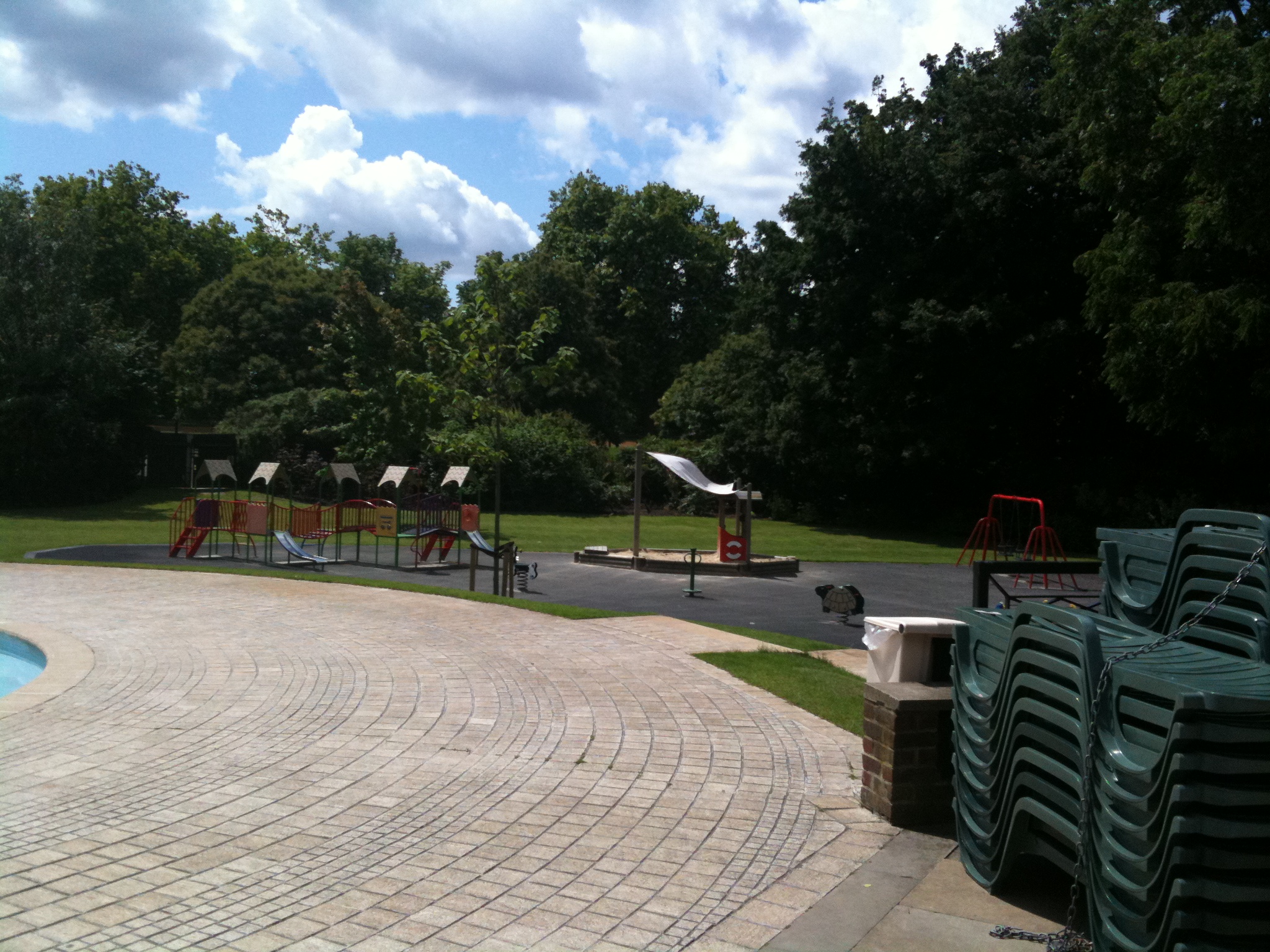
Paddling pool...

...and children's play area

Until this week, however, I hadn’t tried the most central of the lot. The Serpentine Lido, right in the centre of Hyde Park, promised a dip in untreated water in the heart of London. The Serpentine is a large man-made lake created in 1730 by the waters of the River Westbourne but now fed by the Thames. It’s a haven for bird life and is the sort of lake which you’d normally hire a boat to row on a summer’s day. Unusually there’s swimming here, and has been since 1930.

View across the Lido from the bridge. Yes, you really are in central London...

Unlike Highgate Ponds, which offer a wonderful and deliberately spartan experience, there’s plenty here to make you feel like your £4 entrance fee is well spent. There are changing rooms, lockers (20p, refundable) and, once you get upstairs, a large lawn, paddling pool and playing area for kids. Nippers catered for, swimmers cross a bridge over the path – attracting odd looks from tourists at the cafe next door in the old Lido building – and go down steps to the water’s edge. The lake has sloping sides, so diving’s a no-no, so there’s a jetty to stroll, then steps to descend. As it’s late June the water is a balmy 18c, and as there’s no-one else in the water there are a few onlookers gawking from the cafe ensuring no prevaricating on the water’s edge.

Once in, the water is lovely, fresh and cool, and with plenty of space makes for very relaxing swimming. If you’re doing back crawl or breast stroke you can take in some of the landmarks of London visible from the water – the London Eye and the Victoria Tower of the Houses of Parliament are two to look out for. Upon exiting (cold shower at the waterside), you’re back in the land of normal non-cold-swimming types very fast, especially if you hop on one of Boris Bikes conveniently stationed nearby. The warm glow from such a lovely dip will stay with you on your travels around the British capital.

Incidentally, this was the second Olympic venue I’d been able to try out, having test-rafted the Canoe Slalom course at Lea Valley Watersports Centre in May. I’ll upload my report from this over the next few days. The Serpentine will host the 10k open water swimming race, which, having managed a few lengths of the 110m buoyed area, sounds like incredibly hard work.

Keen swimmers may wish to join the Serpentine Swimming Club, a hardy gang of enthusiasts who use the facilities right through winter.

When Haile Selassie went to Jerusalem

Old books burst with history, and sometimes in the most unexpected ways. So it proved with my dusty old copy of George Adam Smith’s Historical Geography of the Holy Land, which dates from 1897 and looks every one of its 114 years of age. HGOTHL is a fascinating read and was much in demand by European visitors to Palestine in the early years of the 20th century, but more on that another time. Something else was inside.

Scanned here, you can see the ancient page that fell out. ‘Sanctuary for the Lion of Judah‘ is H.V. Morton’s tale of ‘the defeated Emperor of Abyssinia seeking a temporary refuge among the Abyssinian Community in Jerusalem’ dating from the May 9, 1936 edition of the Daily Herald. What’s all this about then?

The Lion of Judah arrives in Judah by train, May 1936

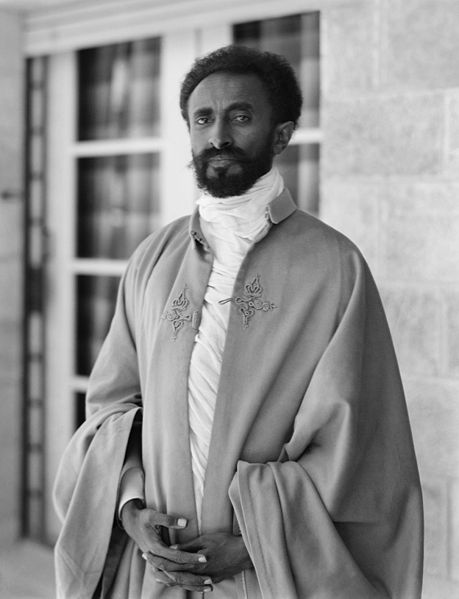
Haile Selassie is the most obvious name here. The Emperor of Abyssinia (Ethiopia) from 1930 to 1974, he was heir to a dynasty tracing its roots back to King Solomon and the Queen of Sheba and messiah to Rastafarians, who take their name from his – Ras (King) and Tafari (his original first name).

He had been the head of state of a country that had been targetted by expansionist Italy under Mussolini, keen to avenge the failures of Italian colonialism that Il Duce viewed as an embarrassment. Hats off to A30yoyo on Flickr who found and shared the photos above and below.

Haile Selassie in front of a modernist house, Jerusalem

In 1936, Italian forces had finally completed the takeover of Ethiopia, forcing Selassie into exile. Though his eventual destination was Fairfield House in Bath, England, his first stop on leaving Africa from Djibouti was Jerusalem, then under the rule of the British Mandate and, as Simon Sebag Montfiore notes in his excellent history of the city, quite a tempestuous place to say the least.

H.V. (Henry Vollam) Morton, the author of the piece, and is widely considered one of the finest travel writers ever. In 1936 he was fresh from completing In the Steps of St Paul, the follow-up to his 1934 bestseller In the Steps of the Master, which was his account of visiting Palestine. He was something like Michael Palin combined with Bill Bryson, so when the Daily Herald wanted a piece on the Abyssinian Christians who must have seemed so exotic to 1930s Britain it is natural that Morton wrote the piece. Given the plug for his next article at the end of this, appears to have been having his work serialised for the paper.

And what about the Abyssinian monks, worshipping in a tent on the roof of the Holy Sepulchre? They’re still there, as they have been for millenia, in the ‘kind of African encampment’ that Morton describes in the cutting. Here, at Easter, you can still see them ‘gyrate sadly round the roof in the moonlight looking for the body of Christ.’ Morton signs off noting ‘Those are the strange people among whom the Lion of Judah, as they call their Emperor, will seek refuge to-day.’ Today they remain exotic and fascinating, rather than strange, but still an essential part of life in the Old City.

I’m pretty sure Selassie did not literally seek sanctuary with the monks, as the Ethiopian Royal Family had a house in the city, but his visit was a symbolic one and helped to keep his profile high and question which of the two nations involved in the conflict was the barbarous one in need of civilising. And under five years later he was back as Emperor in Addis Ababa following the defeat of Italian forces.

The Italian stamp on Ethiopia and Eritrea can still be seen to day in modernist Asmara and Addis Ababa’s Piazza area, a tasty word for the city’s bus-boys to yell at passers by as the tour for trade.

Oddly enough this isn’t the first time I’ve found a random clipping inside an old book. You can read about that plea to demolish the Bank of England here. Not bad for £6 with postage. There are finds galore like this on the mighty Abebooks, and you’re buying from booksellers around the world which keeps prices keen. There are quite a few H.V. Morton titles on there, with who-knows-what waiting to be discovered inside.

An early summer visit to Craven Cottage

Craven Cottage
In one corner stands the cottage, unique
A reminder of an earlier age
An age before the violence
Before the air was full of vile oaths

Opposite, sits the brash new stand
Overlooking the Thames
Smug, expensive, empty
There’s an electronic scoreboard to gaze at when the play gets dull, which isn’t often
Fulham play an attractive brand of football
£4.50 to get in* and the beer is great

Three English Football Grounds by I, Ludicrous

I, Ludicrous may have written these words in 1987 but I’m sure Craven Cottage would get a glowing write-up again today should the boys decide to pay another visit**

In one corner does indeed stand the Cottage (rear view)

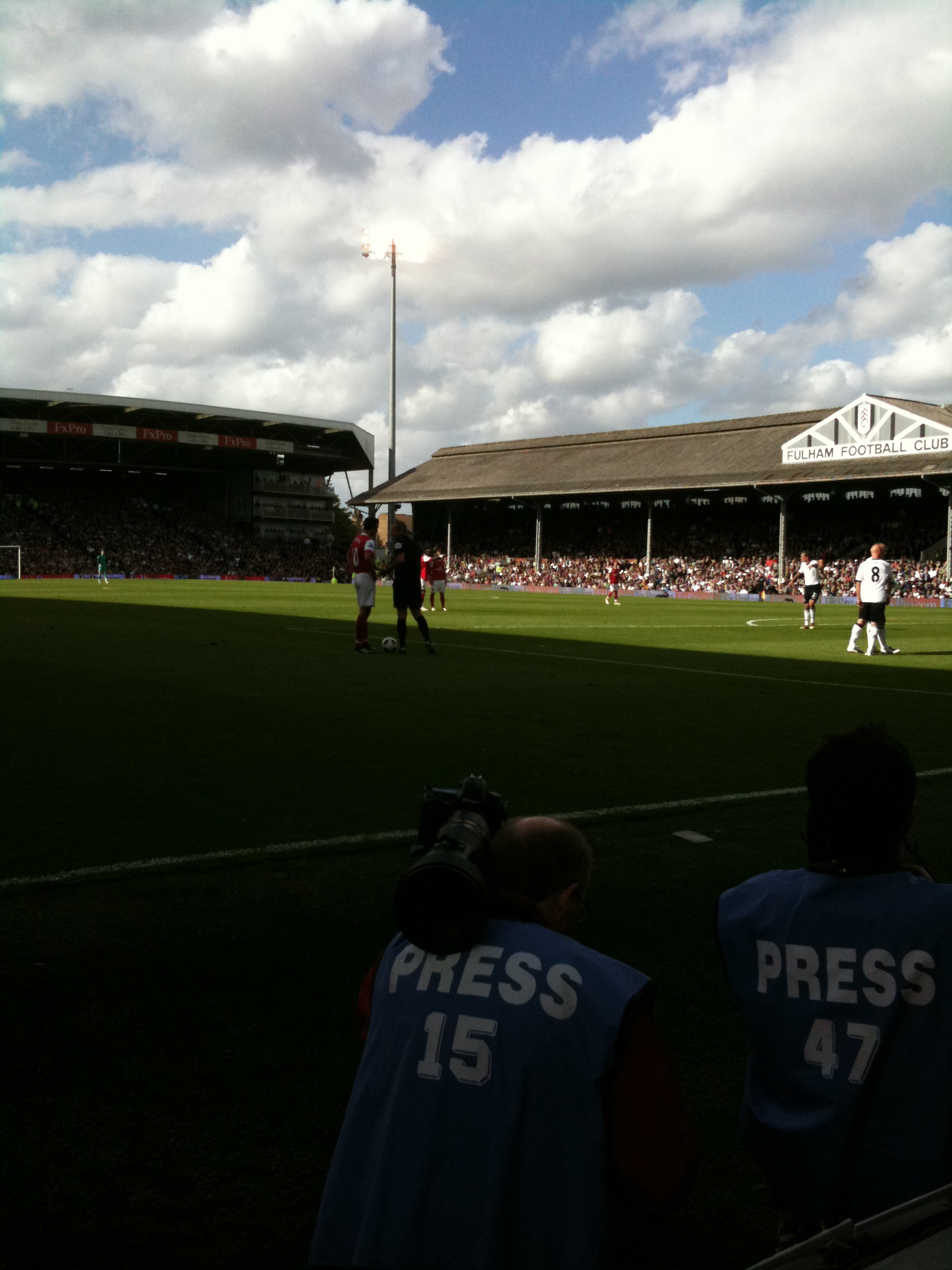
As football in London goes it doesn’t get much better than an early or late season trip to Craven Cottage, the home of Fulham. There’s lots to enjoy about coming here: the lovely walk through Bishop’s Park, with the green, narrowing Thames to your left; London’s oldest football stand fronting the Stevenage Road entrance to the ground; the prospect of a waterside beer at half time and the old-fashioned layout which generally ensures a large and vocal away following.

One English football ground (Stevenage Road Stand to right of picture)

The most recent addition to the attractions of the area is surely the oddest sight at any English league venue. The statue of Michael Jackon, erected by Fulham’s owner Mohammed Fayed, is a long way from the usual bronze effigy of ex-legend found at Old Trafford (Best, Charlton, Law), Elland Road (Bremner) and the Britannia Stadium (Matthews). For starters it’s in colour, and secondly, Michael Jackson may have attended a few Fulham matches but he was hardly known for his extensive Panini sticker collections. No matter, says Fayed, who walks on water in these parts after bankrolling the club into the Premier League and returning Fulham to the Cottage after converting the ground to all-seater for the start of the 2004-5 season. It gives travelling fans a giggle, which is no bad thing as they’re much less likely to come away with a result than they used to be. Fulham are no mugs at home and are an established Premier League club. Not bad when you consider that Fulham were second bottom of the entire Football League in January 1996, and lost away to Torquay United, the one team below them. Cha mon indeed.

For various reasons I failed to get a photo of the statue – there are plenty here – but some waggish Arsenal fans’ song, produced below, raised a smirk:

Your statue is shit
Your statue is shit
It should have been Jedward
Your statue is shit

A large and vocal away following, today

The other famous feature of the ground is the Cottage itself. This unique pavilion is as old as the Stevenage Road Stand and dates from 1905. Legendary stadium designer Archibald Leitch put it up after forgetting to build changing rooms into his plans for the ground. I’ve never been inside but I hope they bring you cucumber sandwiches and tea at half-time.

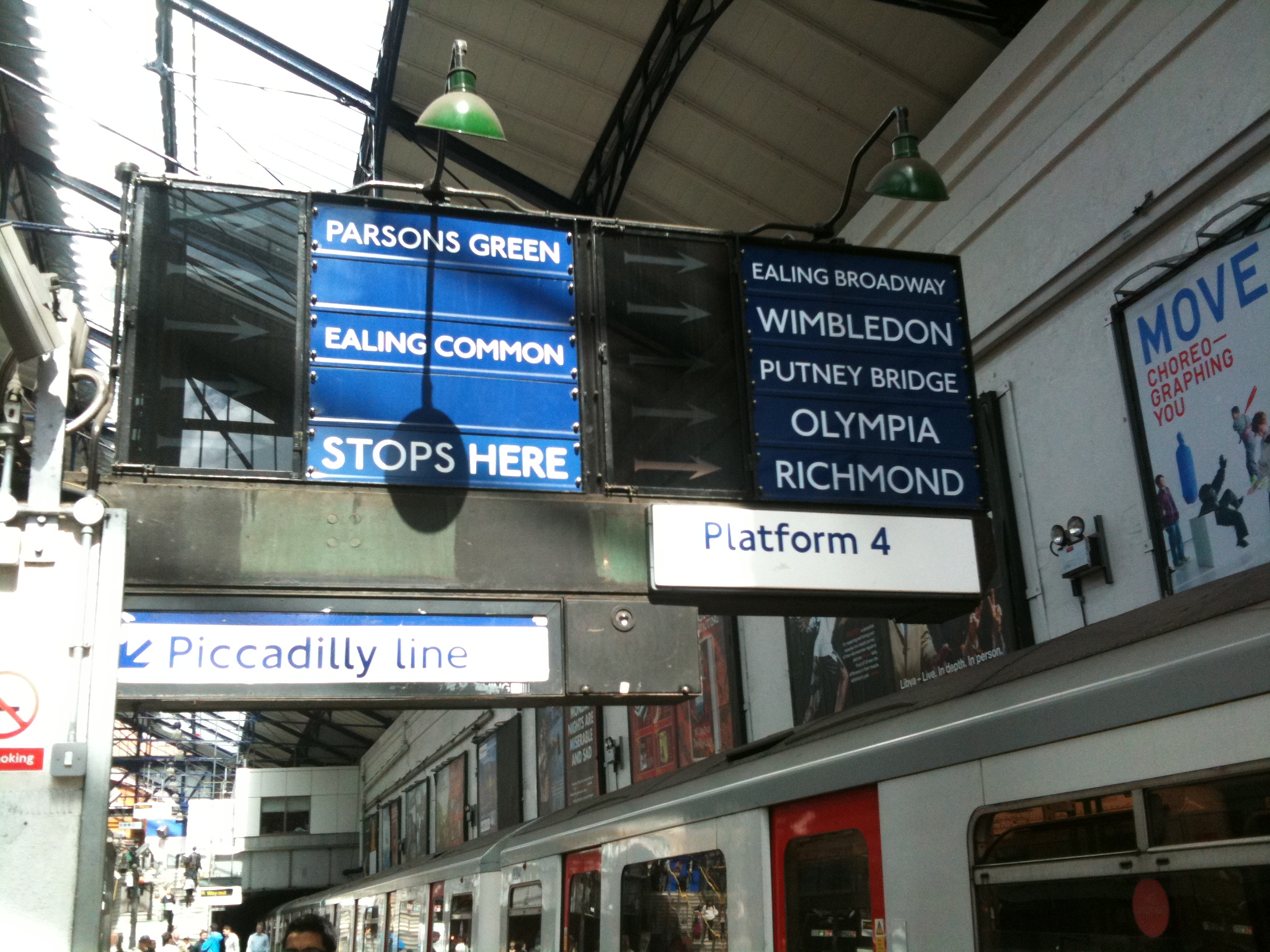
Earl's Court platform indicator...

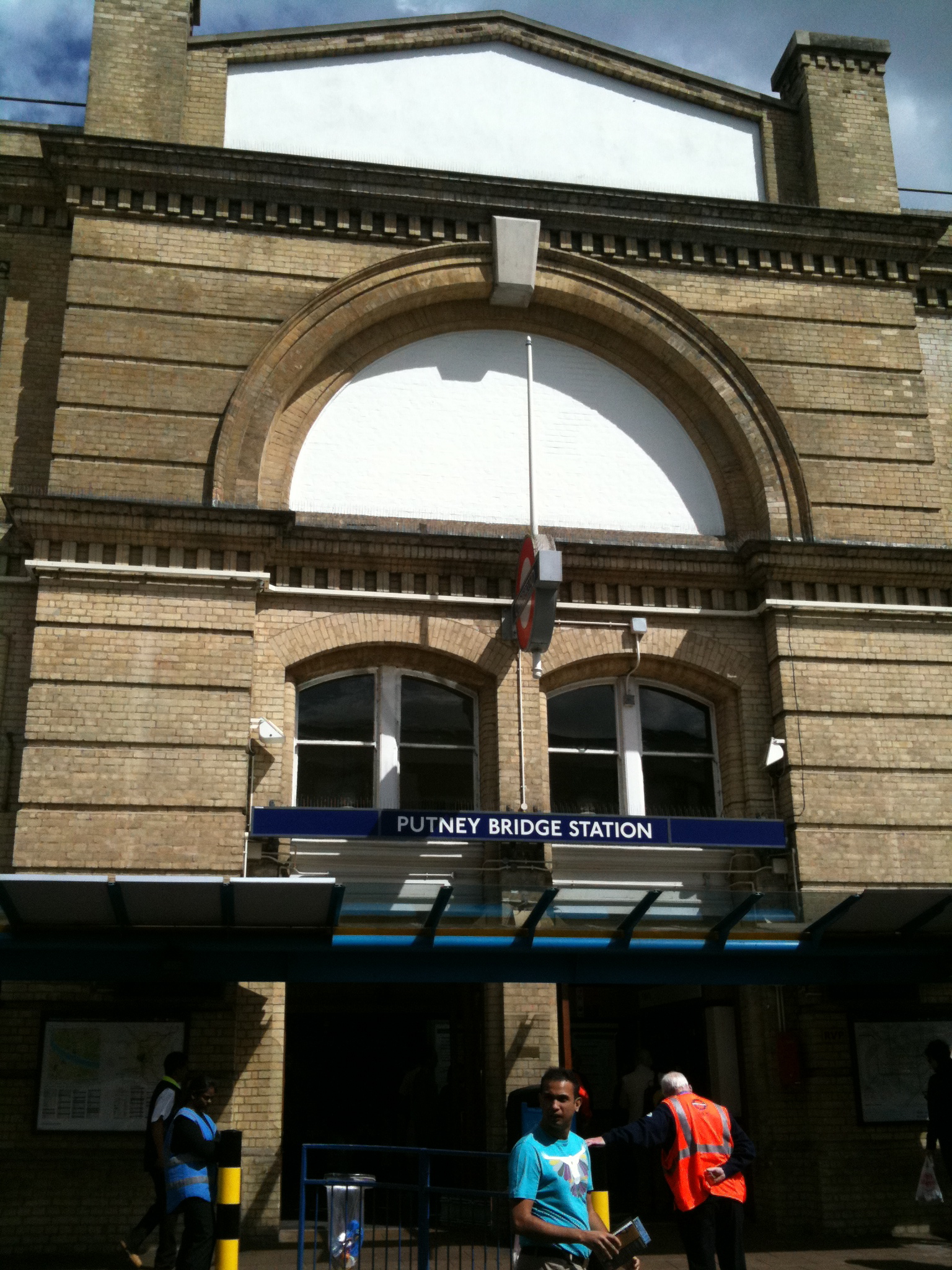
...and Putney Bridge station's elegant facade are two things to keep an eye out for on the way

*It costs rather more than £4.50 to get in to Craven Cottage these days. The beer is cold, which remains shamefully the best you can hope for inside any football ground in Britain.

**In fact, of the three grounds reviewed in the song, Craven Cottage is the only one still standing. Burnden Park and The Den, the homes of Bolton Wanderers and Millwall, have both been replaced by modern all-seater stadiums. Fulham FC kept their terracing later than any Premier League club to date, with standing in the Stevenage Road paddocks and at both ends until the end of the 2001-2 season. I paid the ground a visit in 2001 for the first time since 1994 when Arsenal visited, coming away with a 3-1 win that was closer than the score makes it sound. As with other visits to grounds with terracing it weren’t like the old days.

Arsenal 1990-91; the almost invincibles

This article originally appeared in issue 214 of the Gooner. It looks better in print.

Part two appears in issue 215, currently on sale, and I will post it here once that issue is no longer current.

It is Bank Holiday Monday, May 4 1991, and it is raining at Roker Park, the home of Sunderland. The ground has seen better days, and Arsenal’s away followers are massed on an open terrace with our backs to the North Sea, which is chucking everything it has at us. We’re here to see the championship won back off Liverpool, who we handed it back to rather limply last season. The rain and a fairly dour display by Arsenal mean that 0-0 is a fair result, and the title would have to wait until we’ve dragged our soggy bodies back to London.

Of more immediate concern is the mob of angry Wearsiders occupying the standing enclosure and, highly unusually, the upper tier of the stand to our left. From the moment the gates open they’re making a huge racket, one clad in a Hummel-era Spurs top just to irritate. The rest of them dredge up every 1970s chant about what they’re going to do to us outside. Combined with the poor football on show it’s like stepping back 20 years. Just as we’re all wondering how fast a fat man from Sunderland can run after us the mood changes. Possibly aware they’ve just seen this year’s Champions, or just to show they were only messing when they were threatening to tear us several new ones, the Sunderland lads suddenly want to be our best mates. They break out in song, swap scarves through the fence and shake hands, wishing us well for the run-in.

It was just one event in a very eventful season.

Home of the Champions, 1990-91

The George Graham years, and indeed the entire history of Arsenal from 1980 to 1996 revolve around one moment: Michael Thomas’s immortal surge through the Liverpool defence  (click for video, go on) and flick past Bruce Grobbelaar to take the 1989 league championship. The drama of that season, and that defining goal, overshadow much in the memory of everyone connected with Arsenal of what came after. But 1990-91, which was twenty years ago this season, offered thrill after thrill, and twists and turns to keep us all gripped from the moment the first ball was kicked.

It was a big season for me, too, my first of following Arsenal away pretty much everywhere. I was an Arsenal obsessed 14-year-old and life revolved around Saturdays, home or away, heading up the motorway with my Dad and some friends.

So much has changed in twenty years. England had just reached the World Cup Semi Final and the humdrum reality of league football seemed to contrast with the glamour of the tournament in Italy. There was one ITV game a week on live if you were lucky, and no European football at all.

We were playing for the Barclays League Championship, an ugly triangular shaped thing with the graceful Football League trophy, now awarded to the winners of the Championship thrown in as an afterthought. Ian Wright was playing for a youthful Crystal Palace side that would finish third and impress everyone in the process. Highbury was, apart from the recently-erected executive boxes and roof over the Clock End, pretty much unchanged in fifty years. The Taylor Report was soon to change that, but as the teams ran out for the first home game of the season, an evening match against Luton Town attended by 32,723 the players applauded the West Stand with Junior Gunners enclosure in front of it, the Clock End, East Stand still with old school greenhouse-style dug outs and the boisterous North Bank, enclosed by its low, noise-echoing roof.

Before that we’d kicked off the season at the Makita International tournament at the old Wembley Stadium. Both the weekend fixture against Sampdoria and the evening victory over Aston Villa,   managed by Dr Jozef Venglos, the last and possibly only man with a doctorate to manage in England, were played in very hot weather, and the heat went up a few degrees at the latter when new signing Anders Limpar (some great goals by the original Super Swede here), who looked like a pacy replacement for the departed winger Brian Marwood, burst through the defence to lash home from a tight angle. He was one to watch. Other new signings were Andy Linighan, an addition to the already-established back four, and most controversially David Seaman in goal. He’d nearly joined us on deadline day the previous season but the deal had fallen through. Arsenal fans had rallied around John Lukic and Seaman got a mixed reception at first. He won us over by being fantastic.

The first day of the season took place against a club who no longer exist at a ground that is long gone. The tube journey to Plough Lane, Wimbledon through the longest tunnel on the Underground seemed to take forever, and when we got there we were greeted with a ground offering, like so many others, unreconstructed Victorian facilities. Years after this match I went to Tanzania and used a pit latrine and the smell reminded me instantly of this afternoon: a slowly boiling outdoor toilet. Goals from Merse, Alan Smith and an absolute belter from Perry Groves got us off to a winning start.

Plough Lane: even the horse didn't think the toilets in the away end were up to much

My ticket stub collection for this season is a bit sparse, not because I wasn’t at games but because you could often pay cash on the door at many away grounds. At Nottingham Forest’s City Ground a policeman stopped me, baffled, at the turnstiles and asked what the large wooden block I had in a bag was. My father, who had made the item, explained that it was for me to stand on as I was a bit of a short-arse those days (I still am), and the copper gave me a stern glare and ordered me to ‘grow!’. This box was a feature of that season. People next to me would try to knock me off it to get a better view themselves, and when a goal went in and everyone went flying I had to push through the post-goal scrum to try and retrieve it.

The previous season we’d gone to Old Trafford on the first day of the season as champions. Michael Knighton had just had his bogus bid to buy the club accepted and jogged round the pitch bouncing a ball on his head. Gus Caesar had a shocker and we’d taken a 4-1 hammering. A couple of years before there had been two bad-blooded encounters, one as we lost a long unbeaten run at the same ground and then when Brian McClair had missed a last minute penalty, earning him a taunting from a delighted and relieved Nigel Winterburn. Their fans were confident, taunting us as we walked around the ground beforehand. Long queues formed by red-brick turnstile blocks three hours before kick off. It was never going to go down well then when after United throwing the kitchen sink at a by now firmly established David Seaman for half an hour we scored from an Anders Limpar wonder-shot from by the corner flag. United were seriously wound up and Arsenal weren’t giving an inch.

The second half brawl didn’t affect the result but it made the day unforgettable. The United fans behind the away enclosure were baying for blood and we were kept in for a long time afterwards. Not that it mattered, three points under those circumstances was a triumph to savour. Incidentally, it cost £5 to get into Old Trafford that afternoon.

To be continued…

Seeing Sicily with children

I like places that think they’re at the centre of the world –  I am from London, after all. Sicilians, custodians of a beautiful, historically fascinating island slap bang in the middle of the Mediterranean Sea, are entitled to hold this conviction about where they live.

Roger II: unlikely name, great King of Sicily, had at least 15 kids. Proof it's a great place for nippers!

Their homeland is also a superb place for a family holiday, as the Hall clan just found out. There are always nuances, however, to travelling with children that are less obvious before you visit, so I thought it may be worth passing these on. Here, then, are some tips for visiting Sicily with children:

Sicily's provinces (Wikimedia commons)

1. Don’t try and see the whole island in a week

The main reason for saying this is because you can’t. Sicily may not look big on a map, but it’ll take longer than you think to travel places. Distances are reasonably big, Trapani to Palermo for example is 43 miles (69km) while Catania to the capital is 100 miles (160km). Larger cities are linked by smooth dual-carriageway roads, but head inland and you’ll find yourself on spectacular but slower roads through the mountains.

Sicily has an amazing amount of things to do, too, and there’s enough for a month of child-friendly half-day trips. Once the island is seen there are islands too, including volcanic Stromboli and Vulcano. We chose an area – the north-west of the island and saw it in some detail, visiting Palermo, Monreale, the hilltop treasure of Erice (best reached by a fun cable car) and the ancient sites of Selinunte and Segesta in a week, exploring from our base in Castellammare del Golfo. We are fixed on returning soon and basing ourselves on the Ionian Coast to see the highlights of this area, as well as returning to Palermo. If you try to pack in too much you’ll exhaust yourselves and get frustrated, so slow down and make the most of your immediate surroundings.

2. Hire a car

Sicily has trains and buses but a car is perfect for touring with kids. You quickly get the hang of driving (including mastering being on the ‘wrong’ side of the road if you’re British) but also adapt to  Sicilian motoring style, which means going fast, driving right up the jacksy of the car you wish to overtake and, in Palermo, ignoring whatever lane restrictions or rights of way are in place. I found it quickly became a lot of fun, even in the capital. Trains were slow, and buses left you reliant on someone else’s timetable, plus with a car you could go precisely where you wanted, when. There are beautiful drives everywhere.

3. You can go to Palermo

Big city + hot sunshine + a fearsome reputation for traffic = a succession of tantrums from children and parents. Right? Maybe. But Palermo doesn’t have to be like that. If you’re a gallery fan, church crawler or a mosaic obsessive you might feel the odd pang of frustration that you’re in a city offering serious cultural overload much of which will be out of reach, but then you’ve probably come on holiday prepared to compromise. This might mean that you bag the wonderful Arab-Norman cathedral from the outside. No biggie. Its interior won’t get your blood pumping if you’re been to Monreale or even the Chiesa della Martorana, the wonderful chapel that’s home to some of Palermo’s best mosaic work. It might also mean heading for the Palatine Chapel first thing in the morning or not at all. But there’s more to Palermo than this. Our eldest grizzled at being in a trafficky, smelly city so we took a stroll through some random back-alleys, discovering a quieter side to the city and getting glimpses of baroque palaces hiding behind enormous, ancient doorways.

There’s enough at nearby Monreale to visit this lovely hilltop town separately, by the way. And in many ways it is more kid friendly, as you can ascend dome of the Cathedral, run riot in the Cloisters and lunch in the lovely piazza, complete with fountains.

4. Self catering may suit

Self catering is a good idea with small children anyway, but unless yours like staying up late it can be pretty much the only way to feed them in many places between 4 and 7pm, when restaurants stop serving and many cafes shut too. Though things start waking up in the early evening, this is Passeggiata time, when Sicilians hit the streets for a promenade, gossip and an espresso or something stronger. We tended to feed our lads the usual time they had dinner and then head out and join the fun.

5. Ancient ruins can be fun

Sicily has some wonderful ancient sites, and it’s not hard to make them fun for those too young to appreciate the subtleties of Doric capitals and the superb settings of many of the islands Greek sites. Climbing, hide and seek and even an impromptu concert in the amphitheatre at Segesta made our visits to these places some of the best of the trip.

The subtleties of Segesta - best appreciated during a game of hide and seek

6. Splendid sand

You’re never far from a great beach, and if you’re from a northern climate you might be able to enjoy them when the Italians shy away from a dip. In early May we had a vast stretch of beach at Castellammare, obviously mobbed in July and August, all to ourselves. The sea was around 20c and eminently paddleable. Keep buckets and spades in your hire car.

Mmm, Cannoli

7. Food and drink

This was easy. Pasta and pizza were always on hand, and could be followed up with delicious fresh fruit, gelato and sweet pastries for after, either as pick-me-ups or bribes after another Arab-Norman church. In Maria Grammatica’s famous patisserie in Erice we got pretty much all of these on the table at once, and took half of them away with us for later. At weekends you can get huge cannoli – crunchy pastries with a creamy filling – as an afternoon treat.

8.  Vorresti qualcos’altro? (Anything else?)

Most of all, don’t fret too much. Sicilians love kids and will love yours, so bring them along when you go to buy fresh-baked bread, cheese, olives and tomatoes first thing in the morning or kick a ball around the piazza at Passeggiata time. There’s nothing you’ll need that you can’t find easily, apart from a good stack of English-language DVD’s, books and magazines for the flight home you can pull out when some fresh stimulation is needed.

On Syria

How much do tourists look, but not see?

I’ve been asking myself this a lot lately. I returned from a visit to Syria on 14 March. Quickly after that, protests erupted against corruption and demanding reform, initially in the southern city of Dera’a but spreading quickly to major towns and cities. If the story has followed a similar pattern to other uprisings of the Arab Spring, the response of Syrian authorities has been more repressive than others. The few images that have made their way out of the country have made for grim viewing. At the time of writing there’s no end in sight as the country’s hardline military regime takes a hard line against protestors.

All of this feels a long way away from the Syria that I saw. I spent much of my trip visiting the so-called Dead Cities, Roman-era settlements set among the limestone massif of north-eastern Syria that are so well preserved you expect the locals to wander out, wearing togas and sandals, greet you in and then go about their business. I loved the country, and was delighted that I’d visited despite suggestions from friends to the contrary that I reconsider given events elsewhere. My Mum didn’t really approve. Frankly, I didn’t give their concerns a second’s thought when eating pistachio ice cream in Damascus’ souq, strolling the battlements of Krak des Chevaliers – possibly the best castle in the world – or hitching a lift on a Bedouin farmer’s motorbike. If I’m being honest I’ve never felt safer anywhere in the world.

Given what’s happened since then, reconciling these two views of Syria have proved difficult. Which is real, the grainy images of a country in turmoil, or my own experiences, of a beautiful, little-visited land that felt every inch like the next big thing in travel?

Looking back, there were a few clues about the people and place. A Kurdish taxi driver took me to his village close to the Turkish border outside Aleppo. It was remote and poor, but the neighbouring town was noticeably more prosperous. He said with a wry smile that this was where the police lived, who were the richest people in the area due to the back-handers they took. In Damascus at Friday prayers a heavy police presence materialised, noting who was doing what on exiting the Ummayad Mosque. They obviously suspected that not everyone was planning to admire the jaw-dropping mosaics. And on several occasions young Syrians I was speaking to would look around urgently during conversations, like they were conscious of being watched.

None of this made a huge impression at the time. Rather selfishly I was relieved the country appeared peaceful and didn’t ask too many questions. While that’s wise practice when it comes to politics in many countries, it’s left me with a feeling that I had my head in the clouds. I have mixed feelings about the trip, especially as I came away feeling that the country was not on the verge of revolt. Whether this is naivety or a sign of the careful planning that has gone into the protests, I’m not sure.

Despite the unease I feel when I see Syria on the news, my visit there has made me care more deeply about what’s going on. I find myself reading traveller’s updates on the Thorn Tree daily to see what it’s like currently. I’ve also emailed some of the friends I made to ask if they are safe but have had no replies.

Next time I take a trip like this, though, I shall try to look harder, as however much I loved the country, I can’t escape the feeling that I missed a big part of the picture. I suspect many of us, flying in for a few weeks or less, then buzzing off somewhere else, are doomed to do the same. Tourism’s value, to individual and host, only goes so far.

A grand theft at Westminster Abbey

The eyes of the world are on Westminster Abbey, the pivotal location in the history of royal London, England and Britain for over 1000 years. So old is the Abbey that England did not exist when it was founded in the era of Mellitus, Bishop of London from 604-619. It was built on an island that is no longer extant, known as Thorn Ey or Thorney Island, created by the dissipating channels of the now-buried Tyburn river. Fancy a dip in the Tyburn today? It’s waters tip into the Serpentine, site of open-water swimming at the 2012 Olympics and open to the public for bathing during the summer months.

Westminster Abbey: built on cheerless marshes

The Abbey’s handsome west towers, designed by Nicholas Hawksmoor and built between 1722 and 1745, are one of the more recent additions to this Gothic wonder that, rightly, ranks highly on most London tourist itineraries. Like other icons of the capital, many Londoners pass by frequently, vowing one day to brave the crowds, then never do. They’re missing a treat. Monarchs like Henry V, Richard II and Elizabeth I are interred here, along with Chaucer, Newton, Kipling, Handel and Dickens. An afternoon in the company of the greats of Britain can only be a fascinating one.

Sir Walter Besant, Victorian novelist, historian and a great Victorian who lived all but one year of his life (1836-1901) under the Queen’s reign, had plenty to say about London, and Westminster received special attention in his 1895 book of the same name.

A review of his biography of Sir Richard (Dick) Whittington noted “Mr Besant is an enthusiast about London, and revels in its archives, its traditions, its historic associations and its literary memories. He loves the town, not exactly as Dr Johnson loved it, but somewhat in the manner of Leigh Hunt or Charles Dickens.” That’s not a bad epitaph.

I’ve tried and failed to find a digitised copy of Westminster online, but found one at a second hand book sale and hid it from a lurking old man with a beard who was admiring it. That, reader, is how I have it now and how I can bring you this marvellous anecdote from it. I should point out that I did, at least, pay for it.

Inside is an anecdote which reaches through the centuries from 1303. At the turn of the fourteenth century Edward I, the Hammer of the Scots and the man who built the Eleanor Crosses along the route of the funerary procession of his wife Eleanor of Castile was King of England and had just signed a peace agreement with France which allowed him to focus on whacking those north of the border. His treasure trove, the Royal Treasury, was kept at Westminster Abbey, and was a pretty hefty hoard, having been built up to pay for his Scottish campaigns.

Edward I: not someone likely to be delighted to find out someone’s walked off with his treasure

Things were not going quite so well for Richard de Podelicote, a merchant, “probably”, Besant notes “an unsuccessful trader in foreign wares.” Unsuccessful, but not without cunning. Besant picks up the story:

“…he observed that the small gate in the wall which led from the Palace to the Abbey (at the door now by Poet’s Corner) was unwatched and neglected. At this time the King himself with a great army was on his way to Scotland: the palace was therefore deserted…the strictness of the rules about watching those who entered or went out was relaxed.”

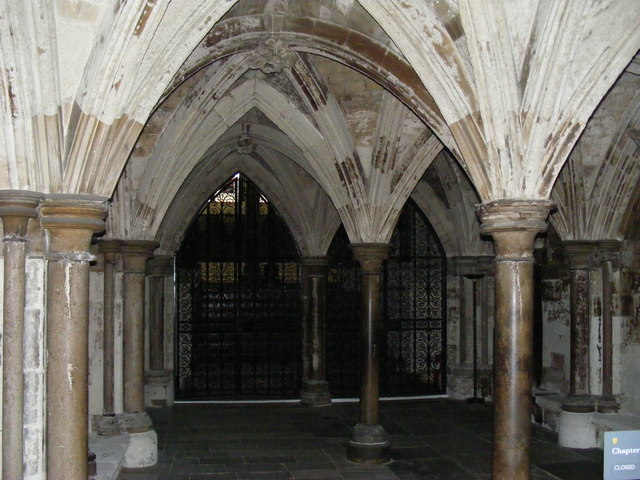
The Chapter House at the Abbey

Podelicote broke in by placing a ladder against the Chapter House windows and, possibly with the assistance of whatever night-watch was in place as an accomplice let himself into the Cloisters. He proceeded to pilfer silver cups from the Refectory and, having reversed his route, hid for the rest of the night simply walked out of the Palace-Abbey complex the following morning. He spent the proceeds and came back hunting for a greater prize.

A bag of swag from the Refectory was one thing, but the Royal Treasury was, as Besant notes, “a far more serious job…the Treasury was a chamber with stone walls of great thickness, cemented firmly, only to be dislodged by being taken away piecemeal with infinite labour: and to carry out whole sacks and hampers full of treasure was impossible for one man unaided.” Then again, given the ease with which he pilfered the Refectory it can’t have been too hard to rope others in.” Besant goes to lengths to question whether the monks of the abbey were involved, and though there’s no evidence it would be remarkable, given what he was up to if he hadn’t at least paid a few of the residents off

This grand theft took place over several nights at the end of April 1303, exactly 708 years ago, the climax of months of diligent work to access the Treasury. His confession noted some of the booty: “pitchers, cups with feet and covers…a pitcher with stones…three pouches full of jewels…a great crucifix and jewels…two little pitchers of silver….spoons, saucers, spice dishes of silver, crowns, girdles and other jewels.” He took all this “out of the gate near St Margaret’s Church and left nothing behind within it.” And nobody stopped him!

As is sometimes the case, the facts of the discovery of Podelicote’s brazen theft of the finest treasure in England is not clear. Edward Longshanks, it can be assumed, was far from happy when he learnt about it in June. It must have been an interesting task for the messenger who broke the news to one of the most fearsome monarchs in history to do so.

Westminster suggests that “many of the criminals were caught in actual possession of the spoil.” but also says “the history of this wonderful case is unfortunately incomplete. The fate of the ringleaders is unknown…it is, however, quite certain they were hanged, most likely with pleasing additions to hanging which prolonged the ceremony and gave it greater prominence.” A load of monks were sent to the Tower of London.

With that, the doors of history slam shut and Podelicote exits stage left. Perhaps Princess Kate should watch that his ghost doesn’t whip the tiara off her head.