The Death of Richard I, Cœur de Lion

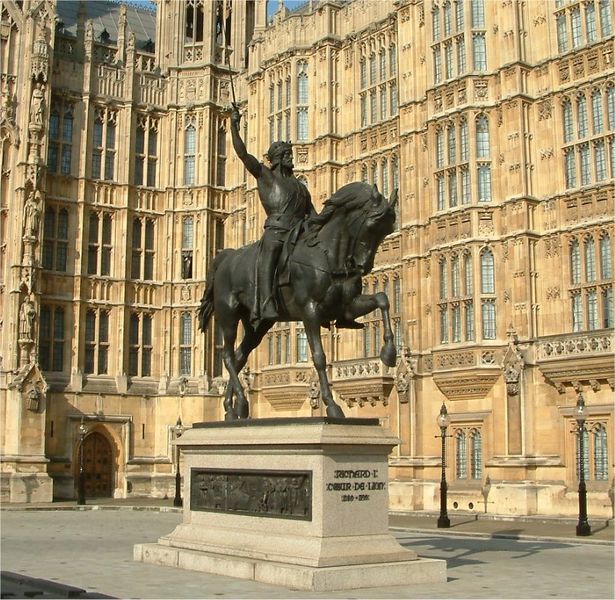
Richard I, Cœur de Lion, the Lionheart, is thought of as one of England’s finest rulers. Here’s his statue outside the Palace of Westminster, known to you and me as the Houses of Parliament.

Grr!

You don’t see too many other kings round there – after all, Parliament lopped one of their heads off once, and made life hard for plenty more. So he must be a pretty special chap in English history?

Well, sort of. When he finally got his hands on the throne of England, after years of plotting against his old man Henry II, having been egged on by his mum and Henry’s wife Eleanor of Aquitaine, he didn’t exactly take England to his bosom. He only spent six months in the country during his reign, splitting his time between crusading the Holy Land – where he failed to recapture Jerusalem from Saladin on the Third Crusade – and squabbling with Philip Augustus of France over Normandy, Anjou and lands in between. He was also captive for over a year, the hostage of his enemies in the Holy Roman Empire.  Like noblemen of the time in England still breathing the fire of William the Conqueror he spoke French not English.

One thing that is indisputable is that he was a great warrior and general, and it is from this that he gets his reputation as something of a badass. Which makes the circumstances of his death almost comical. In March 1199 he was beseiging an unimpressive castle in Chalus, located in what is today the Limoges region and, feeling confident, was touring the perimeter without chainmail on. He was shot by one of history’s more obscure names, Bertrand de Gurdun, armed with a crossbow which hit its intended target in the arm, which became gangrenous.

In those days, it seems, one did not simply shoot someone like Richard, regardless of having the chance to. So, sensing the end was near, he called for the chap to be brought to him and asked why he had shot him. The archer replied that Richard had killed his father and two brothers and – not unreasonably – that he had intended to kill him. Richard magnanimously forgave his killer. Once the King had breathed his last the fellow was seized by Richard’s furious aides, who were less obliging. He was flayed alive and hanged.

Richard’s heir, John, lost all his French possessions and the Lionheart himself now only turns up to save the day in Robin Hood films.

Life could be cruel in the Middle Ages.

Whistle-stop Prague

Inside the old booking hall of Hlavni station

I’ve just got back from a flying visit to Prague, my fourth and shortest visit to the city. Somewhere along the line the Czech capital has become the biggestndraw in central Europe, behind only Paris and Barcelona in the European league table of most popular of city destinations. It’s not as cheap as it once was, but that’s not necessarily a bad thing. The stag groups who once mobbed the Irish bars of the Stare Mesto – Old Town – have packed their bags for unfortunate stops further east in search of pints which cost less than a pound. they’ve left the city in the clutches of tour groups in search of gothic bridges, classical music in Baroque halls and foaming glasses of Czech beer.

Prague, Mother of Cities

1995 seems a long way away now, and the city then may have already begun morphing into the propserous, if less distinctive city it has become. But when I stepped off the train from Vienna, which had sped across the shimmering central European plain in the scorching summer of that year Prague felt only just out of the clutches of communism. The big western brands were here, but not in the force that they are today, and there were mullets and 20p pints eve in the most perfect back-street old town bar. My then girlfriend and I stayed in a room in an apartment owned by an elderly Czech widow who spoke enough English to thrill us with her accounts of the Second World War and the slamming shut of the Iron Curtain. Outside the big windows of that apartment thunderstorms broke the stifling heat.

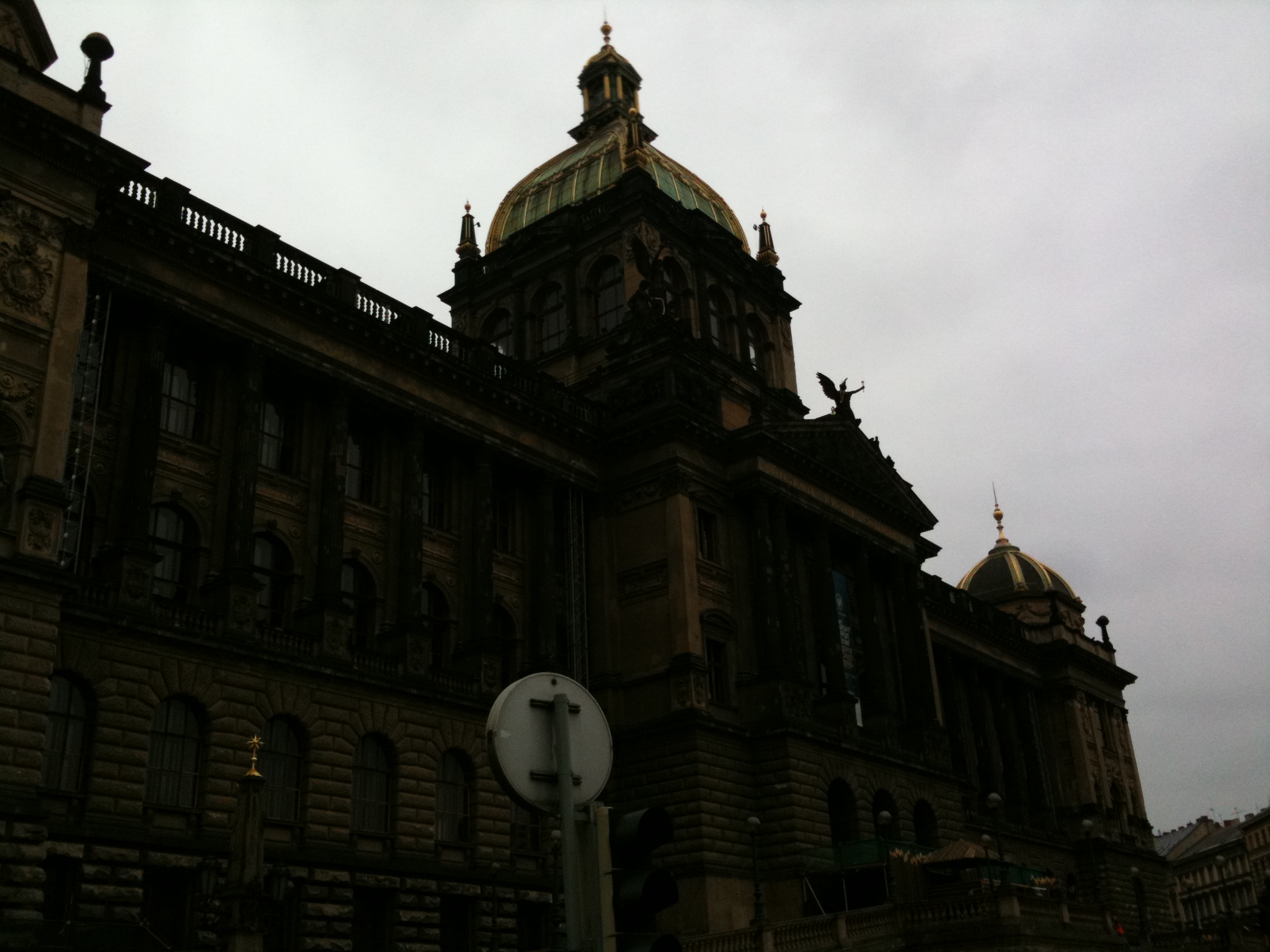
National Museum

So in the two hours I had free to explore I set out to revisit some of the half-memories of that stay. Most prominent was the National Museum (evocatively emblazoned with the inscription ‘Musei Regni Bohemiae’, standing sentinel over Wenceslas Square. As I stood on the steps of that building and looked north-east I spotted the twin arches of Hlavni station, dotted with statuary. A walk there revealed a real find. The station is a treasure trove if art nouveau, a gallery of mosaics, wrought iron and gabling with tracks running beneath it. The best part, shunned by the decision to build a six-lane motorway next to the former main entrance, is the original ticket hall. Stop by if you’re in town.

A great walk from Hlavni is to thread through back streets to the Charles Bridge, the Eiffel Tower of Prague, even if the reality is crowded with slightly underwhelmed day-trippers missing the point by taking pictures of themselves with the Vlatava – and no bridge – in the background. The highlights of this walk are too many to mention, just point yourself in the general direction and meander.

And that was that. Time to go, just a tiny taste of Prague. In 1995 I hopped on a train to Stuttgart, exiting via Hlavni’s hallowed tunnels, swapping to a service through Milan to Switzerland that is still the most beautiful rail journey of my life, and from there along the French Riviera to Cerbere – Port Bou, then finally an agonizingly slow and busy local service on to Barcelona. But Prague, well, it’s different.

North Northumberland: Ultimate England

If you travel as far as you can from London, without leaving the ground, but staying in England, you end up in Northumberland. Your journey to the rump of ancient Northumbria will not be in vain. This last piece of Albion is a peach. Here you’ll find castles and beaches, villages lost in time and brooding hills. And in a short distance you can spend a week or more. Here are treats for those who make it this far.
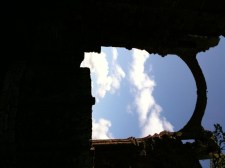
Lindisfarne Priory ruins

One day I shall go to Alnwick and do nothing more than visit Barter Books, a wonderful labyrinth of a second-hand bookshop. It’s easy to lose yourself in this old railway station, with a toy train rattling quietly over the tops of the shelves. You get a discount if you spend more than £50, which I did solely by stopping by their London section. There’s a cafe which serves cake, tea and other good fuel for keen readers, who may enter some kind of state of Nirvana here.

Alnwick’s headline attraction, however, is not this literary gem, it is the Castle and Gardens that stand between the A1 and Alnmouth and the fine market town itself. Both are beautiful and interesting, but if you’ve already tested the patience of any young children in your care in Barter Books, or plan to do so later, make the Gardens your first stop.

The quiet lanes of Nortumberland’s backroads hum with the din of tractors and diggers going about their daily business, and kids will love messing about with the sit-on pedal powered versions at Alnwick Gardens. Provided you can tear them away from those, there are fountains to paddle in and shovel water to and from – bring a change of clothes – and a huge treehouse restaurant with observation tower and rope-bridges straight out of Return if the Jedi, but minus rebellious minature bears.

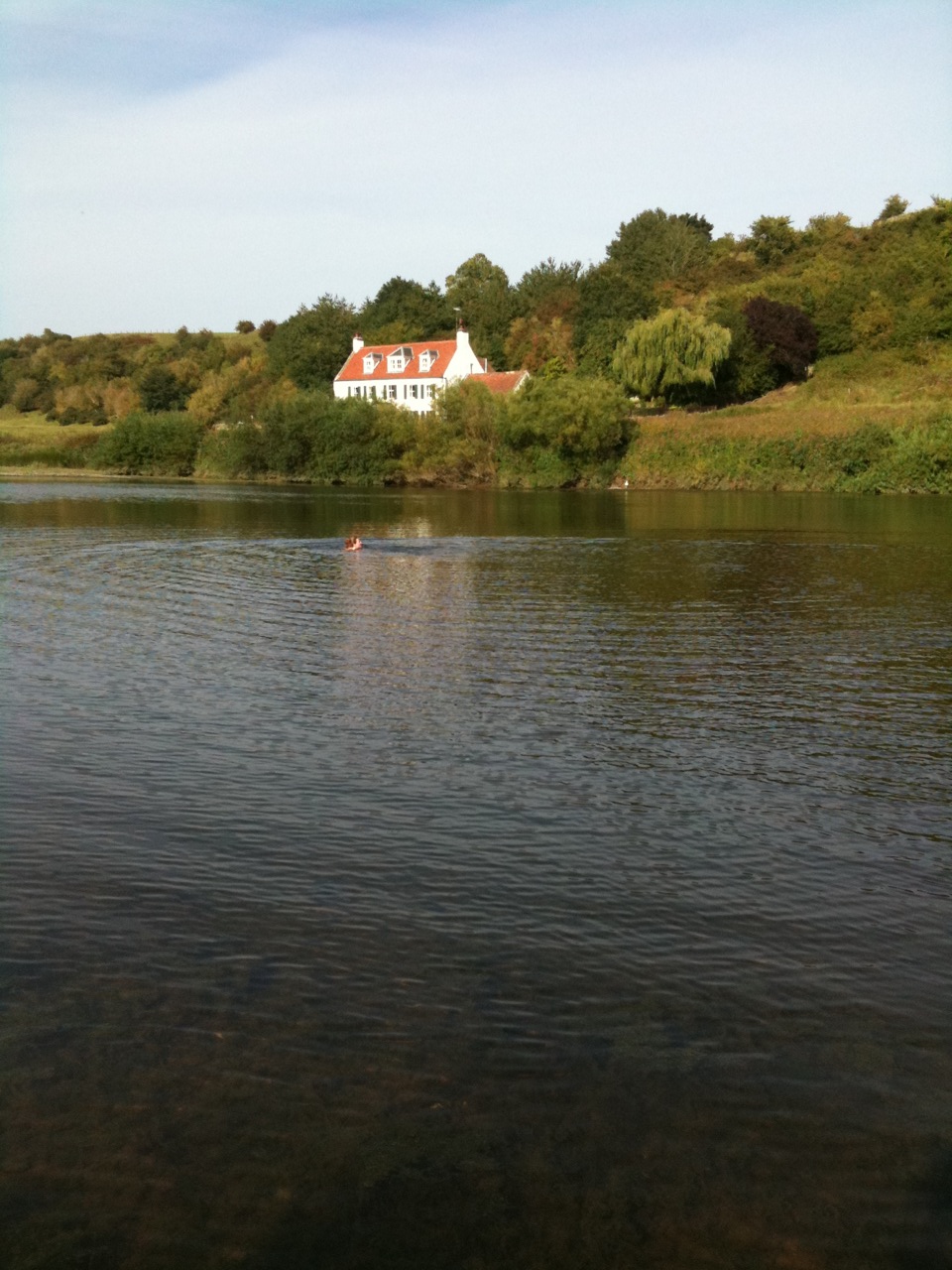
At Norham, by the church of St Cuthbert, you can see where St Aiden (check!) crossed the Tweed on his way from Iona in 635. If the weather’s good, you can dive in and re-enact the crossing. The Tweed is a fine wild swimming river, and there’s another fine way in on the Scottish side of the Union Bridge. In early September it was clear and cool, maybe 14c. Aiden went on to found the Priory at Lindisfarne, or Holy Island as it’s known today. Aiden went on to found the Priory at Lindisfarne.
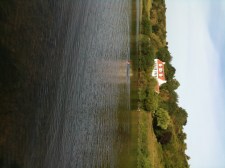
A dip in the Tweed

By the way, Turner painted the fine ruin of Norham Castle, making it look much more splendid than it does today. However, you can’t go and see the Fighting Temeraire anywhere, so stop by if you’re passing.

Lindisfarne gets a lot of visitors, some pilgrims who have walked from Iona, most day-trippers looking to dodge the tides. the drive across is unique in England and possibly Europe, striking out across tidal flats, sometimes with the approaching or retreating water washing at your wheels. Check the tide times and heed local warnings as it’s not called Holy Island for nothing.

Our hosts insisted that the best time to go is when the tide is in and you’re stuck for a few hours. Even if you go when everyone else does there are still plenty of places to hide from the hordes, most of whom don’t seem to get much farther than the gift shops which do a fine trade in mead, the fermented honey drink mastered by the monks. The walk out to the castle, with views over to the other Farne Islands and a North Sea breeze feels like a god excuse for the crab sandwiches for sale once you get there. Small boys may enjoy skimming stones and rock-pooling here too. Local knowledge also insist that the best and quietest beaches in Northumberland are here. I can’t give a personal guarantee but if you have the time, take your OS, walking boots and swimmers.

Although we visited in late summer, on one of our trips across the causeway the weather was wild enough to a make one imagine the bleakness the Monk’s dark age existence here. It would have been cold and tough. But then those who took holy orders often had much better lives than their secular brethren, with reliable food, education and some security from the violence which often racked Anglo-Saxon Northumbria. They were, however, not immune to Viking raids, and their richness made them targets for the odd sacking. Stand on the shore, crab sandwich in hand, and imagine Europe’s most fearsome warriors turning up unannounced and unwelcome. lindisfarne is a place which gives rise to such grand and terrible thoughts.

South of Holy Island and back on dry land is a strong contender for England’s finest stretch of sand. Bamburgh beach has a long sweep of sand running down to gentle waves, with rock pools at the northern end and a surfable break. Elsewhere this is perfect paddling and sandcastle territory, with dune-grass cutting the beach off from the road. Best of all though are the views of Bamburgh Castle, brooding sentinel keeping its eye on those brave enough to take the plunge.

After visiting such a bracing location as Bamburgh chances are you’ll feel go rated and healthy. The logical thing to do next, then, is to stuff your face with fish and chips. Ideally followed by an ice cream. Everyone at Seahouses, just down the coast, has had the same idea so you may have to queue for your just-fried crunchy fish and rough-cut chips. Once you’ve got them, resist the temptation to join the grockles on the benches outside the Bamburgh Castle Hotel and instead walk out onto the quay for a little way. The views are better and you can watch the fishing boats and tour boats heading for the Farne Islands in search of puffins, seals and porpoise.

There’s more – much more – including richly-rewarding raids over the borders into some of southern Scotland’s loveliest towns, but one visit needn’t be too rushed. It may rain on one or more of the day’s you’re here. If and when the sun shines, you’ll feel like you’ve found the perfect piece of England. You might just have it pretty much to yourself.

London’s latest no-frills hotel

Lambeth North at platform level

There’s been plenty of buzz about town regarding Tune Hotels’ first European venture – a 79-room base adjacent opposite Lambeth North in south London. Lambeth North has been unremarkable for pretty much anything except proximity to Waterloo and the Imperial War Museum, and while north Londoners might cock a snook at the idea of anything vaguely approaching hip on the wrong side of the river*, this hotel has certainly got tongues wagging. I spoke to the Independent about it a few weeks ago and was subsequently quoted in the Daily Mail and other pieces, as well as doing some radio interviews.

I was curious then to get a call from BBC News, who were filming an item about the hotel today (Wednesday 25 August) and wondered if I could go down to the hotel on launch day and contribute my view on it.

Tune Hotels, owned by the team behind Malaysian budget carrier Air Asia – whose posters currently adorn many of the walls – take the no-frills travel concept and apply it more ruthlessly to the hotel industry than anyone has before. You have your room, which may cost as little as £9, and a shower.

What’s the catch? Everything else is on top. Want a towel? That’ll be £1. You do get some posh-looking soap, and though Alan Partridge would disapprove of the size it’ll do the job. Your room will be clean on entry but if you want it turning over while there that’ll be £7.50. And that nice flat-screen TV? £3 for the day, £7 for three days, £10 if you want it for the whole of a longer stay. Even with these extras though you should be able to grab a room at off-peak rates for a long way under £50. Want one at weekends? The price will go up. If you’ve flown Ryanair you’ll get the drill.

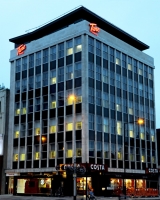
The hotel has an unassuming entrance, with a Costa Coffee in the same building like many large budget chain hotels on Euston Road and elsewhere. Upon going in there’s a simple reception in Tune’s red and white livery, and two vending machines in case late night munchies strike. The lift whizzes you up to your room – the one we looked at was fashionably and soothingly decorated, but small, and would suit a friendly couple or single traveller. There wasn’t any room for a travel cot.  Business travellers, weekenders and sports fans will enjoy it, and if not there’s plenty of competition who’ll throw in a towel and a TV. They’ll probably just cost more. And other hotel chains will be watching this new entrant very closely.

The interview was conducted on the roof which is sadly not open to guests. Access is by a skylight-type door and metal ladder and gives superb views of neighbouring rooftop gardens and the London skyline. The dome of St Paul’s, the Victoria Tower of the Palace of Westminster and Battersea power Station should all be visible from rooms on higher floors. Crystal Palace’s TV antennae are also prominent.

Tune Hotels say they plan to open fifteen more properties in London over the next few years. They already have a network of hotels across Malaysia and in Bali. They clearly have one eye on the influx of tourists around the 2012 Olympic and a slice of the pie of the world’s second-most visited city. The hotel is open now in ‘soft launch’ mode, so now may be a good time to grab a room for later in the year.

If the way budget airlines have mushroomed in popularity is any indicator, this hotel and ones that come after it should do well. London gets enough visitors to be able to withstand competition, even in the budget category. Critics will say that existing chains have been doing many of these things for years. That’s true, but something as extreme as charging to power-up the in-room hairdryer is always going to attract attention. One to watch.

*London’s Cycle Hire scheme has made it here, too, so you can be over the river back to civilisation in under a minute.

The Kinks and Hampstead Heath

Ray Davies, lead singer of the Kinks is the ultimate London musician.

He’s run close by Elvis Costello, Roger Daltrey and John Lydon, but Ray takes it.

Hailing from Muswell Hill – Fortis Green to be precise – he not only wrote most of the songs for the greatest band of the 1960s, the Kinks, but he immortalised the London scene of the decade, from the simple romance of Waterloo Sunset to the pomposity of Carnaby Street in Dedicated Follower of Fashion. Like no other song, You Really Got Me captures the restless energy of London life and being young in the city, and has a timeless appeal.

The Kinks – and Ray’s – finest work is the 1968 album The Kinks are the Village Green Preservation Society. Davies’ lament for a disappearing England – or a scorn for its small-mindedness – was the last by the original line-up of the band and their most complete album. *

The sleeve for Village Green was shot on Hampstead Heath, not far from Muswell Hill. Its appeal is not a secret, but the shot below seems to have been taken on one of the less-visited meadows to the east of Kenwood House. Ray, his brother Dave, Mick Avory and Pete Quaife.

A stroll through this long grass, London’s own slice of countryside, with views of the city that inspired Davies before you, is one of the capital’s finest ways to spend a couple of hours. And you can round it off with a cream tea at Kenwood.

* There are detailed reviews of Village Green all over the web, but Adrian Denning’s album reviews site is the best place to start. As well as covering the Kinks complete output with accuracy and passion there are thousands of other very readable album reviews here. I found Adrian’s site a superb way to get started with previously impenetrable bands and am particularly grateful for his reviews of Felt albums.

Clippings from London’s past

Should the Bank of England move? After all, it is a ‘city incubus that stops all the traffic’ and stops Kendall Robinson of, er, Cheapside from getting home at night. True, it is a large monolith which probably does hinder traffic flow, but it’s probably easier to do something about the traffic that the BoE.

This marvellous clipping was snipped by the reader of an old book on London. Perhaps Kendall Robinson himself preserved his moment of glory, only to be found now. It’s undated, but the clipping on the back offers some clues. It has a report of Chelsea losing 2-1 to Manchester City.

The clipping talks of Nils Middelboe, a Danish player who turned out for Chelsea between 1913 and 1923. Chelsea lost twice in two years to Manchester City on City’s turf in this period, on 22 November 1913, on Boxing Day 1914. However, the clipping talks of Middelboe as though his appearance is a novelty, suggesting the earlier fixture. If so, he had made his debut the previous week after having been made captain of the team in an apparent gesture of faith from his team-mates. They may also have been scared of him as he stood 6″2, earning the unsurprising nickname ‘The Great Dane’. Both matches would have taken place at Hyde Road in Ardwick, Manchester City’s home before their move to Maine Road in 1923.

Thanks to Mr Robinson or whoever else snipped this clipping some 103 years ago. I’m glad the Bank of England didn’t get moved, and not hugely sorry to read about the eight-year-old arrivistes Chelsea losing to a more venerable footballing force. What would Nils Middelboe make of these two clubs, under foreign ownership, slugging it out for the title of largest todger in English football?

The coronation of William the Conqueror

Old and New London is a treasure chest for anyone interested in the city, and hunting down old volumes can be a lot of fun. Here Walter Thornbury parts the mist of history to paint a vivid picture of William the Conqueror‘s coronation at Westminster Abbey. Close your eyes and you can hear the clanking of swords and armour, the crackle of flames and shouts of acclamation.

William the Conqueror complete with Gallic 'tache

It was on Christmas Day, in the year 1066, that the new Abbey of Westminster, the last work of Edward the Confessor, was chosen as the place for the coronation of the first of our Norman kings, William the Conqueror. The suburbs, the streets of London, and all the approaches to the Abbey, we are told, were lined with double rows of soldiers, horse and foot. The Conqueror rode through the ranks, and entered the Abbey Church, attended by 260 of his warlike chiefs, by many priests and monks, and a considerable number of the English who had been gained over to act a part in the pageantry.

Westminster Abbey

At the opening of the ceremony one of William’s prelates, Geoffrey, the Bishop of Coutances, asked the Normans, in the French language, if they were of opinion that their chief should take the title of King of England; and then the Archbishop of York asked the English if they would have William the Norman for their king. The reply on either side was given by acclamation in the affirmative, and the shouts and cheers thus raised were so loud that they startled the foreign cavalry stationed round the Abbey. The troops took the confused noise for a cry of alarm raised by their friends, and as they had received orders to be on the alert and ready to act in case of any seditious movement, they rushed to the English houses nearest the Abbey and set fire to them all. A few, thinking to succour their betrayed duke, and the nobles they served, ran to the church, where, at sight of their naked swords and the smoke and flames that were rising, the tumult soon became as great as that without its walls. The Normans fancied the whole population of London and its neighbourhood had risen against them; while the English imagined that they had been duped by a vain show, and drawn together, unarmed and defenceless, that they might be massacred.

Both parties ran out of the Abbey, and the ceremony was interrupted, though William, left almost alone in the church, or with none but Archbishop Aldred and some terrified priests of both nations near to him at the altar, decidedly refused to postpone the celebration. The service was therefore completed amidst these bad auguries, but in the utmost hurry and confusion; and the Conqueror took the usual coronation oath of the Anglo-Saxon kings, making, as an addition of his own, the solemn promise that he would treat the English people as well as the best of their kings had done.

Meanwhile the commotion without still continued, and it is not mentioned at what hour of the day or night the conflagration ended. The English who had been at the Abbey ran to extinguish the fire—the Normans, it is said, to plunder and otherwise profit by the disorder; but it appears that some of the latter exerted themselves to stop the progress of the flames, and to put an end to a riot peculiarly unpalatable to their master, whose anxious wish was certainly, at that time, to conciliate the two nations.

Silly ways to use the London Cycle Hire scheme

The London Cycle Hire scheme, supported by a well-known bank, is almost upon us.As it needs a nom de plume, how about Velondon?

The purpose of the scheme, to replace short taxi and tube rides with jaunts on bicycles that are heavy and ugly enough to be undesirable to thieves, is laudable in the extreme and it is to be hoped that eventually the scheme can echo the knock-on effects of Paris’ Velib – of creating an unbreakable case for better cycling infrastructure, separated lanes and world peace between those on two wheels and four. We can dream.

That’s all well and good, but what silly things could you do with the idea of picking up a bike in one part of London and dropping it off in another? Here are a few ideas for Cycle Hire-related japes that – hopefully – won’t get you into trouble with the rozzers.

1. See how far you can ride on in half an hour before returning it to the same place. The first thirty minutes are free. Can you make it outside Zone 2 and back again without incurring a fee?

2. Take a mate in the magazine rack on the front. This looks better if rider and passenger have got a hood on and are riding the wrong way up City Road in rush hour swaying from side to side. If they get stuck, you simply dock the bike and leave them there and hope the next punter doesn’t mind too much.

3. Leave random notes in the spokes of bikes for users to find. It could be a way of setting up a blind date or, through the gradual accumulation of answers to geography questions, identify the London Cycle Hire scheme capital cities quiz king.

4. Organise a flash mob style ride, where as many of the bikes as possible are undocked simultaneously and ridden around Regent’s Park, creating a kind of endless circle of riders.

5. Take one to Paris. Undock early in the morning, take on Eurostar and spend the day confusing the French by asking for directions to London landmarks. Take a photo for Boris.

6. (this one is quite a good idea I think) – create a way of logging the journeys each bike makes and invite riders to contribute stories of the adventures they had on them. To paraphrase Suede, after a few weeks all the love and poison of London will be worn into the grooves of these two-wheeled iron horses.

Anyone got any others?

Stereolab at the Powerhaus

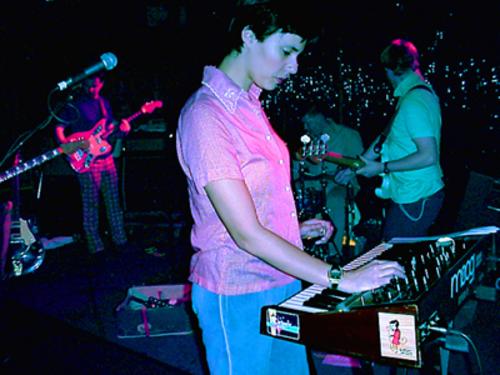
Stereolab on stage – Laetitia Sadier and Tim Gane centre and right

For a band much-acclaimed for their eclectic and dynamic body of work, determined independence and massively collectible output, Stereolab are often overlooked on the list of great live acts. But this does them a disservice. For a time in the 1990s they were the best live band in Britain, and without them this period would have been a long, dull slog through the most dismal excesses of Britpop. Stereolab delivering us gig-goers from an unrelenting diet of Echobelly and Sleeper and this must be added to the list of reasons to hold them to the ears of our bosoms, or something.

Summer in 1993 was hot and concerts were sticky affairs. But my brother had picked up a copy of Peng!, Stereolab’s 1992 debut LP after a chance overhearing in a record shop and bought it home. He and I were quickly hooked by the way it rocked along in parts and grooved in others, intrigued by the French-English lyrics and, most of all, enthralled by the way the entire LP, like Stereolab’s entire output, relied only on one chord. The famous Chord X was employed throughout the bands career and across many excellent albums, but never in such a pure and sprightly way as it was on Peng! So when we spied their name in the small ads in NME a Friday night in Islington at the Powerhaus was in order.

Peng!

Neither of us could rustle up any idiot friends so it was just the two of us, unusually. Maybe this is one of the reasons I remember it so fondly. The Powerhaus occupied a site now filled with a Halifax and an All Bar One, and was one of the last remnants of a time when now hugely bourgeois Upper Street was more like the southern part of Camden High Street. It’s actually on a street officially called Islington High Street, where it segues into Liverpool Road. Other landmarks are London’s biggest news-stand and an always incredibly busy traffic crossing from Angel tube.

As still is my wont, we arrived stupidly early, before the first support had even sound-checked. Three bands for six quid. As Rocket Monkeys, like the other support band, Herzfeld heard from neither before nor since, played their set Matt and I were able to sit and talk with two friendly types sitting cross-legged on the floor of the venue. This couple, it turned out, were Laetitia (Seaya) Sadier and Tim Gane, the singer and guitarist and songwriting team behind Stereolab. Kids these days who can Twitter and Face-party Will Young or whoever it is the hell you like won’t appreciate the simple thrill of sitting and talking in this way. It felt like a treat then and it does now.

Hollar's view of Islington - Powerhaus not built yet

As the room filled Matt and I met more unusual people. First up, an older couple, already in the know about Stereolab called Dave and Wendy who we bumped into at all the best gigs for years to come afterwards. A Belgian called ‘Boods’ who pointed out London indie scenester Miki from Lush and invited us to a free gig at the old Rough Trade store in Neal’s Yard the following day that he never turned up to. It was rubbish. I’ve met dozens of people who claim to have seen the Beastie Boys play a punk set down there in 1993 when there were skaters moshing in Slam City Skates upstairs, but never anyone who yawned and scratched through the Hair and Skin Trading Company. Some things are secret for a reason.

The temperature was rising too. The Powerhaus was sweaty at the best of times and this was a near-aqueous evening. Stereolab came on and proceeded to play an electrifying set. They were always slightly too clever to attract a moshing crowd but everyone was dancing. Tim Gane’s pogoing as he played Chord X all night with a beatific look on his face was unforgettable. Laetitia and the late Mary Hanson, as beguiling a chanteuse as her partner in crime next to her, with a near-identical singing voice.

The show finished on a massive high with an extended version of Stomach Worm (on the setlist as ‘Jealousy’). It was a crashing, bashing, chordant mess by the end, as were the crowd. The Islington night air was broken by the shouts of minicab touts, the laughter of happy drunks and the noise of sirens.

Stereolab avoided the over-hyped and under-talented guitar rock scene of the 1990s and kept their credibility intact to this day. They would do perverse things: release albums with the same song played a slightly different way twice (‘We’re not adult oriented’ from ‘The Groop played Space Age Bachelor Pad Music’) and appear on The Word playing French Disko and then shy away from the fevered hype around this marvellous song. It was good but they made many better and seemed to loathe the idea of having a hit. They virtually gave away fantastic songs on limited edition 7-inches at concerts which now sell for hundreds. But Stereolab were a fabulous band then and remain so now.

The evening has long been a benchmark for excellent evenings out and for sheer musical exhilaration has never been bettered before or since.

Water by Philip Larkin

Water

If I were called in
To construct a religion
I should make use of water.

Going to church
Would entail a fording
To dry, different clothes;

My liturgy would employ
Images of sousing,
A furious devout drench,

And I should raise in the east
A glass of water
Where any-angled light
Would congregate endlessly.

From Philip Larkin’s The Whitsun Weddings, Faber & Faber Ltd, 1964. Reproduced without permission.