Category Archives: Uncategorized

A blast (of cold air) from the past: classic winter football

Chaos as referee loses contact lens, Highbury, January 1926

The unusually long, cold snap we’re enjoying has put paid to football fan’s fun all over Britain. But it wasn’t always this way. The picture above harks back to a different age, from the referee’s jacket and collar to the spirit of getting on with the game and to hell with the cold. I thought it might be of interest to find out a little more about the game captured here.

It turns out it was a cracker. The game was played between Arsenal (in red in the picture above) and Manchester United (in the funky red chevron shirt on the left, which inspires this year’s effort)  on January 16, 1926 before a palindromic crowd of 25, 252. Arsenal won 3-2 (have that, Mancs) with goals by Jimmy Brain (2) and legendary centre-forward Charlie Buchan. Buchan was in the first of three seasons at Highbury, having been signed that August by Herbert Chapman from Sunderland. His 21 goals that season, scored at the age of 34, propelled Arsenal to second place, then their best-ever finish.

Also playing that day was Jock Rutherford, who had just re-signed for Arsenal for the third time aged 41. He went on until March 1926 and, via a spell at Clapton Orient, ended up opening a newsagent’s in Neasden. He is still the club’s oldest-ever player. As for United, they finished the season in ninth place. Huddersfield Town, Chapman’s former charges, won the league for the third successive season.

The Times report from January 18, 1926 notes:

‘The ground presented a remarkable sight when play begun, for the only snow had been cleared had been on either side of the touch and goal lines and in front of the two goals. Around this enormous sheet of pure white was packed a dense crowd of spectators’

The quality of play, however, was debatable, the Times notes:

…the ground was slow of course and the ball hardly bounced all afternoon’

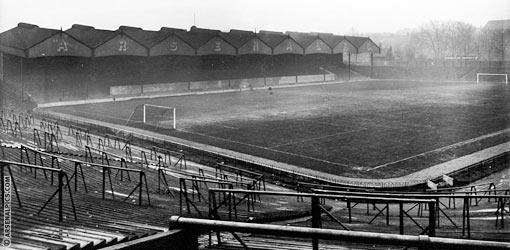
It must have made for chilly viewing for those standing on the terraces. Highbury then was largely as it had been on opening in 1913. As the picture below shows, the ground had opening terracing on the north, west and south sides. Only the east side had seats, this in a classic Archibald Leitch stand with a gabled roof carrying the letters of ‘Arsenal’.

Highbury in the 1920s, looking towards the East Stand from the North Bank

The classic East and West Stands, designed by Claude Waterlow Ferier and William Binnie, the roof on the North Bank and the famous clock – now on the outside of the new Arsenal Stadium – came with the club’s success in the 1930s. Don’t feel too sorry for the fans in the ground, though, they could drink beer while watching and paid just a few pence to get in.

Arsenal’s team that day would have lined up in a 2-3-5 formation favoured at the time. The team was Harper (GK), Mackie, John, Baker, Butler, Blyth, Rutherford, Buchan, Brain, Neil, Haden. If any United fans have information about the chap in the picture, their scorers or team that day then drop me an email.

Thanks to Ian Kirk at Arsenal Football Club for his help with some of the details of this article.

– Tom Hall

Cycling in Denmark: Aalborg to Skagen

Cyclists this way (Wikimedia Commons)

This is from a trip to Jutland in 2008, and rescued from the vaults.

Denmark is flat. It must be flat, because everyone says so. It is with some surprise then that I find myself hissing ‘It’s supposed to be flat here’ as I sweat my way up another short, sharp hill on a bicycle that while sturdy and upright, is clearly built for cruising round the heavenly cycle lanes of the country’s northern cities.

This is not the only surprise that greets me while cycling 75 miles – plus detours – across north Jutland, from Aalborg to Skagen by bike. Danes, it appears, do not cycle like I do. Like many commuter cyclists, I like wearing as much unflattering cycling gear as possible and charging off at breakneck speed. Danes glide along in everyday clothes, seemingly incapable of sweating or indeed getting even slightly steamed up. Mikael Colville-Andersen, who runs the Danish cycling website Copenhagen Cycle Chic explains why. Cycling, he says is ‘a social activity for people first and a sport second.’ Colville-Andersen takes this philosophy to heart, and his website is light on practical tips and heavy on pictures of pretty girls on bikes. An emotional approach to cycling also explains why everyone in Denmark appears to be riding granny bikes. ‘Danes will go for colour and style – and it’s definitely style over speed’

Resplendent in Kraftwerk-esque black lycra cycling gear with angry bumblebee pannier bags, style was never going to be a problem. Speed, however, was leaving much to be desired. This was only partly down to my grey granny bike which would have had London commuters sniggering at me at the lights. Aalborg, Denmark’s fourth largest city and the starting point for my journey was home to enough great-looking cafes for a dozen breakfast carbo-loading sessions. It was tempting to linger. By the time I’d detoured via Lindholm Høje, Denmark’s largest – and very cool – Viking gravesite, my vision of idly pedalling along for eighty or so wind-assisted miles in a day seemed somewhat foolish. Not that doing something foolish is a problem. Having got used to the head-shaking reaction of friends and family at many dubious travel plans over the years, the English eccentric on holiday label sits comfortably on my shoulders. It was no more than a pleasant surprise that the good people in the Aalborg tourist office said I was ‘crazy’ when I told them my route plans. It was a sure sign of a good trip in prospect.

Undaunted, I hit national route 3 and put my foot down. The path largely follows the Old Military Road up the spine of Jutland, the peninsula that makes up the largest part of Denmark. Copenhagen, the usual destination for the 700,000 Brits (this figure is growing) who visit every year, is a few hundred miles away on the island of Zealand. Soldiers, merchants and pilgrims have passed this way for centuries, travelling from other parts of Scandinavia to central and southern Europe. They avoided soggy feet by following the contours of the land rather than blazing a trail across rivers and streams. The path remains rural and beautiful: it passes stone circles, visits medieval castles and crosses forests full of wildlife before hitting the coast and joining route 1, which leads north and east to Skagen.

Tilsandede Kirke near Skagen (Wikimedia Commons)

Route signing, as you might expect, is immaculate. The Danes are proud of their cycle paths. ‘Denmark was the first country in the world to develop a national bike route system and there are over 10,000km of signed bike routes.’ explains Colville-Andersen. ‘From the nineteenth century, Cycling Unions were well-organised and politically active and cyclists’ voices were heard.’ The result is a served as the blueprint for our own National Cycle Network – and is a boon for holidaymakers.  It only goes wrong when you ignore it and attempt to build your own route visiting nearby places with silly-sounding names like Pajhede Skov and Uggerby. I learnt this to my cost mid-morning, when  pondering that the bloke I was passing on my left hitting golf balls looked just like the bloke I’d passed twenty minutes ago on my right. He was the same chap. Lesson learnt: stick to the signed route.

Chastened, I returned to route 3 and, turning back into a London cyclist, started chasing the only other riders I saw all day. They seemed to be wearing their Sunday best and riding bikes straight out of Last of the Summer Wine. I expected to catch them quickly. They disappeared over the next hill and I didn’t see them again. Mikael Colville-Andersen later told me that these bikes are standard issue in Denmark. In fact, Danes insist on them: “Each year about 500,000 new bikes are sold in Denmark. Bikes are an important accessory for Danes and it’s an ever-changing market, even if the bikes are, as a rule, granny bikes. Even companies like Raleigh and Batavus have models only available in Denmark for the Danish market.”

Despite the occasional hiccup, there were enough wow moments to ensure I felt pretty smug all day. Being a bike commuter the quiet roads and respect for cyclists were remarkably refreshing. The morning’s sunlit fields of head-high corn and long grass gave way to forest trails and, as afternoon rolled on to sandy heathland. As the afternoon sunshine began to redden the bits of my body not covered in lycra I got my first whiff of the sea. Suddenly I was on holiday, surrounded by Danish families on bikes, pedalling out to the dunes and into small towns from their holiday homes. I joined a crowd paying a respectful visit to Dens Tilsandede Kirke, a medieval church lost to the sands in the eighteenth century. A reminder of the centuries-long battle against encroaching sand in this part of the world, it’s used as a navigation aid and a rest-stop for knackered cyclists starting to think the people at Aalborg’s tourist board might have a point.

Granny bike or not, I made it to Skagen, with lengthening late afternoon shadows and a strong breeze hastening my progress through dense beech forest and past the towering dunes of Rabjerg Mile. It seemed I had arrived in the Danish Cape Cod, complete with clapperboard houses and an unmistakable air of fishy gentility. My hotel owner greeted my explanation of how far I’d come with a friendly incredulity, which made me feel even better. The scene in Skagen revolved inevitably around the harbour. Yachties from Norway, Sweden and Germany scoffed freshly caught £5 fish and chip suppers – and they said Denmark was expensive – and swapped stories long into the night. Another surprise came as the temperature dipped: a triumph of function over Scandinavian style. Rather than retreat inside, outdoor drinkers wrapped themselves up in thick, beer-branded blankets and continued grogging.

Skagen has a lot going for it, especially in summer. The Danes know this and do their best not to tell anyone. Everyone in town is especially proud of the light in Skagen. It is, apparently, famed throughout the country for its ethereal qualities and every local I spoke to wanted to know what I thought of it. It was an interesting question, especially as the main thing I was thinking about was how my buttocks were feeling after yesterday’s exertions. But as light goes, it had a certain something, especially from under my nice warm blanket with a cold, cold beer.

The Skagen light has inspired painters for years, and while the town’s excellent art museum concedes that actually it’s the same light as everywhere else. If something special is going on it’s probably all the sand making everything seem brighter. The museum is celebrating its centenary this year with a superb exhibition of Skagen art, including works by PS Krøyer and Michael and Anna Ancher. The museum also provides another insight into the Danish cycling psyche. A timeline of local and world events exclaims in big bold type that in 1861, Ernest Michaux invented the modern bicycle. The publishing of Darwin’s The Origin of Species two years earlier is a footnote in small type. The visitor is in no doubt which event is of greater importance.

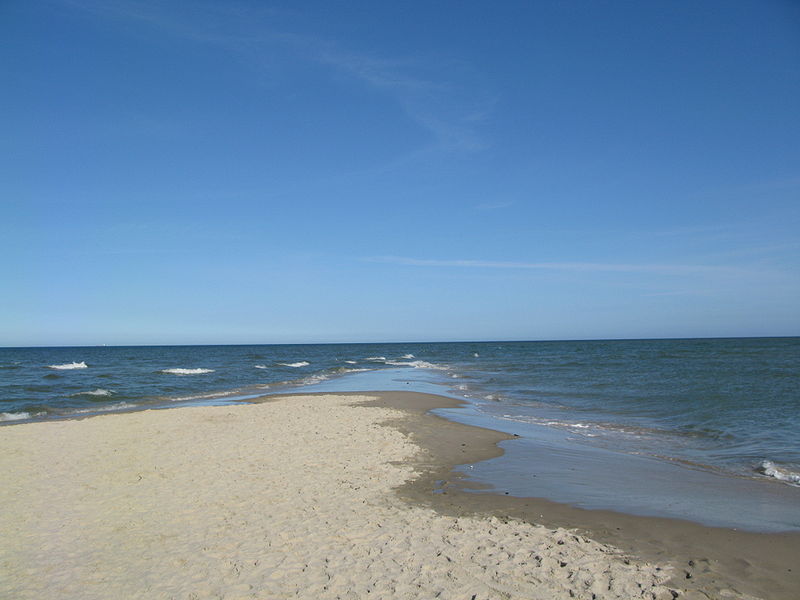
The cycling, however, did not stop there. Skagen is best explored by bicycle, especially as the town’s big draws are a little spread out. Over a million Danes each year visit Grenen, the sandy tip of both Skagen and Denmark. They all, it seems, have the same idea as me: shoes and socks off, trousers rolled up, digital camera out. This means that the natural beauty of Grenen gets a little lost in an orgy of camera-swapping and sprints into the frigid surf. If you prefer a more sheltered setting to appreciate the light, Skagen Odde, the Jørn Utzon-designed nature centre a mile or so across the sands from the town is a temple to natural light and elements. As well as displays on the local ecosystem has an impressive collection of 1960s and 70s Olivetti computers and serves excellent coffee. It still asks happily museum-like questions: one display invites the visitor to ponder whether vikings did indeed ‘bring a new type of mussel from America?’ Answer: probably.

Europe's end: Grenen

Reluctantly, the next day I took the train back to Aalborg, and after another fantastic lunch at an outdoor cafe moved on to Århus, another Jutland gem and Denmark’s second largest city. It’s also another cyclists paradise, with row upon row of bikes stacked around the magnificently frescoed cathedral, a short pedal from the Latin Quarters coffee houses and music shops. The city’s other big draw, the Bronze Age Moesgård Man is a more taxing excursion six miles south of the city.  Judging by how full my Ryanair flight home (£4 including taxes – again, who said Denmark was expensive), word may be getting out about this part of Denmark. Explore it on two wheels to see it at its best.

Factbox

Tom Hall returned from Århus with Ryanair – a wide range of fares are available. He stayed in Aalborg at the Radisson SAS, doubles start at £53 per person including breakfast. In Aalborg, bikes can be hired from Munk’s Efterfølger. For more information about north Jutland, start at Visit Nordjylland and Visit Denmark (020 7259 5955 ).

Travel highlights of 2009

Over on Lonely Planet I’ve posted my travel highlights from the past decade. Here, I thought I might run the best bits from 2009 before the year is out. What are yours?

Leaving Zimbabwe on the Victoria Falls Bridge

Feeling the torrents of Victoria Falls on my bare chest. Lacking a rain mac, I whipped off my top and let the surging Zambezi Waters do their worst. One wonder of the world which lived up to the name. While in Zimbabwe I picked up a few $100 Trillion bills, which made for good presents. I gave one to Tony Wheeler, who left in on Jack Kerouac’s grave in Lowell, Massachusetts. Jack gave me my first itchy feet, so this felt quite appropriate.

One hundred trillion dollars - as Dr Evil would say

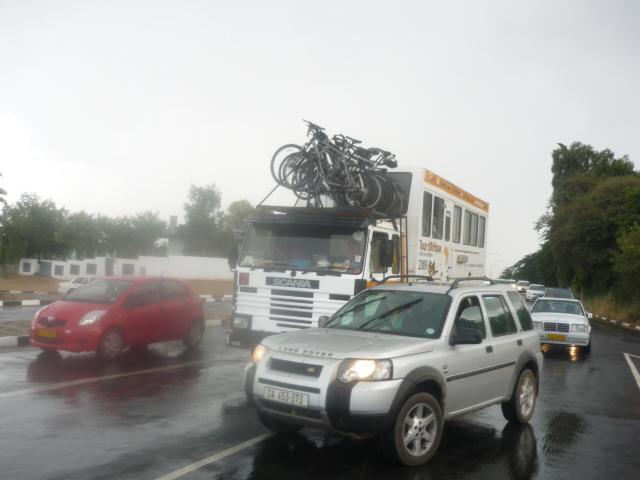
Riding through the Windhoek (Namibia) rain and rush hour to finish my stage of the Tour d’Afrique, one of the finest adventures of my life.

Like the man himself, Windhoek's Robert Mugabe Avenue goes on forever and induces misery

Eating chips on the Kusttram in Belgium, and getting on Marvin Gaye’s trail in Ostend.

Thor Heyerdahl’s Oslo: the Kon-Tiki discovered, and warming up in the Tiki Bar before walking beautiful Autumnal streets.

Oslo Opera House

I loved being in transit at Changi Airport, and went for a swim at sunset. If only all airports were like this.

A happy picnic lunch at the Gare de Lyon, Paris, then across France by TGV, to a tiny hameau with a river at the end of the road to swim in, and my family to have fun with.

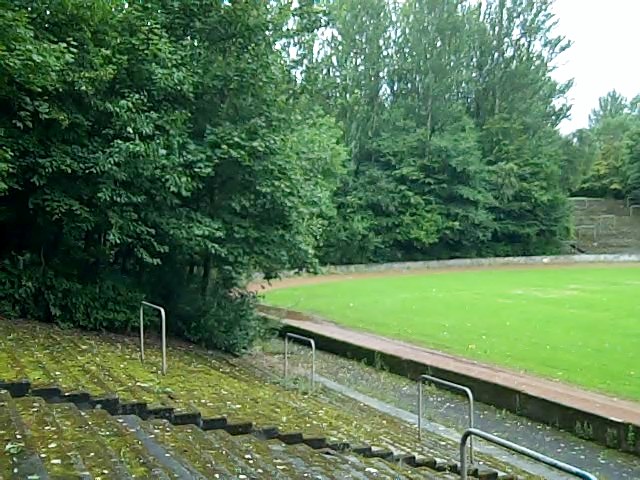
Glasgow, at last. So many highlights, but drinking 1% ginger beer in Monorail Records and communing with the ghosts of the Hi-Hi in Cathkin Park. Then being far too excited to sleep on the Sleeper Train home.

Glasgow's Cathkin Park

London to West Brom: a grand bike-ride

England’s wonderful secrets: a church in an Oxfordshire field, a summer’s evening at a riverside pub in the Norfolk Broads, a man’s face at The Hawthorns as I told him I’d cycled from London, fell running on the West Riding, the London Transport Depot in Acton and Gunnersbury Park.

Here’s to a great 2010. Happy Christmas to everyone who has stopped by this year, and I hope to see you again.

Secret Amsterdam: the Rijksmuseum under wraps

It’s too early to call it even a sneak preview, but my hard hat tour of the Rijksmuseum in Amsterdam was nothing less than thrilling. The museum closed its doors in 2003 for a complete refurbishment after decades of less-than-sensitive alterations to Pierre Cuyper’s iconic 1903 structure. There is a limited display of the museums masterworks, which happily includes Rembrandt’s The Night Watch and a few paintings on display at the city’s superlative-inducing Schipol Airport. This winter an exhibition of Hendrick Avercamp’s lively paintings of Dutch ice skating in the seventeenth century fits very well with what was a frozen city when I visited. The rest, comprising thousands of priceless works, stays underground.

The Rijksmuseum

If from the outside the Rijksmuseum resembles a building site that’s because it is one. My behind-the-scenes peek involved donning hard-hat and steel-capped shoes and promising not to take pictures. But the Rijksmuseum is a work of art in itself. Cuyper defied convention to produce an ornate and colourful building at odds with the Calvinist restraint dominating Dutch culture at the time. His work is shining through the scaffolding. Each hallway, room, stairway and chamber homages a different architectural style. You walk through a Gothic hall into a room filled with classical columns, then into a mock-medieval monastery. Staircases resemble a fairy castle. Stained glass and column mountings homage in name and image the great artists and buildings of the Netherlands. And underneath it all, a 9m-deep excavation has been designed to ensure that cyclists will be able to pedal their bikes right through the museum. They’ve been able to do this since it opened, we are told, it’s only right that this should continue.

Our guide rushed from room to room, raving about Cuyper’s work and the ambition of the renovation work. The enthusiasm was contagious. By the time the museum reopens in 2013 half a generation of visitors to Amsterdam will have missed out on seeing one of Europe’s finest art houses. Early indications, however,  are it will be worth the wait. And let’s be honest, there are worse places to have to find something else to do than Amsterdam. Take the Hermitage Museum, opened in June to great acclaim and housing a revolving collection from St Petersburg’s legendary palace.

Multi-storey cycle park at Amsterdam Centraal

Here’s my video of the trip.

My Talking Travel podcast with Public Radio International’s ‘The World’

Clark Boyd from PRI, Lonely Planet’s US Travel Editor Robert Reid and myself have recorded a couple of podcasts which we hope will form part of a regular series.

You can find them at Talking Travel with Lonely Planet & The World

And while we’re doing multimedia, here’s a video of me and fellow rider Mara Vorhees on the Tour d’Afrique

Comments welcome!

Kings Cross Underground Station – northern ticket hall opens

Arriving back at St Pancras after an afternoon out giving a talk at a school in Derbyshire I noticed that the escalators leading down from the eastern exit to the concourse and down under Pancras Road were open.

Descending into the Underground station’s new northern ticket hall, freshly opened this week, was a revelation. As anyone who’s tried to buy a ticket on a Saturday morning will testify Kings Cross has needed huge amounts of new space, ticket machines and information booths for years. And now it’s got it. The escalators to the Northern Line (I haven’t explored the other lines yet) bypass the chaos of the old access points completely. The prominent signage to the Regent’s Canal is another nice touch.

It’s slightly disorienting to suddenly have a different set of twists and turns to negotiate. This map from TfL helps make sense of it. Click to enlarge.

London has one terminus (St Pancras) to be proud of, King’s Cross being fast renovated and a tube station for them both that’s finally heading in the right direction. The escalator up from the Piccadilly Line with gaping holes in the roof will not be missed. More from TfL

BBC Knowledge, the World and a heap of great travel ideas

I teamed up (wearing my Lonely Planet hat) with BBC Knowledge to help them promote some programming themed around ‘The World’

The result is a site in English and Polish which take readers on a trip around the world, helping  them plan their travels according to their interests and passions. You’ll find my suggestions for the world’s best ancient sites, country retreats, underground experiences, activity trips, star-gazing, lost cities, train journeys, movie locations, cycling trips, relaxing, sea views and road trips. I’d love to know what you think.

Click here to take a tour.

More on Marvin Gaye – Ostend Terminal

I get a lot of Marvin Gaye fans coming to the site, hopefully who aren’t disappointed by the brief mention of his time in Ostend in this article.

There’s a classic documentary about the soul legend’s time in Belgium, Ostend Terminal by Richard Olivier. As well as showing Marvin at peace and performing beautifully it documents his thoughts on Ostend, often to a backdrop of black and white footage of the town in its belle epoque heyday.

Marvin + Ostend = Sexual Healing

In perfectly describing the port as ‘a beat back, maybe two beats back’ from the cities he was accustomed to living in Gaye shows a talent for catching the spirit of a place.

You can find the full documentary here.

The Guardian’s David Stubbs also wrote an excellent piece about Gaye’s time in Ostend in 2005.

Two new articles on Lonely Planet

Here are two recent pieces I wrote for Lonely Planet:

The world’s hottest cool places

Europe’s best night trains (with nice wallpaper)

Comments welcome there or here!


A very fine cat indeed

‘There is in London all that life can afford.’ – Samuel Johnson

The alleys and lanes snaking north from Fleet Street are full of interest, and are an easy detour for a quick fix of London history. Their car-free atmosphere offers a taste of how London once was, with city workers hurrying here and there. If you follow your nose you might end up at Gough Square, home to Samuel Johnson’s House and what, as far as I know, is the only statue in London devoted to a domestic cat.

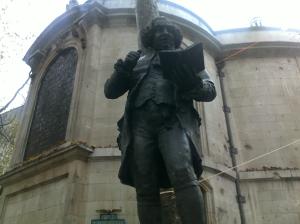
Dr Johnson hiding round the back of St Clement Danes on the Strand

Dr Johnson hiding round the back of St Clement Danes on the Strand

Hodge, the immortalised moggy in question, lived with Johnson in the house on Gough Square for many years. So devoted was Johnson to him that he’d go out to personally buy him oysters, then so plentiful as to be staple grub for London’s poor.

Hodge - note the oyster shell

Hodge - note the oyster shell

Dr Johnson, who was prone to black moods, seems to be have been most upset by Hodge’s demise. One of his inner circle, Percival Stockdale, eulogised Hodge in an apparent bid to cheer the Doctor up.

Here’s an excerpt:

The general conduct if we trace
Of our articulating race,
Hodge’s, example we shall find
A keen reproof of human kind.

And Stockdale concludes:

Then in thy life exert the man,
With moral deed adorn the span;
Let virtue in they bosom lodge;
Or wish thou hadst been born a Hodge.

Not lucky enough to have been born a Hodge, it was a black cab back to the office for me.