
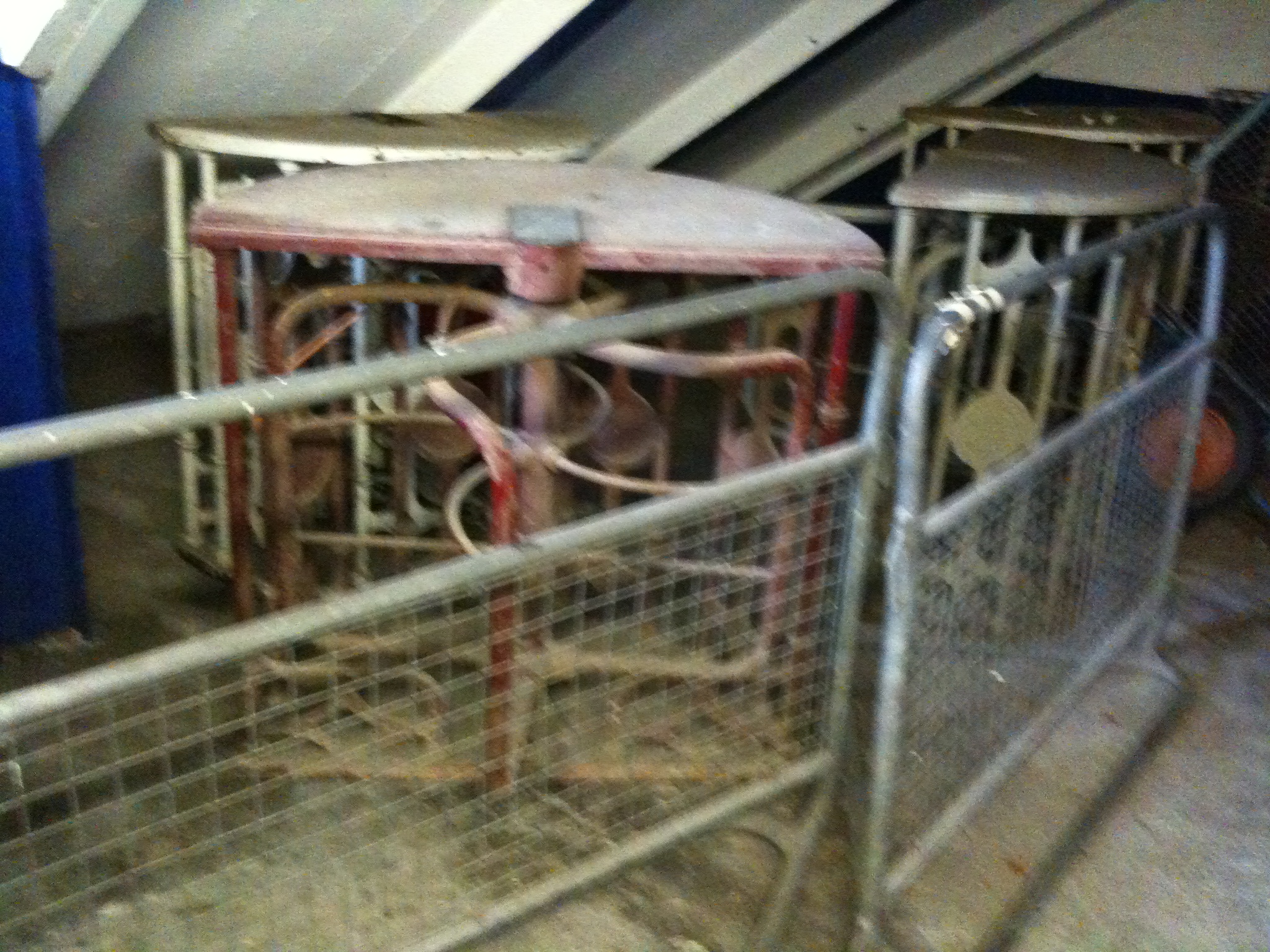
Old turnstiles gathering dust, Bullens Stand

Rush preventative turnstile

Pitchside punning

Happy travellers
Old turnstiles gathering dust, Bullens Stand
Rush preventative turnstile
Pitchside punning
Happy travellers
Posted in Uncategorized
Tagged Archibald Leitch, Arsenal, Everton, Goodison Park, Turnstiles

Breathing the lonely word
Regular readers might know of my enthusiasm for Felt, one of the great lost bands. They’re a little less lost right now, thanks to Cherry Red’s reissue series and name-checking by the likes of Belle and Sebastian.
Another landmark in frontman Lawrence’s road to redemption and the legend status he always knew would come one day is the publication of Foxtrot Echo Lima Tango, a fanzine devoted to the band. The first edition sold out quickly, but a fresh print run has just become available. It is limited in numbers but is £10 very well spent.
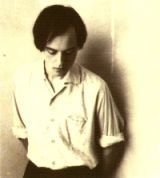
Lawrence: (sur)name dropper
Fanzines were the predecessors of websites devoted to bands. Hacked together with little more than scissors, glue, a (possibly illegally) commandeered photocopier and bags of enthusiasm. I loved music and football zines, especially for their DIY can-do approach. Smiths Indeed typified them.
Foxtrot Echo Lima Tango is something else though. It’s as beautifully written and thoughtfully packaged as Felt’s albums, and as close to a miscellany about this most mysterious of bands as you’ll find. Reading it makes Felt’s place among bands like the Jesus and Mary Chain, the Smiths and Cocteau Twins in the canon of 80s guitar music much clearer, and you’re sure to laugh, frown and read open-mouthed about the band’s near-misses with fame.
So big up Christian and Mike for shining a little more light on Felt. Read and listen on.
Posted in Uncategorized
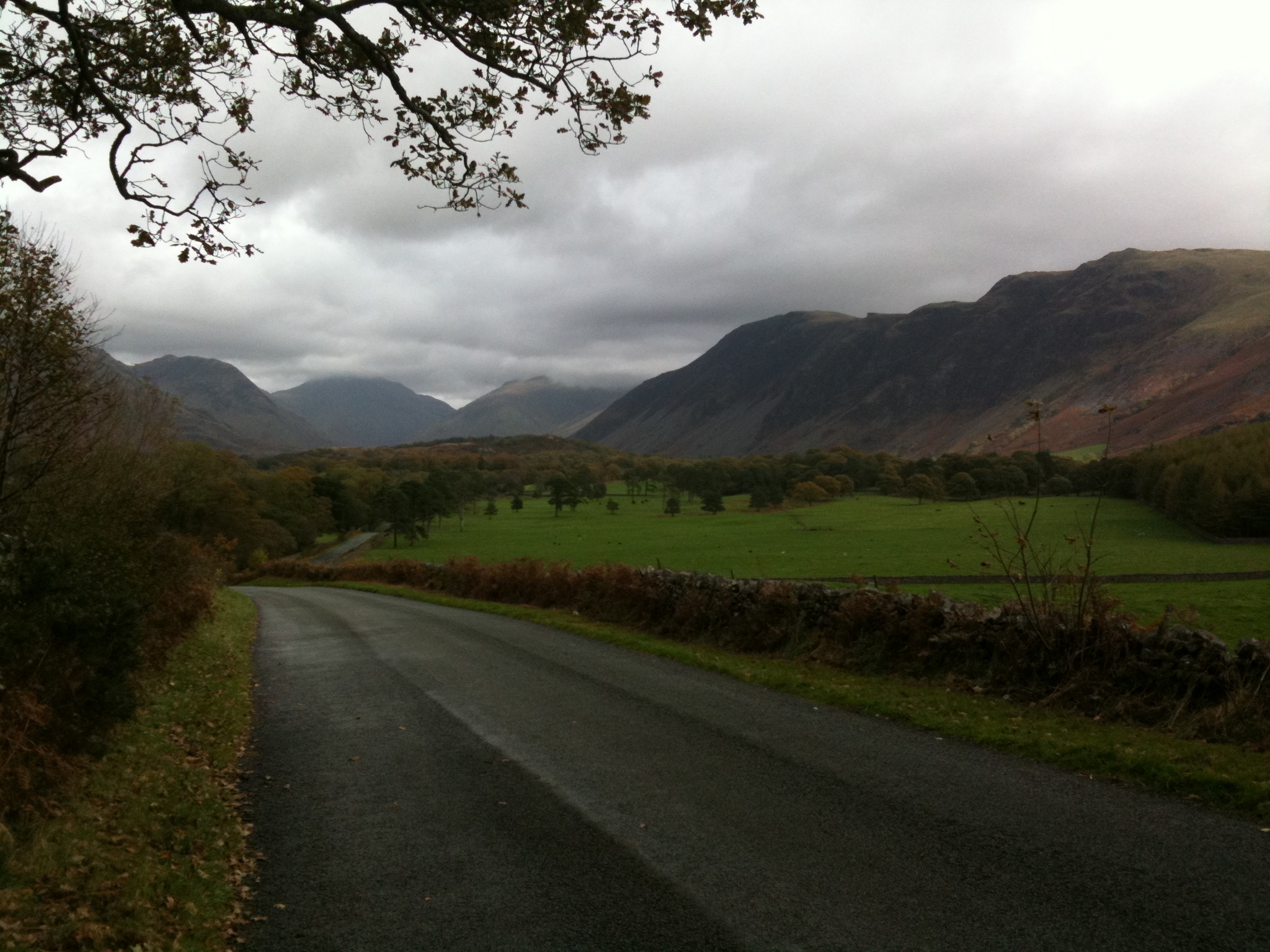
Distant Wasdale
The best way to reach the lakes? The snaking, traffic-trodden M6? Crammed up against a beer-bellied chap with a large bag on a west coast mainline train to Oxenholme or Penrith, then begging a lift? How about none of the above?

Lost in the world of modern railways is the Cumbria Coast Line, a two-coach throwback to another era, complete with request stops, signal-box attendants who double as gate-keepers for level crossings and an abundance of wonderful scenery. You’re probably not surprised by the looming, brooding fells – though Cumbrians are a no-nonsense bunch and you won’t see poets scribbling lines in awe of the hills on board – but the delicate wetlands, estuaries and tidal flats of the coast are less celebrated. Yet this is a journey to savour.
In fact, the Cumbria Coast line may save you time too. The south-western fells around Wasdale are notoriously time-consuming to get to from the motorway. If Langdale and Borrowdale are an hour from the big roads, Wasdale can be close to double that. Ravenglass, Drigg and Seascale are all ten miles or so from the western tip of Wasdale, and can be reached from London, with kind connections, in four and a half hours.
The lakes unfold slowly and deliberately. Just north of Lancaster station, where you’ll leave the main line unless bound to do so at Preston by a service running fewer options, you’ll get your first view if the mountains glowering at Morecambe Bay. Though this is the best known of the tidal flats n the Lancashire and Cumbria coasts it is by no means the only one. Carnforth, famous as the setting for Brief Encounter, is next, with rusting boilers from steam engines sitting alongside mighty diesels at Steamtown, an open-air museum dedicated to locos from the past. At Barrow-in-Furness, where the Royal Navy’s submarines are built you change from the zippy sprinters services to the Cumbria Coast line proper.
There’s more for rail-buffs of all ages at Ravenglass, close to my one journeys end. Here L’al Ratty, a narrow-gauge railway, climbs up to eskdale on a very scenic journey. Muncaster Castle next door offers tamer appeal, with gardens alive with colour year round.
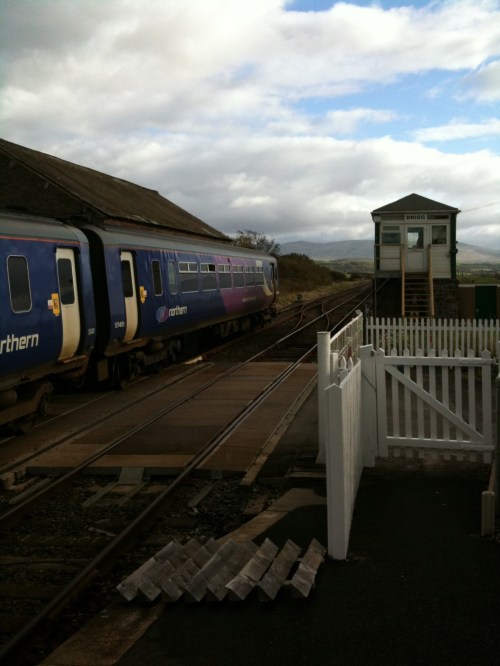
Request a stop at Drigg and have the station to yourself
The route crosses some of England’s most isolated spots, hiding amidst the folds of assorted Lakeland river estuaries, the North Sea and the cloud-covered Fells. The sun is intermittently blinding with the kind of fresh, sharp light that rain and breeze puts into sharpest focus. Who needs to travel this beautiful stretch of the Cumbrian coast on a Thursday afternoon, bound for Ravenglass, Seascale and Carlisle? No-one except me it seems. So I have the train to myself until I get off at Drigg, a request stop. Requesting it seemed to surprise the Guard, whose tone of replying ‘really?’ to my request lends me to think that either no-one ever does or that it’s really not my kind of town. To my right, the bracken is a bright orangey-brown on steep, hummocky hills.

Burnmoor Tarn, reached via the Old Corpse Road from Wasdale
The highlights of this journey are many. On the first leg to Barrow in Furness, the crossings of the Kent and Leven viaducts are astonishing, ever-changing vistas. Water and mountains are everywhere yet the train appears suspended, almost floating above it all. It looks more like the north-west of Scotland than the Lakes. A golf course with links on rocky promontories looms into view, then quickly passes. Wading birds find safe havens in the oxbows and inlets, the seagrass and sands out the window.

Oliver’s Gill: good scrambling
As I get off at Drigg, I wait while the train pulls away bound for distant Sellafield, Whitehaven and Carlisle. There’s much more to explore on the coast, but I’m headed inland via a wonderful road where the mountains reveal themselves through folds of foothills. And then there it is: Wastwater. Not the biggest, not the most spectacular of the lakes but for me, the one that takes the prize as the biggest classic. As I slowly cycle its length to journeys end, the calm of England’s greatest landscape is already working its magic. If I were to stay forever would anyone mind?

Wasdale sunset
Posted in Uncategorized
Tagged cycling, England, Lake District, Ravenglass, trains, travel, walking, Wasdale, Wastwater
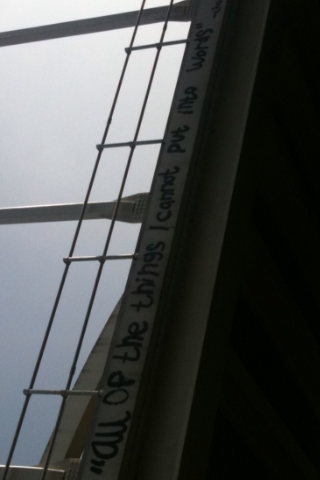
This probably counts as slow graffiti. I wonder what daring type managed to do this, dangling over the shallow water of the Regent’s Canal while on the lookout for trains?
Richard I, Cœur de Lion, the Lionheart, is thought of as one of England’s finest rulers. Here’s his statue outside the Palace of Westminster, known to you and me as the Houses of Parliament.
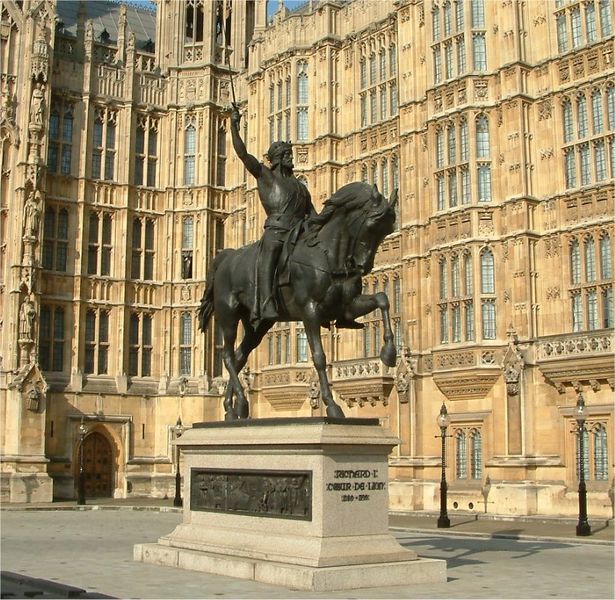
Grr!
You don’t see too many other kings round there – after all, Parliament lopped one of their heads off once, and made life hard for plenty more. So he must be a pretty special chap in English history?
Well, sort of. When he finally got his hands on the throne of England, after years of plotting against his old man Henry II, having been egged on by his mum and Henry’s wife Eleanor of Aquitaine, he didn’t exactly take England to his bosom. He only spent six months in the country during his reign, splitting his time between crusading the Holy Land – where he failed to recapture Jerusalem from Saladin on the Third Crusade – and squabbling with Philip Augustus of France over Normandy, Anjou and lands in between. He was also captive for over a year, the hostage of his enemies in the Holy Roman Empire. Like noblemen of the time in England still breathing the fire of William the Conqueror he spoke French not English.
One thing that is indisputable is that he was a great warrior and general, and it is from this that he gets his reputation as something of a badass. Which makes the circumstances of his death almost comical. In March 1199 he was beseiging an unimpressive castle in Chalus, located in what is today the Limoges region and, feeling confident, was touring the perimeter without chainmail on. He was shot by one of history’s more obscure names, Bertrand de Gurdun, armed with a crossbow which hit its intended target in the arm, which became gangrenous.
In those days, it seems, one did not simply shoot someone like Richard, regardless of having the chance to. So, sensing the end was near, he called for the chap to be brought to him and asked why he had shot him. The archer replied that Richard had killed his father and two brothers and – not unreasonably – that he had intended to kill him. Richard magnanimously forgave his killer. Once the King had breathed his last the fellow was seized by Richard’s furious aides, who were less obliging. He was flayed alive and hanged.
Richard’s heir, John, lost all his French possessions and the Lionheart himself now only turns up to save the day in Robin Hood films.
Life could be cruel in the Middle Ages.

Inside the old booking hall of Hlavni station
I’ve just got back from a flying visit to Prague, my fourth and shortest visit to the city. Somewhere along the line the Czech capital has become the biggestndraw in central Europe, behind only Paris and Barcelona in the European league table of most popular of city destinations. It’s not as cheap as it once was, but that’s not necessarily a bad thing. The stag groups who once mobbed the Irish bars of the Stare Mesto – Old Town – have packed their bags for unfortunate stops further east in search of pints which cost less than a pound. they’ve left the city in the clutches of tour groups in search of gothic bridges, classical music in Baroque halls and foaming glasses of Czech beer.

Prague, Mother of Cities
1995 seems a long way away now, and the city then may have already begun morphing into the propserous, if less distinctive city it has become. But when I stepped off the train from Vienna, which had sped across the shimmering central European plain in the scorching summer of that year Prague felt only just out of the clutches of communism. The big western brands were here, but not in the force that they are today, and there were mullets and 20p pints eve in the most perfect back-street old town bar. My then girlfriend and I stayed in a room in an apartment owned by an elderly Czech widow who spoke enough English to thrill us with her accounts of the Second World War and the slamming shut of the Iron Curtain. Outside the big windows of that apartment thunderstorms broke the stifling heat.
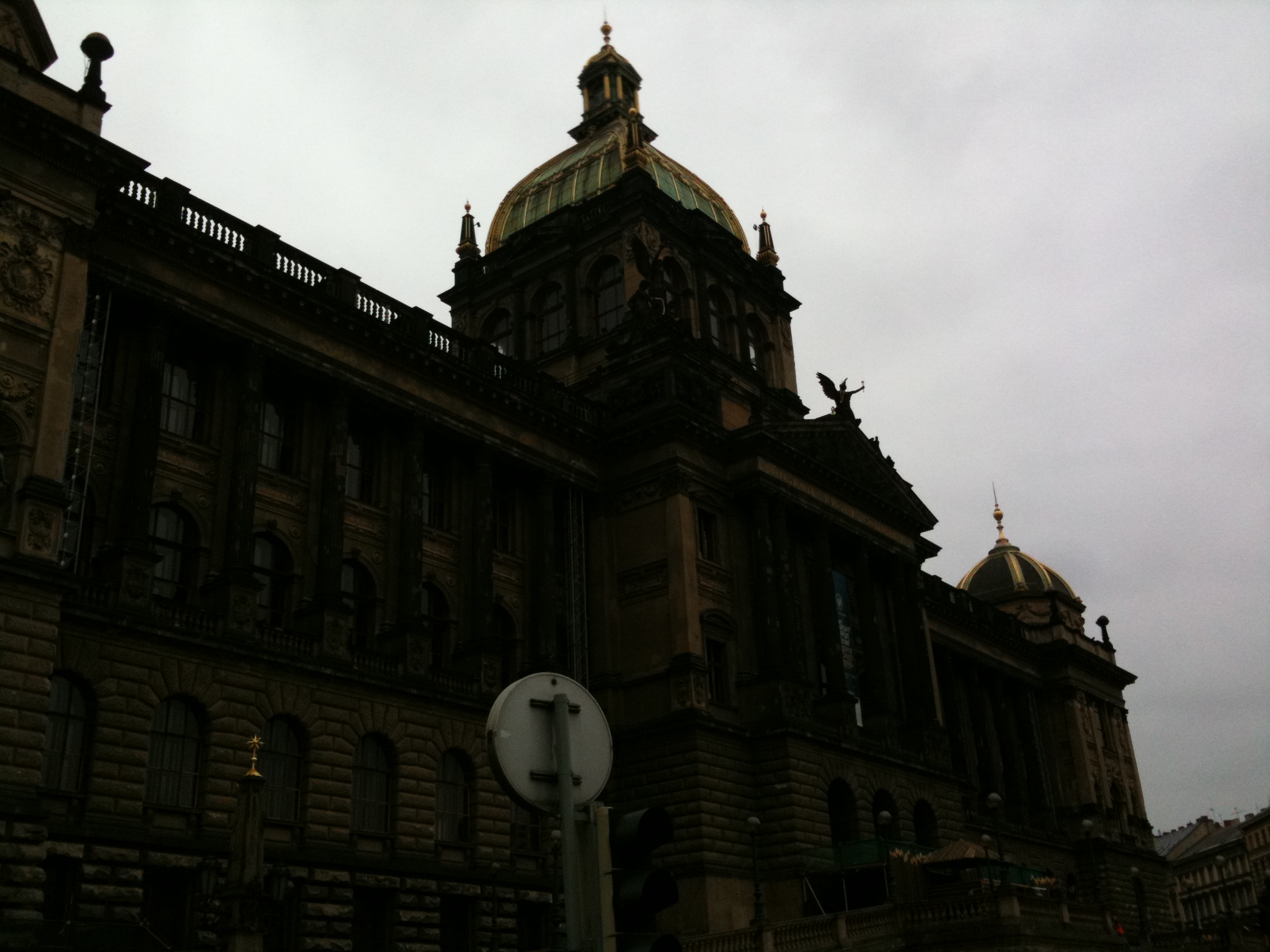
National Museum
So in the two hours I had free to explore I set out to revisit some of the half-memories of that stay. Most prominent was the National Museum (evocatively emblazoned with the inscription ‘Musei Regni Bohemiae’, standing sentinel over Wenceslas Square. As I stood on the steps of that building and looked north-east I spotted the twin arches of Hlavni station, dotted with statuary. A walk there revealed a real find. The station is a treasure trove if art nouveau, a gallery of mosaics, wrought iron and gabling with tracks running beneath it. The best part, shunned by the decision to build a six-lane motorway next to the former main entrance, is the original ticket hall. Stop by if you’re in town.
A great walk from Hlavni is to thread through back streets to the Charles Bridge, the Eiffel Tower of Prague, even if the reality is crowded with slightly underwhelmed day-trippers missing the point by taking pictures of themselves with the Vlatava – and no bridge – in the background. The highlights of this walk are too many to mention, just point yourself in the general direction and meander.
And that was that. Time to go, just a tiny taste of Prague. In 1995 I hopped on a train to Stuttgart, exiting via Hlavni’s hallowed tunnels, swapping to a service through Milan to Switzerland that is still the most beautiful rail journey of my life, and from there along the French Riviera to Cerbere – Port Bou, then finally an agonizingly slow and busy local service on to Barcelona. But Prague, well, it’s different.
Posted in Uncategorized
Tagged Prague, Prague Hlavni, Prague railway station architecture, Prague walking tour, Praha
If you travel as far as you can from London, without leaving the ground, but staying in England, you end up in Northumberland. Your journey to the rump of ancient Northumbria will not be in vain. This last piece of Albion is a peach. Here you’ll find castles and beaches, villages lost in time and brooding hills. And in a short distance you can spend a week or more. Here are treats for those who make it this far.

Lindisfarne Priory ruins
One day I shall go to Alnwick and do nothing more than visit Barter Books, a wonderful labyrinth of a second-hand bookshop. It’s easy to lose yourself in this old railway station, with a toy train rattling quietly over the tops of the shelves. You get a discount if you spend more than £50, which I did solely by stopping by their London section. There’s a cafe which serves cake, tea and other good fuel for keen readers, who may enter some kind of state of Nirvana here.
Alnwick’s headline attraction, however, is not this literary gem, it is the Castle and Gardens that stand between the A1 and Alnmouth and the fine market town itself. Both are beautiful and interesting, but if you’ve already tested the patience of any young children in your care in Barter Books, or plan to do so later, make the Gardens your first stop.
The quiet lanes of Nortumberland’s backroads hum with the din of tractors and diggers going about their daily business, and kids will love messing about with the sit-on pedal powered versions at Alnwick Gardens. Provided you can tear them away from those, there are fountains to paddle in and shovel water to and from – bring a change of clothes – and a huge treehouse restaurant with observation tower and rope-bridges straight out of Return if the Jedi, but minus rebellious minature bears.
At Norham, by the church of St Cuthbert, you can see where St Aiden (check!) crossed the Tweed on his way from Iona in 635. If the weather’s good, you can dive in and re-enact the crossing. The Tweed is a fine wild swimming river, and there’s another fine way in on the Scottish side of the Union Bridge. In early September it was clear and cool, maybe 14c. Aiden went on to found the Priory at Lindisfarne, or Holy Island as it’s known today. Aiden went on to found the Priory at Lindisfarne.
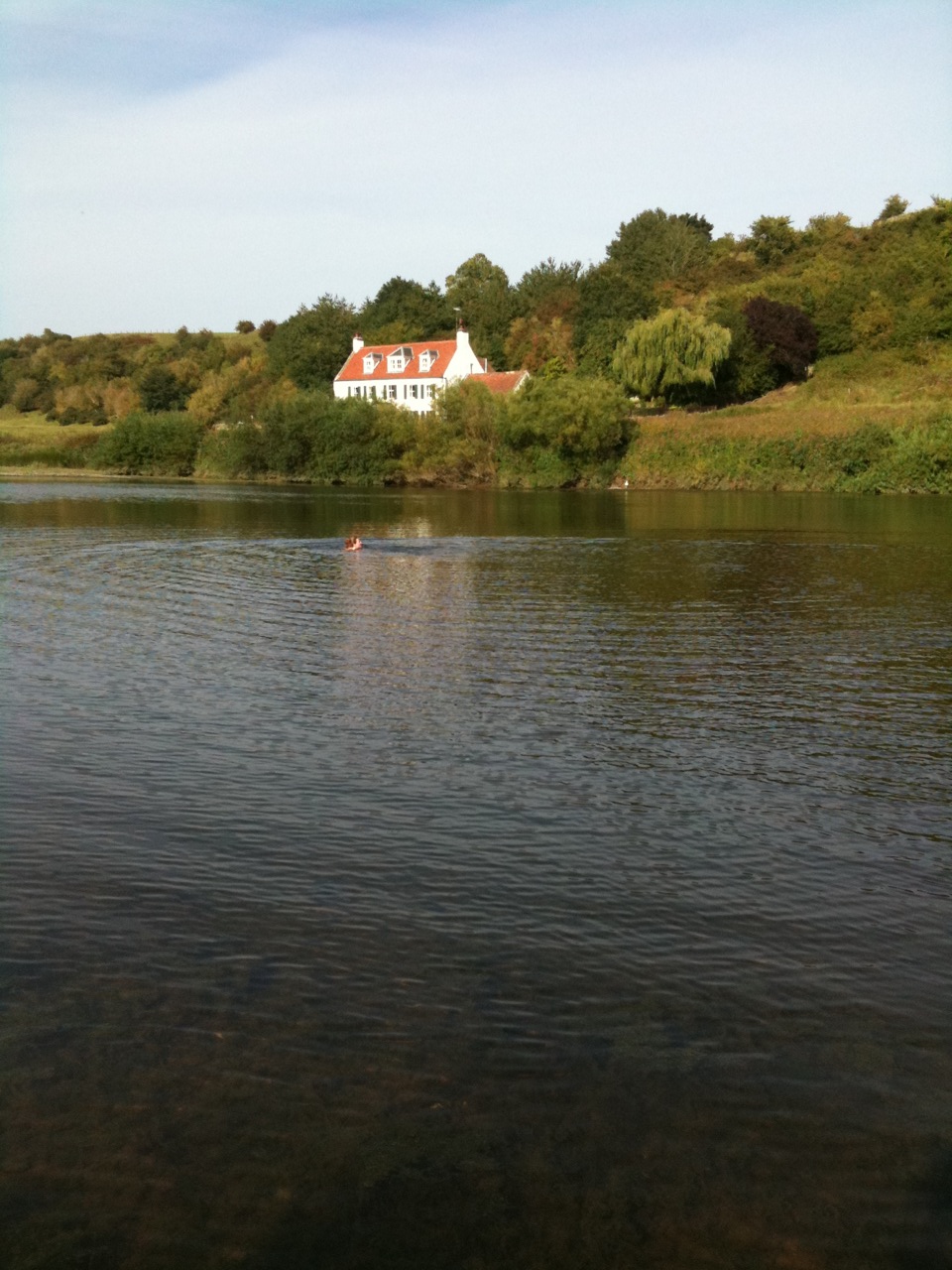
A dip in the Tweed
By the way, Turner painted the fine ruin of Norham Castle, making it look much more splendid than it does today. However, you can’t go and see the Fighting Temeraire anywhere, so stop by if you’re passing.
Lindisfarne gets a lot of visitors, some pilgrims who have walked from Iona, most day-trippers looking to dodge the tides. the drive across is unique in England and possibly Europe, striking out across tidal flats, sometimes with the approaching or retreating water washing at your wheels. Check the tide times and heed local warnings as it’s not called Holy Island for nothing.
Our hosts insisted that the best time to go is when the tide is in and you’re stuck for a few hours. Even if you go when everyone else does there are still plenty of places to hide from the hordes, most of whom don’t seem to get much farther than the gift shops which do a fine trade in mead, the fermented honey drink mastered by the monks. The walk out to the castle, with views over to the other Farne Islands and a North Sea breeze feels like a god excuse for the crab sandwiches for sale once you get there. Small boys may enjoy skimming stones and rock-pooling here too. Local knowledge also insist that the best and quietest beaches in Northumberland are here. I can’t give a personal guarantee but if you have the time, take your OS, walking boots and swimmers.
Although we visited in late summer, on one of our trips across the causeway the weather was wild enough to a make one imagine the bleakness the Monk’s dark age existence here. It would have been cold and tough. But then those who took holy orders often had much better lives than their secular brethren, with reliable food, education and some security from the violence which often racked Anglo-Saxon Northumbria. They were, however, not immune to Viking raids, and their richness made them targets for the odd sacking. Stand on the shore, crab sandwich in hand, and imagine Europe’s most fearsome warriors turning up unannounced and unwelcome. lindisfarne is a place which gives rise to such grand and terrible thoughts.
South of Holy Island and back on dry land is a strong contender for England’s finest stretch of sand. Bamburgh beach has a long sweep of sand running down to gentle waves, with rock pools at the northern end and a surfable break. Elsewhere this is perfect paddling and sandcastle territory, with dune-grass cutting the beach off from the road. Best of all though are the views of Bamburgh Castle, brooding sentinel keeping its eye on those brave enough to take the plunge.
After visiting such a bracing location as Bamburgh chances are you’ll feel go rated and healthy. The logical thing to do next, then, is to stuff your face with fish and chips. Ideally followed by an ice cream. Everyone at Seahouses, just down the coast, has had the same idea so you may have to queue for your just-fried crunchy fish and rough-cut chips. Once you’ve got them, resist the temptation to join the grockles on the benches outside the Bamburgh Castle Hotel and instead walk out onto the quay for a little way. The views are better and you can watch the fishing boats and tour boats heading for the Farne Islands in search of puffins, seals and porpoise.
There’s more – much more – including richly-rewarding raids over the borders into some of southern Scotland’s loveliest towns, but one visit needn’t be too rushed. It may rain on one or more of the day’s you’re here. If and when the sun shines, you’ll feel like you’ve found the perfect piece of England. You might just have it pretty much to yourself.
Posted in Uncategorized
Tagged Alnwick Castle, Barter Books, Holy Island, Lindisfarne, Norham, Northumberland, Swim the Tweed

Lambeth North at platform level
There’s been plenty of buzz about town regarding Tune Hotels’ first European venture – a 79-room base adjacent opposite Lambeth North in south London. Lambeth North has been unremarkable for pretty much anything except proximity to Waterloo and the Imperial War Museum, and while north Londoners might cock a snook at the idea of anything vaguely approaching hip on the wrong side of the river*, this hotel has certainly got tongues wagging. I spoke to the Independent about it a few weeks ago and was subsequently quoted in the Daily Mail and other pieces, as well as doing some radio interviews.
I was curious then to get a call from BBC News, who were filming an item about the hotel today (Wednesday 25 August) and wondered if I could go down to the hotel on launch day and contribute my view on it.

Tune Hotels, owned by the team behind Malaysian budget carrier Air Asia – whose posters currently adorn many of the walls – take the no-frills travel concept and apply it more ruthlessly to the hotel industry than anyone has before. You have your room, which may cost as little as £9, and a shower.
What’s the catch? Everything else is on top. Want a towel? That’ll be £1. You do get some posh-looking soap, and though Alan Partridge would disapprove of the size it’ll do the job. Your room will be clean on entry but if you want it turning over while there that’ll be £7.50. And that nice flat-screen TV? £3 for the day, £7 for three days, £10 if you want it for the whole of a longer stay. Even with these extras though you should be able to grab a room at off-peak rates for a long way under £50. Want one at weekends? The price will go up. If you’ve flown Ryanair you’ll get the drill.

The hotel has an unassuming entrance, with a Costa Coffee in the same building like many large budget chain hotels on Euston Road and elsewhere. Upon going in there’s a simple reception in Tune’s red and white livery, and two vending machines in case late night munchies strike. The lift whizzes you up to your room – the one we looked at was fashionably and soothingly decorated, but small, and would suit a friendly couple or single traveller. There wasn’t any room for a travel cot. Business travellers, weekenders and sports fans will enjoy it, and if not there’s plenty of competition who’ll throw in a towel and a TV. They’ll probably just cost more. And other hotel chains will be watching this new entrant very closely.
The interview was conducted on the roof which is sadly not open to guests. Access is by a skylight-type door and metal ladder and gives superb views of neighbouring rooftop gardens and the London skyline. The dome of St Paul’s, the Victoria Tower of the Palace of Westminster and Battersea power Station should all be visible from rooms on higher floors. Crystal Palace’s TV antennae are also prominent.
Tune Hotels say they plan to open fifteen more properties in London over the next few years. They already have a network of hotels across Malaysia and in Bali. They clearly have one eye on the influx of tourists around the 2012 Olympic and a slice of the pie of the world’s second-most visited city. The hotel is open now in ‘soft launch’ mode, so now may be a good time to grab a room for later in the year.
If the way budget airlines have mushroomed in popularity is any indicator, this hotel and ones that come after it should do well. London gets enough visitors to be able to withstand competition, even in the budget category. Critics will say that existing chains have been doing many of these things for years. That’s true, but something as extreme as charging to power-up the in-room hairdryer is always going to attract attention. One to watch.
*London’s Cycle Hire scheme has made it here, too, so you can be over the river back to civilisation in under a minute.
Posted in Uncategorized
Ray Davies, lead singer of the Kinks is the ultimate London musician.
He’s run close by Elvis Costello, Roger Daltrey and John Lydon, but Ray takes it.

Hailing from Muswell Hill – Fortis Green to be precise – he not only wrote most of the songs for the greatest band of the 1960s, the Kinks, but he immortalised the London scene of the decade, from the simple romance of Waterloo Sunset to the pomposity of Carnaby Street in Dedicated Follower of Fashion. Like no other song, You Really Got Me captures the restless energy of London life and being young in the city, and has a timeless appeal.
The Kinks – and Ray’s – finest work is the 1968 album The Kinks are the Village Green Preservation Society. Davies’ lament for a disappearing England – or a scorn for its small-mindedness – was the last by the original line-up of the band and their most complete album. *
The sleeve for Village Green was shot on Hampstead Heath, not far from Muswell Hill. Its appeal is not a secret, but the shot below seems to have been taken on one of the less-visited meadows to the east of Kenwood House. Ray, his brother Dave, Mick Avory and Pete Quaife.

A stroll through this long grass, London’s own slice of countryside, with views of the city that inspired Davies before you, is one of the capital’s finest ways to spend a couple of hours. And you can round it off with a cream tea at Kenwood.
* There are detailed reviews of Village Green all over the web, but Adrian Denning’s album reviews site is the best place to start. As well as covering the Kinks complete output with accuracy and passion there are thousands of other very readable album reviews here. I found Adrian’s site a superb way to get started with previously impenetrable bands and am particularly grateful for his reviews of Felt albums.

Should the Bank of England move? After all, it is a ‘city incubus that stops all the traffic’ and stops Kendall Robinson of, er, Cheapside from getting home at night. True, it is a large monolith which probably does hinder traffic flow, but it’s probably easier to do something about the traffic that the BoE.
This marvellous clipping was snipped by the reader of an old book on London. Perhaps Kendall Robinson himself preserved his moment of glory, only to be found now. It’s undated, but the clipping on the back offers some clues. It has a report of Chelsea losing 2-1 to Manchester City.

The clipping talks of Nils Middelboe, a Danish player who turned out for Chelsea between 1913 and 1923. Chelsea lost twice in two years to Manchester City on City’s turf in this period, on 22 November 1913, on Boxing Day 1914. However, the clipping talks of Middelboe as though his appearance is a novelty, suggesting the earlier fixture. If so, he had made his debut the previous week after having been made captain of the team in an apparent gesture of faith from his team-mates. They may also have been scared of him as he stood 6″2, earning the unsurprising nickname ‘The Great Dane’. Both matches would have taken place at Hyde Road in Ardwick, Manchester City’s home before their move to Maine Road in 1923.
Thanks to Mr Robinson or whoever else snipped this clipping some 103 years ago. I’m glad the Bank of England didn’t get moved, and not hugely sorry to read about the eight-year-old arrivistes Chelsea losing to a more venerable footballing force. What would Nils Middelboe make of these two clubs, under foreign ownership, slugging it out for the title of largest todger in English football?
Posted in Uncategorized
Tagged Bank of England, Chelsea, Chelsea FC, Hyde Road, London history, Manchester City, Manchester City Fc, Nils Middelboe
 Tom Hall: travel, London, other things